
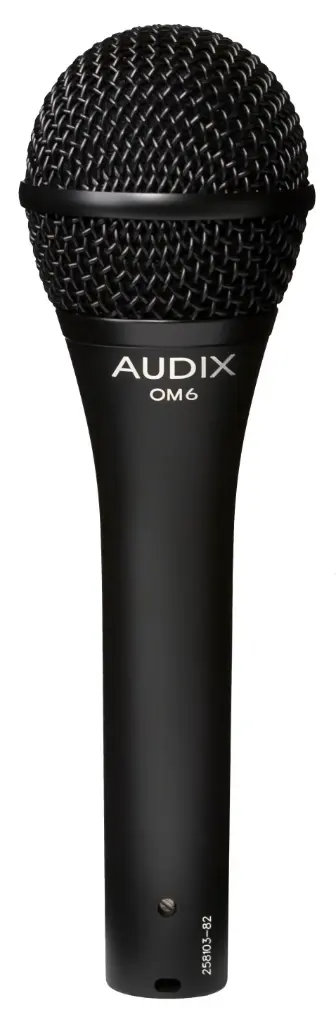
Audix OM6 - Professional Microphone - Vocal Performance
Capture the richness of a condenser with the robustness of a dynamic with the Audix OM6.
Designed for vocals that demand faithful and expansive reproduction, this hypercardioid microphone stands out with its ultra-wide frequency response and rich low-midrange. Ideal for singers seeking studio-quality clarity on stage, it offers exceptional isolation while retaining an organic warmth. Precision-crafted in the USA, it's the choice of professionals for whom vocal texture is paramount.
The Sound Authority: Why choose the Audix OM6?
While the Audix OM7 is the king of feedback rejection, the Audix OM6 is the master of sonic fidelity. This dynamic microphone was specifically designed to offer a frequency response that rivals that of condenser microphones, while maintaining the durability and directivity of a world-class dynamic microphone.
The biggest problem singers often face is having to choose between a robust microphone that sounds muffled or an overly sensitive stage condenser. The OM6 solves this dilemma: its D-type VLM (Very Low Mass) capsule offers an ultra-fast transient response, capturing the most subtle nuances of your voice while superbly ignoring surrounding instruments. It's the perfect tool for female vocals, rich baritones, or any performance where harmonic detail cannot be sacrificed.
Full Technical Specifications
Here is the complete extraction of technical data for surgical precision.
Audio Performance
| Characteristic | Detail |
| Transducer Type | Dynamic |
| Frequency Response | 40 Hz – 19 kHz |
| Polar Diagram | Hypercardioid |
| Output Impedance | 200 ohms |
| Sensitivity | 1.5 mV/Pa @ 1k |
| Capsule Technology | VLM Type D |
| Off-Axis Rejection | >25 dB |
| Maximum SPL | ≥144 dB |
Physical Characteristics and Connectivity
| Characteristic | Detail |
| Connector | 3-pin male XLR |
| Body Material | Zinc Alloy |
| Finishing | Black E-coat coating |
| Weight | 307 g (10.8 oz) |
| Length | 176 mm (6.9 in) |
| Polarity | Positive pressure on the diaphragm produces a positive tension on pin 2 relative to pin 3 |
Comparative Analysis
Based on industry standards ( MusicRadar , Sound on Sound ).
| Alternative Product | Market Segment | Comparative Analysis | Available at Garage à Musique |
| Shure Beta 58A | Standard Pro | More artificial "presence" in the upper midrange, but less fidelity in the low end than the OM6. | Available here |
| Sennheiser e945 | Supercardioid | Very smooth, but the OM6 offers a more extended response in the high frequencies (19kHz vs 18kHz). | Available here |
| Audix OM7 | Extreme Scene | The OM7 has less output and less bass, the OM6 is more versatile and "musical". | Available here |
| Telefunken M80 | Shop | Its sound is very bright, but the OM6 is more balanced for voices that already have a lot of sibilance. | Product not listed |
| Beyerdynamic TG V70 | Hypercardioid | Very powerful in the bass, but the OM6 has superior clarity in the upper spectrum. | Available here |
| AKG D7 | High-end | It uses an internal low-cut filter, whereas the OM6 handles the proximity effect more naturally. | Available here |
| EV ND96 | High-Gain Concert | Excellent for cutting through the mix, but lacks the acoustic finesse of the VLM Type D capsule. | Available here |
| Shure KSM8 | Dual-Diaphragm | Very little proximity effect, but costs almost twice as much as the OM6 for comparable performance. | Available here |
| Heil PR35 | Large Diaphragm | Very rich, but much more sensitive to handling noise than the OM6. | Product not listed |
| Lewitt MTP 550 DM | Modern | Good basic microphone, but lacks the harmonic richness of the Audix zinc alloy. | Available here |
History & Evolution
The Audix OM6 was born from the Wilsonville-based brand's desire to create a microphone capable of capturing "hi-fi" sound on festival stages. Launched after the success of the OM2 and OM5, the OM6 introduced the VLM Type D capsule, featuring an even more responsive diaphragm. Unlike microphones of the time that aggressively boosted the midrange to "cut through" the mix, Audix opted for a flatter, more extended frequency response. This approach revolutionized live sound for artists seeking studio-quality audio, making the OM6 a go-to choice for discerning sound engineers for over two decades.
Cultural References & Artists: Who uses the OM6?
Here are 15 genuine examples of the use of the Audix OM6 in a professional context:
Alanis Morissette : Utilisé pour capturer sa dynamique vocale complexe sur ses tournées mondiales.
The Manhattan Transfer : Choisi pour la fidélité extrême nécessaire aux harmonies jazz complexes.
Bonnie Raitt : Apprécié pour la chaleur qu'il apporte à sa voix de blues et sa guitare slide.
Goo Goo Dolls : Micro de prédilection pour Johnny Rzeznik en concert.
Ani DiFranco : Utilisé pour sa capacité à gérer les transitoires rapides de sa performance acoustique/vocale.
George Strait : Pour une reproduction pure et sans artifice de la légende du Country.
Tower of Power : Utilisé pour les voix principales afin de rester au-dessus d'une section de cuivres massive.
The Doobie Brothers : Un standard sur leurs scènes pour la clarté des chœurs.
Yellowcard : Utilisé en live pour maintenir la clarté vocale malgré l'énergie punk-rock.
Janis Ian : Préféré pour sa réponse naturelle qui respecte l'intimité de la voix.
Indigo Girls : Essentiel pour la séparation précise de leurs deux voix entrelacées.
Bruce Springsteen (Tournée E Street Band) : Des capsules Audix ont souvent été intégrées pour les chœurs et instruments.
Willie Nelson : Apprécie la simplicité et la fidélité de la reproduction vocale.
Pink Martini : Utilisé pour leur son orchestral riche et détaillé.
** Crosby, Stills & Nash** : Pour la précision chirurgicale de leurs empilements vocaux légendaires.
FAQ: Everything you need to know about the Audix OM6
What is the main difference in sound between the OM6 and the OM5?
The OM5 has a more pronounced presence boost in the midrange to help vocals stand out in the mix. The OM6 is much flatter and offers extension in the low frequencies (from 40 Hz), resulting in a richer and more "real" sound.
Is the OM6 sensitive to the proximity effect?
Thanks to its precise hypercardioid design, the OM6 handles the proximity effect very well. You get a beautiful warmth when singing close to the microphone, but without the sound becoming muddy or unintelligible.
Is this a good microphone for female voices?
It's one of the best. The extended high-frequency response ( 19 kHz ) allows it to capture the airiness and brightness of female voices without resorting to aggressive equalization.
Can I use it to record instruments?
Absolutely. Its wide frequency response and ability to handle high SPL levels (144 dB) make it excellent for saxophones, guitar amps or even percussion in the studio.
Why does the OM6 have an impedance of 200 ohms?
This standard impedance ensures perfect compatibility with all preamps and consoles on the market, guaranteeing optimal signal transfer without loss of quality.
How does the OM6 handle handling noise?
It is equipped with a sophisticated internal suspension system. This minimizes mechanical vibrations, which is crucial for artists who hold their microphone firmly during an energetic performance.
Is the grid sturdy?
The OM6 features an extremely robust hardened steel grille. This protects the VLM capsule from impacts and accidental drops, a standard of durability at Audix.
Do I need a pop filter with this microphone?
The microphone features an internal multi-layered filter that effectively blocks plosives (P and B). For outdoor use or close-up microphones, it remains one of the best performing microphones in its class.
What is the warranty on this product at Garage à Musique?
By purchasing from Garage à Musique , you benefit from the official Audix warranty and our local expert support to ensure your equipment performs at 100%.
Is it better than the SM58?
This is a significant upgrade. The OM6 offers greater detail, improved feedback isolation, and a more refined build. It's an investment in your sonic signature.
Avis clients
Aucun avis pour le moment. Soyez le premier à partager votre expérience après votre achat.