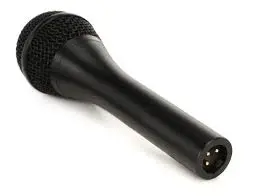
Audix OM7 - Hypercardioid Dynamic Microphone
Dominate the noisiest scenes with the surgical precision of the Audix OM7.
Designed specifically for high-volume live performances, this hypercardioid dynamic microphone offers unparalleled gain before feedback without sacrificing sonic fidelity. It's the ultimate tool for singers who refuse to have their voices drowned out by amps or drums, guaranteeing crystal-clear clarity even in the most challenging acoustic environments. Tour-ready, made in the USA, and trusted by the world's leading sound engineers.
This content will be shared across all product pages.
The Authority of Sound: Why the Audix OM7 is indispensable
If you've ever struggled with feedback on a stage saturated with monitors and amplifiers, the Audix OM7 is your ultimate solution. Unlike standard microphones, the OM7 is designed with a deliberately low output level (approximately 8-10 dB less than conventional microphones). Why? To allow the sound engineer to push the preamp gain without picking up ambient noise. The result is exceptional vocal isolation and complete control over the mix. Whether you're a powerful rock singer or a touring engineer, the OM7 transforms the chaos of the stage into a controlled studio performance.
Full Technical Specifications
No compromise on data. Here are the full technical specifications of the Audix OM7.
Audio Performance
| Characteristic | Detail |
| Transducer Type | Dynamic |
| Frequency Response | 48 Hz – 19 kHz |
| Polar Diagram | Hypercardioid |
| Output Impedance | 50 ohms |
| Sensitivity | 0.8 mV/Pa @ 1kΩ |
| Capsule Technology | VLM Type C (Very Low Mass) |
| Off-Axis Rejection | >30 dB |
| Maximum SPL | ≥144 dB |
Physical Characteristics and Connectivity
| Characteristic | Detail |
| Connector | 3-pin male XLR |
| Body Material | Zinc Alloy |
| Finishing | Black E-coat coating |
| Weight | 307 g (10.8 oz) |
| Length | 176 mm (6.9 in) |
| Polarity | Positive pressure on the diaphragm produces a positive tension on pin 2 relative to pin 3 |
Comparative Analysis
This table is based on technical consensus from authorities such as Sound on Sound and Gearspace .
| Alternative Product | Market Segment | Comparative Analysis | Available at Garage à Musique |
| Shure SM58 | Standard Scene | Less clarity in the high frequencies and much more susceptible to feedback than the OM7. | Available here |
| Sennheiser e945 | Supercardioid Pro | More "warmth" in the lower midrange, but doesn't match the extreme isolation of the OM7 on noisy stages. | Available here |
| Telefunken M80 | Dynamic Shop | Response closer to that of a capacitor, but less tight polar pattern than the OM7. | Product not listed |
| EV ND96 | High-Gain Concert | Excellent for gain before feedback, but with a more aggressive presence bump than the OM7. | Available here |
| Beyerdynamic M88 | High-end | Very versatile (kick/vocals), but more fragile and prone to plosives than the OM7. | Available here |
| Audix OM5 | Vocal Performance | More output gain than the OM7, but less off-axis rejection. | Available here |
| Heil PR35 | Large Diaphragm | Its sound is richer, but it is very sensitive to the proximity effect, unlike the OM7. | Product not listed |
| AKG D7 | Professional | Its sound is detailed, but its mechanical robustness is often considered inferior to that of the Audix. | Available here |
| Lewitt MTP 550 DM | Modern | Excellent value for money, but doesn't have the world touring history of the OM7. | Available here |
| Sennheiser e845 | Mid-range | Good performance, but lacks the surgical precision of the VLM capsule. | Available here |
History & Evolution
The Audix OM7 was launched in the mid-1990s to address a critical need: the increasing stage volumes of rock and metal bands. As stage monitors became ever more powerful, traditional microphones reached their physical limits. Audix innovated with the VLM (Very Low Mass) capsule, using an extremely lightweight diaphragm capable of reacting instantly to transients. The OM7 became legendary for solving feedback problems for major bands, establishing itself as the standard for front-of-house (FOH) engineers working with high-intensity performers.
Cultural References & Artists: The Sound of Legends
Here are 15 references from musicians and groups who have used the Audix OM7 for its reliability and isolation:
Red Hot Chili Peppers : Anthony Kiedis utilise l'OM7 pour contrer le volume massif sur scène.
Alanis Morissette : Micro principal en tournée pour sa clarté vocale naturelle.
Pearl Jam : Eddie Vedder, favorisé pour sa robustesse et sa gestion des hautes pressions acoustiques.
Soundgarden : Chris Cornell l'utilisait pour sa capacité à percer à travers les murs de guitares.
Nirvana : Kurt Cobain (Live), apprécié pour sa résistance aux larsens imprévus.
Goo Goo Dolls : Johnny Rzeznik l'utilise régulièrement en concert.
Bush : Gavin Rossdale, pour maintenir la voix au-dessus du mix grunge.
Collective Soul : Ed Roland, fidèle à la série OM pour la précision.
The Offspring : Dexter Holland, essentiel pour les scènes punk-rock bruyantes.
Blink-182 : Utilisé fréquemment pour les voix principales sur les tournées mondiales.
Green Day : Billie Joe Armstrong a souvent été vu avec des capsules Audix.
Annie Lennox : Pour la pureté de sa reproduction vocale sans bruits de fond.
Bonnie Raitt : Apprécie la réponse en fréquence plate et naturelle.
Crosby, Stills, Nash & Young : Pour la clarté des harmonies sur les grandes scènes.
Janis Joplin (Tribute/Estate context) : Souvent choisi pour les performances hommages nécessitant un look classique et un son moderne.
FAQ: Everything you need to know about the Audix OM7
Why is the output level of the OM7 lower than other microphones?
The OM7 has low sensitivity, allowing engineers to increase the gain at the console without picking up surrounding instruments. This drastically reduces the risk of acoustic ground loops and feedback. By pushing your preamp, you achieve perfect isolation.
Does the OM7 require phantom power?
No, it's a dynamic microphone. It works without a battery or phantom power . However, due to its low output level, using a quality preamp or a mic activator (like a Cloudlifter) can be beneficial for softer vocals.
How does the OM7 perform in the face of RF interference?
The OM7's zinc alloy casing and precision design offer excellent protection against RF (radio frequency) interference. You can use it on stages equipped with massive wireless systems without fear of interference.
What is the difference between the OM5 and the OM7?
While the OM5 offers a slight bump in the midrange frequencies, the OM7 is much flatter and more natural. The OM7 is also more demanding in terms of input gain , but offers the best off-axis rejection of the entire Audix range.
Is this microphone suitable for studio singing?
Although optimized for the stage, its 48 Hz to 19 kHz frequency response and VLM capsule make it an excellent choice for capturing authentic rock vocals in the studio, especially if you are recording with the musicians in the same room.
Does the OM7 reduce handling noise?
Absolutely. Its internal design includes a shock-absorbing mounting system that minimizes mechanical noise when the singer moves, ensuring a clean signal to the broadcast system.
Is the VLM diaphragm fragile?
On the contrary. Although very light for a fast response, the diaphragm is extremely resistant to high sound pressure levels ( SPL ), supporting more than 144 dB without distortion.
What is the ideal distance for singing into an OM7?
The OM7 is designed for use very close to the lips. Its handling of the proximity effect is exemplary, allowing for a full and rich sound without the bass becoming muddy.
Is it compatible with all XLR cables?
Yes, it uses a standard 3-pin male XLR connector. For optimal performance at Garage à Musique , we recommend high-quality shielded cables to maintain signal integrity.
Where is the Audix OM7 manufactured?
Each OM7 is designed, machined, assembled, and tested by Audix in Wilsonville, Oregon, USA. This proximity ensures rigorous quality control, a value we proudly share at Garage à Musique .
The Authority of Sound: Why the Audix OM7 is indispensable
If you've ever struggled with feedback on a stage saturated with monitors and amplifiers, the Audix OM7 is your ultimate solution. Unlike standard microphones, the OM7 is designed with a deliberately low output level (approximately 8-10 dB less than conventional microphones). Why? To allow the sound engineer to push the preamp gain without picking up ambient noise. The result is exceptional vocal isolation and complete control over the mix. Whether you're a powerful rock singer or a touring engineer, the OM7 transforms the chaos of the stage into a controlled studio performance.
Full Technical Specifications
No compromise on data. Here are the full technical specifications of the Audix OM7.
Audio Performance
| Characteristic | Detail |
| Transducer Type | Dynamic |
| Frequency Response | 48 Hz – 19 kHz |
| Polar Diagram | Hypercardioid |
| Output Impedance | 50 ohms |
| Sensitivity | 0.8 mV/Pa @ 1kΩ |
| Capsule Technology | VLM Type C (Very Low Mass) |
| Off-Axis Rejection | >30 dB |
| Maximum SPL | ≥144 dB |
Physical Characteristics and Connectivity
| Characteristic | Detail |
| Connector | 3-pin male XLR |
| Body Material | Zinc Alloy |
| Finishing | Black E-coat coating |
| Weight | 307 g (10.8 oz) |
| Length | 176 mm (6.9 in) |
| Polarity | Positive pressure on the diaphragm produces a positive tension on pin 2 relative to pin 3 |
Comparative Analysis
This table is based on technical consensus from authorities such as Sound on Sound and Gearspace .
| Alternative Product | Market Segment | Comparative Analysis | Available at Garage à Musique |
| Shure SM58 | Standard Scene | Less clarity in the high frequencies and much more susceptible to feedback than the OM7. | Available here |
| Sennheiser e945 | Supercardioid Pro | More "warmth" in the lower midrange, but doesn't match the extreme isolation of the OM7 on noisy stages. | Available here |
| Telefunken M80 | Dynamic Shop | Response closer to that of a capacitor, but less tight polar pattern than the OM7. | Product not listed |
| EV ND96 | High-Gain Concert | Excellent for gain before feedback, but with a more aggressive presence bump than the OM7. | Available here |
| Beyerdynamic M88 | High-end | Very versatile (kick/vocals), but more fragile and prone to plosives than the OM7. | Available here |
| Audix OM5 | Vocal Performance | More output gain than the OM7, but less off-axis rejection. | Available here |
| Heil PR35 | Large Diaphragm | Its sound is richer, but it is very sensitive to the proximity effect, unlike the OM7. | Product not listed |
| AKG D7 | Professional | Its sound is detailed, but its mechanical robustness is often considered inferior to that of the Audix. | Available here |
| Lewitt MTP 550 DM | Modern | Excellent value for money, but doesn't have the world touring history of the OM7. | Available here |
| Sennheiser e845 | Mid-range | Good performance, but lacks the surgical precision of the VLM capsule. | Available here |
History & Evolution
The Audix OM7 was launched in the mid-1990s to address a critical need: the increasing stage volumes of rock and metal bands. As stage monitors became ever more powerful, traditional microphones reached their physical limits. Audix innovated with the VLM (Very Low Mass) capsule, using an extremely lightweight diaphragm capable of reacting instantly to transients. The OM7 became legendary for solving feedback problems for major bands, establishing itself as the standard for front-of-house (FOH) engineers working with high-intensity performers.
Cultural References & Artists: The Sound of Legends
Here are 15 references from musicians and groups who have used the Audix OM7 for its reliability and isolation:
Red Hot Chili Peppers : Anthony Kiedis utilise l'OM7 pour contrer le volume massif sur scène.
Alanis Morissette : Micro principal en tournée pour sa clarté vocale naturelle.
Pearl Jam : Eddie Vedder, favorisé pour sa robustesse et sa gestion des hautes pressions acoustiques.
Soundgarden : Chris Cornell l'utilisait pour sa capacité à percer à travers les murs de guitares.
Nirvana : Kurt Cobain (Live), apprécié pour sa résistance aux larsens imprévus.
Goo Goo Dolls : Johnny Rzeznik l'utilise régulièrement en concert.
Bush : Gavin Rossdale, pour maintenir la voix au-dessus du mix grunge.
Collective Soul : Ed Roland, fidèle à la série OM pour la précision.
The Offspring : Dexter Holland, essentiel pour les scènes punk-rock bruyantes.
Blink-182 : Utilisé fréquemment pour les voix principales sur les tournées mondiales.
Green Day : Billie Joe Armstrong a souvent été vu avec des capsules Audix.
Annie Lennox : Pour la pureté de sa reproduction vocale sans bruits de fond.
Bonnie Raitt : Apprécie la réponse en fréquence plate et naturelle.
Crosby, Stills, Nash & Young : Pour la clarté des harmonies sur les grandes scènes.
Janis Joplin (Tribute/Estate context) : Souvent choisi pour les performances hommages nécessitant un look classique et un son moderne.
FAQ: Everything you need to know about the Audix OM7
Why is the output level of the OM7 lower than other microphones?
The OM7 has low sensitivity, allowing engineers to increase the gain at the console without picking up surrounding instruments. This drastically reduces the risk of acoustic ground loops and feedback. By pushing your preamp, you achieve perfect isolation.
Does the OM7 require phantom power?
No, it's a dynamic microphone. It works without a battery or phantom power . However, due to its low output level, using a quality preamp or a mic activator (like a Cloudlifter) can be beneficial for softer vocals.
How does the OM7 perform in the face of RF interference?
The OM7's zinc alloy casing and precision design offer excellent protection against RF (radio frequency) interference. You can use it on stages equipped with massive wireless systems without fear of interference.
What is the difference between the OM5 and the OM7?
While the OM5 offers a slight bump in the midrange frequencies, the OM7 is much flatter and more natural. The OM7 is also more demanding in terms of input gain , but offers the best off-axis rejection of the entire Audix range.
Is this microphone suitable for studio singing?
Although optimized for the stage, its 48 Hz to 19 kHz frequency response and VLM capsule make it an excellent choice for capturing authentic rock vocals in the studio, especially if you are recording with the musicians in the same room.
Does the OM7 reduce handling noise?
Absolutely. Its internal design includes a shock-absorbing mounting system that minimizes mechanical noise when the singer moves, ensuring a clean signal to the broadcast system.
Is the VLM diaphragm fragile?
On the contrary. Although very light for a fast response, the diaphragm is extremely resistant to high sound pressure levels ( SPL ), supporting more than 144 dB without distortion.
What is the ideal distance for singing into an OM7?
The OM7 is designed for use very close to the lips. Its handling of the proximity effect is exemplary, allowing for a full and rich sound without the bass becoming muddy.
Is it compatible with all XLR cables?
Yes, it uses a standard 3-pin male XLR connector. For optimal performance at Garage à Musique , we recommend high-quality shielded cables to maintain signal integrity.
Where is the Audix OM7 manufactured?
Each OM7 is designed, machined, assembled, and tested by Audix in Wilsonville, Oregon, USA. This proximity ensures rigorous quality control, a value we proudly share at Garage à Musique .
Avis clients
Aucun avis pour le moment. Soyez le premier à partager votre expérience après votre achat.