



Antelope Orion 32+ Gen4 - Audio Interface - High Quality
The Antelope Audio Orion 32+ Gen 4 redefines high-density AD/DA conversion with unparalleled sonic clarity.
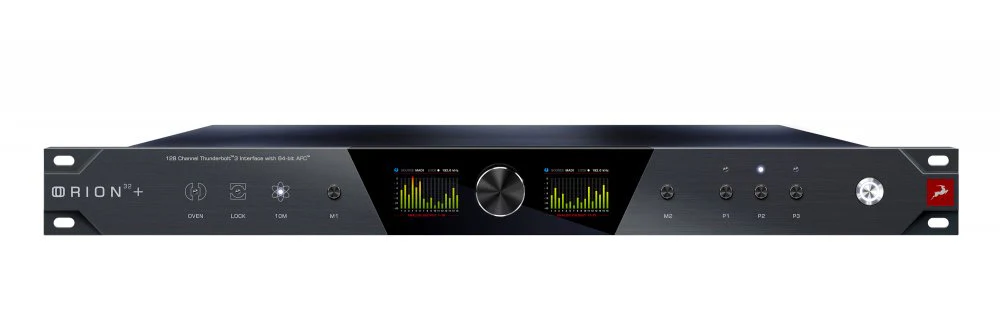
This Thunderbolt 3 and USB interface offers 32 channels of analog I/O and 128-channel connectivity, all powered by 64-bit AFC™ sync technology. A surgically precise choice for elite studios and complex mixing setups seeking acoustic perfection.
The Ultimate Authority in Conversion: Why the Orion 32+ Gen 4 is Essential
The Antelope Audio Orion 32+ Gen 4 is not simply an update; it's a revolution in studio infrastructure. For the modern musician and sound engineer, the challenge remains managing a large number of tracks without compromising fidelity.
This interface solves the problem of workflow saturation by offering near-zero latency and an extended dynamic range of 130 dB on its monitor outputs. Whether you're doing analog summing, massive multitrack recording, or managing a Dolby Atmos system, the Orion 32+ Gen 4 acts as the beating heart of your audio chain, ensuring a wide stereo image and microscopically precise frequency separation.
Full Technical Specifications
Audio & Conversion
| Characteristic | Technical Details |
| AD Converters | Dynamic range: 122 dB; THD+N: -116 dB |
| DA Converters (Line Output) | Dynamic range: 128 dB; THD+N: -115 dB |
| DA (Monitor) Converters | Dynamic range: 130 dB; THD+N: -115 dB |
| Sampling rate (kHz) | 44.1, 48, 88.2, 96, 176.4, 192 |
| Clock (Clocking System) | 4th Generation Acoustically Focused Clocking (AFC™); 64-bit DDS |
Connectivity & Inputs/Outputs
| Connection Type | Quantity / Protocol |
| Analog Inputs | 4 × D-Sub 25 (32 channels total), +24 dBu max |
| Analog Outputs | 4 × D-Sub 25 (32 channels total), +24 dBu max |
| Monitor Outputs | 2 × 1/4" TRS Jacks |
| Digital Inputs | 1 × ADAT (up to 8 channels), 1 × S/PDIF (2 channels), 2 × MADI (up to 128 channels) |
| Digital Outputs | 1 × ADAT, 1 × S/PDIF, 2 × MADI |
| USB I/O | USB 2.0 Type B (32 I/O channels) |
| Thunderbolt™ | Thunderbolt™ 3 (128 I/O channels) |
| Word Clock | 1 × Input @ 75 Ohms 3Vpp, 2 × Outputs @ 75 Ohms 3Vpp |
| 10M Input | 1 × Input for atomic clock |
Physical Fitness & Nutrition
| Property | Data |
| Dimensions (L x W x H) | 483 mm x 280 mm x 44 mm (19" Rackmount 1U) |
| Weight | 3.4 kg / 7.5 lbs |
| Consumption | 25 Watts |
| Operating temperature | 0-50°C, 32-122°F |
Comparative Analysis
Authority sources: Sound on Sound, Gearspace, MusicRadar.
| Alternative Product | Market Segment | Comparative Analysis | Available at Garage à Musique |
| Focusrite Red 16Line | Dante/TB3 Interface | Strengths: Native Dante connectivity. Weaknesses: Fewer direct analog channels (16 vs 32). | Available here. |
| Lynx Aurora (n) 32 | Conversion Mastering | Strengths: Extreme modularity. Weaknesses: Software ecosystem less complete than the Antelope Control Panel. | Product not listed. |
| RME M-32 AD/DA Pro | Broadcast Conversion | Strengths: Legendary driver stability. Weaknesses: Significantly higher cost per channel for 32 I/Os. | Available here. |
| Apogee Symphony I/O MKII | Premium Interface | Strengths: Touchscreen, premium sound. Weaknesses: 32-channel configuration is significantly more expensive. | Available here. |
| Universal Audio Apollo x16 | DSP Interface | Strengths: Integrated UAD-2 plugins. Weaknesses: Limited to 16 analog channels, requires two units to match the Orion. | Available here. |
| Motu 24Ai / 24Ao | Entry-level Pro | Strengths: Affordable price. Weaknesses: Lower dynamic range and clock accuracy. | Available here. |
| Avid Pro Tools Carbon | DAW Integration | Strengths: DSP acceleration for Pro Tools. Weaknesses: Less versatile for other DAWs. | Product not listed. |
| PreSonus Quantum 4848 | Advanced Home Studio | Strengths: Unbeatable price. Weaknesses: Higher converter quality and jitter. | Available here. |
| Metric Halo LIO-8 | Audio Shop | Strengths: Unique sonic character. Weaknesses: Limited number of channels for large setups. | Product not listed. |
| Ferrofish A32 Dante | MADI/Dante conversion | Strengths: Compact format. Weaknesses: User interface less intuitive than Antelope software. | Available here. |
History & Evolution
The Orion adventure began over a decade ago, with Antelope Audio being the first to house 32 channels of analog I/O in a single 1U rack space. The Gen 4 represents the culmination of this lineage. While the original version focused on USB, the Gen 4 embraces Thunderbolt 3 for massive audio streaming performance. The most significant evolution is the integration of the 64-bit AFC™ sync chip, derived from their world-class atomic clocks, delivering virtually no jitter.
Cultural References & Artists
Rik Simpson (Coldplay) - Utilisation en studio pour la clarté des convertisseurs.
Michael Brauer - Mixage hybride complexe utilisant la densité d'E/S.
Brian Blade - Captation de batterie avec une fidélité organique.
Greg Wells (Adele, Katy Perry) - Pour la précision de l'image stéréo.
Jaycen Joshua - Setup de sommage analogique massif.
Todd Terry - Production House avec intégration de synthétiseurs externes.
Underworld - Utilisation en tournée pour la robustesse et le nombre de sorties.
Devin Townsend - Gestion de sessions massives en studio.
Robert Babicz - Mastering et performance live avec une horloge stable.
The Chemical Brothers - Intégration de hardware analogique vintage.
Hans Zimmer (Remote Control Productions) - Standard pour les stations de composition.
Zedd - Production électronique de précision.
Vulfpeck (Jack Stratton) - Pour le workflow analogique simplifié.
Deadmau5 - Utilisation de la technologie de clocking Antelope.
Hozier - Enregistrement d'instruments acoustiques riches.
FAQ (Frequently Asked Questions)
What is the actual performance difference between USB and Thunderbolt 3 on the Orion 32+ Gen 4?
Thunderbolt 3 allows you to manage up to 128 I/O channels with sub-millisecond latency, while USB 2.0 limits the stream to 32 channels. For demanding mixing sessions or the use of external processors, Thunderbolt virtually eliminates any perceptible delay. In short: You benefit from unparalleled workflow fluidity at Garage à Musique.
Does the Orion 32+ Gen 4 eliminate ground loop problems in a hybrid setup?
Although the interface has high-quality grounding, a ground loop depends on your overall cabling. However, the precision of its internal power supply significantly reduces background noise (RF) induced by digital components. Conclusion: A pure and silent signal for your most critical recordings.
Can I use the Orion 32+ Gen 4 for a Dolby Atmos monitoring system?
Absolutely. With its 32 analog outputs and new control panel, managing immersive setups is seamless and intuitive. You can calibrate each speaker with surgical precision. In short: Garage à Musique supports you in your transition to spatial audio.
Is phantom power handled by the D-Sub 25 connectors?
No, the D-Sub 25 inputs are line inputs. To use microphones requiring phantom power, you'll need to use an external preamp; the Orion will then handle the high-precision A/D conversion. In short: Preserve the integrity of your favorite preamps with transparent conversion.
How does 64-bit AFC™ technology influence my final mix?
This synchronization technology reduces jitter to imperceptible levels, resulting in better instrument separation and increased depth of field. Your stereo image becomes more stable and defined. In short: Achieve world-class sound with the expertise of our consultants.
Is the interface compatible with Apple Silicon chips (M1, M2, M3)?
Yes, Antelope Audio has optimized its drivers for full compatibility with the latest Apple processors, guaranteeing exceptional stability even under heavy CPU load. In short: A sound investment for your modern studio.
Can I route any input to any output?
Yes, Antelope's software routing matrix offers complete flexibility. You can send a physical signal to multiple digital destinations simultaneously without any loss of gain. In short: Versatility that simplifies even the most complex routing.
Is the front screen customizable?
The high-resolution LCD screen displays peak levels for any channel group, facilitating visual monitoring without looking at your computer. In short: Maintain constant visual control over your gain structure.
How robust is the device for mobile use?
With its all-metal chassis, robust D-Sub connectors, and optimized heat dissipation, the Orion is built for the rigors of the road and the touring studio. In short: Antelope reliability, backed by Garage à Musique's excellent service.
Does the Orion 32+ Gen 4 require a constant internet connection?
Internet access is required only for initial product activation and software updates via the Antelope Launcher. Once activated, it works perfectly offline. Conclusion: Security and performance, wherever music takes you in Quebec.
Avis clients
Aucun avis pour le moment. Soyez le premier à partager votre expérience après votre achat.