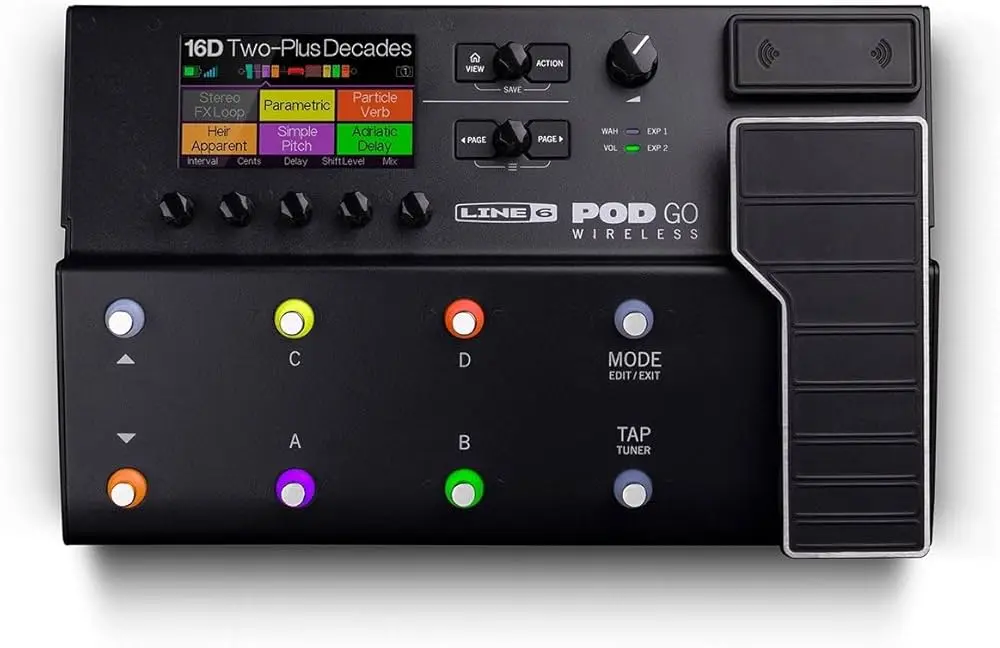
Line 6 Pod Go WL Wireless Guitar Processor
The devastating power of Helix in an ultra-portable format. The Line 6 POD Go redefines performance for the modern guitarist seeking efficiency without compromise. By integrating amp and effects models from the HX family, a high-resolution colour screen and an intuitive interface, it turns every stage or studio session into a world-class experience. No more choosing between sonic depth and portability: master your tone with Line 6 authority, available at Garage à Musique.
Why the POD Go Is the Centrepiece of Your Rig
For the professional musician in Quebec, setup time and gear weight are critical factors. The Line 6 POD Go solves these problems by delivering a "tour-grade" signal chain in a compact, rugged enclosure. It's not just another multi-effects unit; it's a complete sonic ecosystem that uses the algorithms of the Helix series, the industry standard.
Its strength lies in its disarming simplicity: its 4.3-inch colour screen lets you see your signal chain instantly, eliminating endless dives into menus. With the Snapshots function, you can switch from a clean sound with reverb to massive distortion without any audio dropout, a major technological advantage for complex live performances. At Garage à Musique, we recommend the POD Go as the ultimate solution for those who want the Helix sound with a "plug-and-play" interface.
Complete Technical Specifications (Absolute Extraction)
Sound Engine & Audio
| Feature | Technical Detail |
| Modelling Type | Amp, cabinet and effects models from the HX (Helix) and Legacy series |
| Number of Models | Over 270 (Amps, Cabs, Effects) |
| Audio Resolution | 24-bit / 96 kHz |
| DSP Processing | Powerful HX audio engine with fixed signal path (8 blocks) |
| Impulse Responses (IR) | Third-party IR support (1024-point) |
| Presets | 256 (128 user, 128 factory) |
Controls & Interface
| Element | Technical Detail |
| Screen | 4.3-inch (11 cm) colour LCD screen |
| Footswitches | 8 footswitches with coloured LED rings (RGB) |
| Expression Pedal | Built-in (multi-function with toe switch) |
| Parameter Knobs | 5 rotary encoders below the screen + main navigation knob |
Complete Connectivity
| Port | Connector Type |
| Guitar Input | 1/4" unbalanced jack |
| Exp 2 Pedal Input | 1/4" TRS jack (for expression pedal or dual footswitch) |
| Main Outputs (L/Mono, R) | 1/4" TRS jacks (balanced) |
| Amp Out Output | 1/4" jack (for direct connection to the front of a guitar amp) |
| Effects Loop (FX Loop) | 1/4" TRS jack (stereo Send/Return usable as additional inputs/outputs) |
| Headphone Output | 1/4" stereo jack |
| USB | 4-in/4-out USB audio interface with re-amping capability |
Physical Build & Power
| Feature | Measurement |
| Dimensions | 359 mm x 230 mm x 88 mm |
| Weight | 2.35 kg (5.2 lbs) |
| Chassis | Die-cast aluminum and rugged polycarbonate |
| Power Supply | DC-3h (9V DC, 2.5A) included |
Comparative Analysis: The Experts' Verdict
Based on the consensus of Sound on Sound, MusicRadar and Gearspace.
| Alternative Product | Market Segment | Comparative Analysis | Availability at Garage à Musique |
| Line 6 HX Stomp | Ultra-Compact / Pro | More routing flexibility. No built-in expression pedal or large screen. | Available here |
| Boss GX-100 | Modern / Touchscreen | Colour touchscreen. AIRD vs HX modelling. Bulkier than the POD Go. | Available here |
| Headrush MX5 | Compact / Touchscreen | Ultra-smooth touchscreen. Effects library less extensive than the Line 6 ecosystem. | Available here |
| Mooer GE250 | Mid-Range | Built-in Tone Capture. Playing dynamics less organic than the HX engine. | Available here |
| Valeton GP-200 | Budget / Complete | Very rugged, simple interface. Converter quality a notch below Line 6. | Available here |
| Zoom G6 | Hybrid / Practical | Interface based on multiple screens. Less precision in the high frequencies (gain). | Available here |
| NUX MG-30 | Compact / Efficient | Very quick to set up. Time-based effects section less rich than Line 6. | Available here |
| Neural DSP Nano Cortex | Capture / Boutique | Superior capture quality. No full effects chain or screen. | Available here |
| Ampero II Stage | Modern / Performance | Dual DSP processor. Less active preset-sharing community. | Available here |
| Fractal FM3 | High-End / Studio | The pinnacle of precision. Steep learning curve and double the price. | Product not listed |
History & Evolution: From the Red "Bean" to the HX Revolution
The POD name changed the music world in 1998 with the famous red bean that democratized digital modelling. After decades of innovation (XT, X3, HD series), Line 6 reached a historic milestone with Helix technology. The POD Go is the culmination of this lineage: it carries on the original POD's legacy of simplicity but injects the raw power of the Helix DSP engine. It's the perfect marriage between the brand's history and the future of digital audio, designed for the musician who wants immediate results without professional compromise.
Cultural References & Artists
The Line 6 ecosystem (Helix/POD) is at the heart of these artists' sound:
Dustin Kensrue (Thrice): Uses the Line 6 ecosystem for his vintage amp textures.
Bill Kelliher (Mastodon): A fan of Line 6 modelling for consistency on world tours.
Misha Mansoor (Periphery): A pioneer in the use of IRs and digital gear for progressive metal.
The Edge (U2): Has integrated Line 6 technology into his stage rigs since the DM4.
Trent Reznor (NIN): Uses Line 6 processors for industrial sound design.
John Petrucci: Has used Line 6 modulation effects on numerous albums.
Vernon Reid (Living Colour): A master of experimentation with Line 6 gear.
Pete Thorn: World-renowned demonstrator who validates the POD Go's dynamics.
Richie Castellano (Blue Öyster Cult): Uses the POD Go for its extreme portability when flying.
Soma (Vola): For the massive, precise sounds of modern rock.
Jeff Loomis (Arch Enemy): Uses Line 6 for his fluid, compressed lead sounds.
Steve Howe (Yes): Has integrated Line 6 modelling to recreate his classic sounds.
Billy Corgan (Smashing Pumpkins): Uses Line 6 units for fuzz and delays.
Rivers Cuomo (Weezer): Loyal to Line 6 modelling solutions live.
Tim Henson (Polyphia): Although associated with Neural, he built his sonic foundations on Line 6.
FAQ - Musical & Technical Expertise
What is the difference between the POD Go and the Helix? It's a question of flexibility and DSP. The POD Go uses the same amp and effects models as the Helix, but with a fixed signal chain (8 blocks) and a single processor. The Helix allows complex dual routing and more simultaneous blocks. For 90% of guitarists in Quebec, the POD Go offers all the power they need without the complexity.
Can you plug the POD Go directly into an amp? Absolutely, via the "Amp Out" output. This output is specifically designed to send your signal to a real amplifier. You can choose to disable the speaker simulation (Cab) globally for this output while keeping it active on the main XLR/TRS outputs to the mixing console.
Does the POD Go handle bass well? Yes, it includes legendary bass amp models. You'll find Ampeg®, Mesa/Boogie® and Aguilar® simulations, as well as dedicated effects. Signal clarity and low-frequency handling are managed by the HX engine with surgical precision, ensuring stable gain without muddiness.
How do you install third-party IRs on the unit? Via the POD Go Edit software. Connect the unit to your computer via USB. The software lets you drag and drop your favourite impulse response files. This literally transforms the unit's sound to achieve a custom studio sound in a few seconds.
What is the POD Go's latency? It is imperceptible (< 3ms). Line 6's digital processing is optimized so that the playing feel is identical to that of an analog amp. You keep all the attack and dynamics of your touch, a crucial point for demanding musicians at Garage à Musique.
Can the POD Go be used as an audio interface? It's a high-performance 24-bit / 96 kHz interface. Via USB, it lets you record your processed sound and a dry signal (DI) simultaneously. It's the ideal re-amping tool for finalizing your mixes in the studio in Vancouver, Gatineau or Montreal.
What is the "Snapshot" function? It's latency-free configuration switching. Within a single preset, Snapshots let you change the state of several effects (on/off) and their parameters (e.g. increasing the gain) without any sound dropout (spillover). It's the pros' favourite feature for live use.
Is it possible to use an external expression pedal? Yes, via the EXP 2 input. You can add an extra expression pedal to control volume and wah separately, or use it to connect two additional footswitches to extend your real-time control capabilities.
Is the enclosure solid enough for touring? The chassis is made of aluminum and high-strength polycarbonate. Line 6 designed the POD Go for the rigours of the road. The footswitches and encoders are protected, ensuring durability worthy of Garage à Musique's authority across Canada.
How are firmware updates done? Directly via Line 6 Central. By connecting via USB, you get access to the new amp and effects models regularly added by Line 6. Your investment evolves over time, ensuring you stay at the cutting edge of sound technology.
Avis clients
Aucun avis pour le moment. Soyez le premier à partager votre expérience après votre achat.