
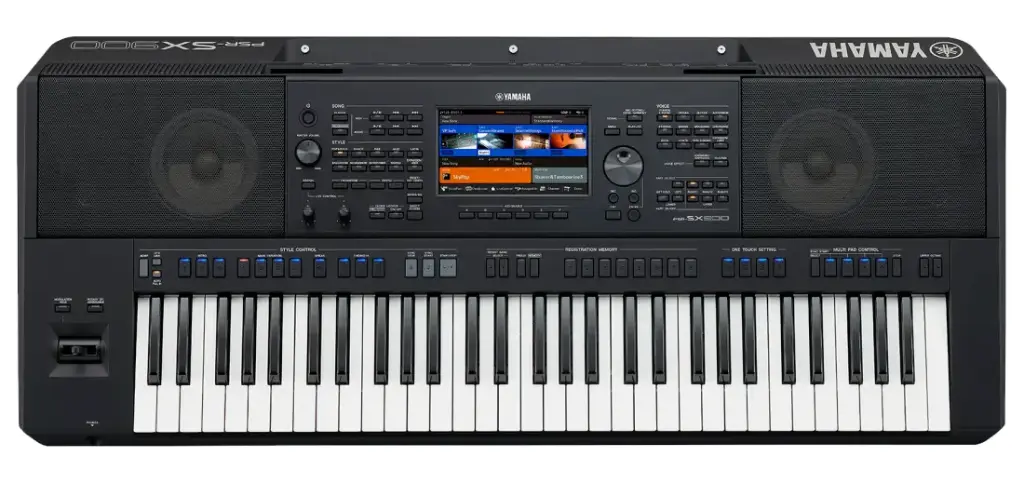
Yamaha PSR-SX900 - 61-key workstation - Musical performance
The pinnacle of the PSR-SX series: Uncompromising creative power for the stage and studio musician. The Yamaha PSR-SX900 stands out as the ultimate composition and performance tool, incorporating the sonic legacy of the legendary Genos into a compact 61-key design. With its intuitive touchscreen interface, wide-field speaker system, and professional routing capabilities with SUB outputs, this instrument transforms every musical idea into a finished production with exceptional sonic clarity.
Why the PSR-SX900 is a Must-Have
The Yamaha PSR-SX900 is not simply an evolution of the PSR-S series; it embodies a technological revolution that blurs the line between arranger keyboards and professional studio workstations. In the Quebec music scene, where versatility is a fundamental requirement for bar musicians, section leaders, and home studio composers, this instrument solves real-world workflow problems.
The first obstacle keyboardists often encounter is the complexity of the interface during a live performance. The PSR-SX900 solves this problem with its 7-inch touchscreen, which allows for precise navigation between sound banks and accompaniment styles, eliminating downtime and handling errors under pressure. The integrated FSB keyboard, with its increased initial resistance and optimized key travel, offers a tactile response that satisfies pianists accustomed to a certain consistency, while remaining agile enough for the fastest synthesizer or organ passages.
The authority of this instrument also lies in its ability to project a rich, balanced sound without systematically requiring a massive external PA system, especially in smaller venues. The Expansive Soundfield Speakers system uses bi-amplified polypropylene diaphragms to deliver a precise frequency response, ensuring that the nuances of Super Articulation vocals are perceived by the audience with studio-quality fidelity. For larger environments, the inclusion of SUB outputs allows for separate routing of bass or metronome tracks, providing mixing flexibility worthy of the most demanding touring setups.
Full Technical Specifications
Analysis of the technical data reveals precision engineering. Here is the complete data extracted for the PSR-SX900 model.
Dimensions, Weight and Physical Characteristics
| Setting | Specification Details |
| Product width | 1017 mm (40") |
| Product height | 139 mm (5.5") |
| Product Depth | 431 mm (17") |
| Instrument weight | 11.5 kg (25.35 lb) |
| Frame color | Professional matte black |
| Packaging carton dimensions | 1,181 mm x 251 mm x 524 mm (46-1/2" x 9-7/8" x 20-5/8") |
Control Interface and Ergonomics
| Component | Technical Description |
| Number of keys | 61 |
| Keyboard type | Organ (FSB), Initial Touch |
| Touch response | Normal, Soft 1, Soft 2, Hard 1, Hard 2 |
| Main controller | Joystick (Pitch Bend and Modulation combined) |
| Direct control buttons | 2 Assignable Rotary Knobs (Live Control) |
| Main screen | TFT Color Wide VGA LCD (7 inch) |
| Screen resolution | 800 x 480 points |
| Screen type | Capacitive touchscreen |
| Interface languages | English, German, French, Spanish, Italian |
| Sign language | English |
Sound Engine and Synthesized Voice
| Category | Technical Details |
| Sound generation | AWM (Advanced Wave Memory) stereo sampling |
| Maximum polyphony | 128 notes |
| Total number of votes | 1337 Voices + 56 Drum Kits/SFX |
| Super Articulation Voice | 252 S.Art! (Realistic Instrumental Nuances) |
| MegaVoice | 54 Mega Voices |
| Sweet! / Cool! / Live! voice | 31 Sweet!, 87 Cool!, 131 Live! |
| Organ Flutes! | 24 Modeled Organ Voices |
| Software compatibility | XG (read), GS (read), GM, GM2 |
| Expansion memory | Approximately 1 GB (for extension data) |
| Keyboard parts | Right 1, Right 2, Right 3, Left |
Audio Effects and Processing (VCM)
| Type of effect | Quantity and Presets |
| Reverberation | 59 Presets + 30 User Presets |
| Chorus | 106 Presets + 30 User Presets |
| DSP (Digital Signal Processing) | 322 Presets (with VCM) + 30 User |
| Insertion effect (1-8) | 322 Presets (with VCM) + 30 Users per game |
| Master Compressor | 5 Presets + 30 User |
| Master Equalizer (EQ) | 5 Presets + 30 User |
| Game Equalizer | 28 Independent Parties |
| Microphone/Guitar Effects | Noise Gate, Compressor, 3-band EQ |
| Dedicated vocal effects | 23 types of effects |
| Vocal Harmony | 54 Presets |
| Synth Vocoder | 20 Presets |
| Harmony/Vocoder User Settings | 60 in total |
Accompaniment Styles and Composition
| Function | Full specification |
| Number of built-in styles | 525 |
| Details of style categories | 463 Pro, 46 Session, 10 DJs, 6 Free Play |
| Style control | INTRO x 3, MAIN VARIATION x 4, FILL x 4, BREAK, ENDING x 3 |
| Supported fingerings | Single, Fingered, Fingered On Bass, Multi, AI Fingered, Full, AI Full |
| One Touch Setting (OTS) | 4 for each style |
| Chord Looper | Recording and looping chord sequences |
| Style Section Reset | Immediate reset to the beginning of the measurement |
| Expansion of styles | Yes (via internal memory) |
| Expansion of audio styles | Yes (via internal memory) |
Recording and Playing Songs
| Setting | Capacity and Formats |
| Number of built-in pieces | 5 Example Pieces |
| Number of tracks per song | 16 tracks |
| Data capacity per piece | Approximately 3 MB |
| Recording function | Fast, multi-track, step-by-step recording |
| MIDI playback format | SMF (Format 0 & 1), XF |
| MIDI recording format | SMF (Format 0) |
| Multi Pads | 329 Banks x 4 Pads |
| Audio Recording (USB) | Format .wav (44.1 kHz, 16 bit, stereo) |
| MP3 recording (USB) | 44.1 kHz, 128/256/320 kbps |
| Maximum recording time | 80 minutes per piece |
| Additional Audio Functions | Time Stretch, Pitch Shift, Vocal Cancel |
Professional Storage and Connectivity
| Interface | Connection details |
| Internal memory | Approximately 4 GB |
| External readers | USB key (via USB TO DEVICE port) |
| Headphone Output | Standard stereo jack |
| Control pedal 1 | Sustain (assignable) |
| Control pedal 2 | Articulation (assignable) |
| Microphone/Guitar Input | 6.35 mm jack with gain control |
| NOON | IN, OUT (5-pin DIN connectors) |
| Entrance AUX IN | Stereo mini-jack (3.5 mm) |
| Main line exit | MAIN OUTPUT (L/L+R, R) |
| SUB (AUX) outputs | SUB (AUX) OUTPUT 1 & 2 (L/L+R, R) |
| USB TO DEVICE | 2 ports (front and rear) |
| USB TO HOST | 1 port (for computer connection) |
| Video Output | Via compatible USB-display adapter |
| Bluetooth Audio | Yes (depending on regional availability) |
Amplification System and Speakers
| Component | Output specification |
| Amplifiers | (15 W + 10 W) x 2 (Bi-amplified) |
| Speakers | 13 cm x 2 + 2.5 cm (dome) x 2 |
| Diaphragm structure | High-response polypropylene |
Comparative Analysis: The PSR-SX900 vs. the Global Market
The following analysis is based on technical data and consensus from industry authorities such as Sound on Sound, MusicRadar, and Gearspace. It compares the PSR-SX900 to direct competitor models and alternatives from adjacent segments.
| Alternative Product | Market Segment | Comparative Analysis (Technical Expertise) | Available at Garage à Musique |
| Korg Pa1000 | Pro Arranger | Strengths: Tilting screen, integrated TC-Helicon vocal harmonizer. Weaknesses: Less internal memory for styles, less streamlined interface than the Genos OS. | Available here |
| Roland E-A7 | Arranger Workstation | Strengths: Dual screen (one for styles, one for sounds), very lightweight (7.7kg). Weaknesses: Monochrome screens, no touchscreen, less dynamic acoustic samples. | Available here |
| Yamaha PSR-SX700 | Mid-Range Workstation | Strengths: Identical architecture, excellent value for money. Weaknesses: No Vocal Harmony, fewer S.Art! voices, limited expansion memory (400 MB). | Available here |
| Ketron SD9 | High-End Arranger | Strengths: Audio styles based on real recorded drums (Live Drums). Weaknesses: Highly technical and less intuitive user interface, significantly higher price. | Product not listed |
| Medeli AKX10 | Budget Workstation | Strengths: Low-cost 7-inch touchscreen, 256-note polyphony. Weaknesses: Speaker quality and audio sample depth fall well short of Yamaha standards. | Product not listed |
| Nord Stage 4 (61) | Piano/Synth Stage | Strengths: Swedish build quality, unparalleled piano and organ sounds. Weaknesses: No accompaniment engine (arranger), tiny screen, completely different approach. | Available here |
| Casio MZ-X500 | Performance Arranger | Strengths: 16 performance pads for triggering samples. Weaknesses: Previous generation touchscreen, less diverse sound library. | Product not listed |
| Yamaha Genos 2 | Flagship Workstation | Strengths: The ultimate industry standard, 76 aftertouch keys, FMX synthesis. Weaknesses: Three times the price, bulky for frequent transport. | Available here |
| Korg Pa700 | Professional Arranger | Strengths: Powerful string sequencer, compact size. Weaknesses: Fewer preset styles (430 vs. 525), weaker amplification than the SX900. | Available here |
| Roland GO:KEYS 5 | Portable Entertainment | Strengths: Advanced Bluetooth connectivity, very affordable price. Weaknesses: Lacks FSB feel on the keyboard, very limited style creation features. | Available here |
History & Evolution: From the PSR-S series to the SX revolution
The evolution of the Yamaha PSR range is a journey through digital innovation. The PSR (Portatone Super Rhythm) series began its rise in the 1980s, but it was in 2006, with the launch of the "S" range (PSR-S700 and S900), that Yamaha truly targeted the professional musician demanding extreme portability without sacrificing the sound quality of the Tyros, the flagship of the time.
The Yamaha PSR-SX900, launched in 2019, marks the beginning of a new era: that of a unified architecture with the Genos. It succeeds the PSR-S975 (launched in 2018), which still relied on physical button navigation and a non-touchscreen display. The change to the "SX" suffix symbolizes this extensive integration of high-end technologies: the introduction of a joystick, a full-screen keyboard (FSB), and the Virtual Circuitry Modeling (VCM) effects engine.
A significant technological advancement was the drastic increase in expansion memory. Where models like the S970 offered 512 MB, the SX900 boasted 1 GB, allowing for the loading of large sample libraries and the customization of the instrument for genres specific to the Quebec market, such as folk or dance music. This software transition to "Genos OS" also enabled the implementation of the Chord Looper, a revolutionary feature allowing pianists to free their left hand for complex solos while maintaining the harmonic accompaniment.
Cultural References & Artists: The PSR-SX900 in the Field
Although arranger workstations are often perceived as tools for soloists, Yamaha's PSR technology has been adopted by a multitude of international artists for composition, tour arrangement, and television performances.
| Artist / Group | Album / Event | Year | Song / Context | Documented Usage |
| Alan Walker | All Falls Down | 2017 | Latin Remix | Utilisation des styles DJ pour la structure rythmique. |
| Elton John | Live Performances | Varied | Piano Solo | Utilisation des technologies d'échantillonnage de piano Yamaha (CFX). |
| Alicia Keys | Studio Recording | 2021 | Piano Soul | Préférence pour le son de piano Yamaha Silent, base des voix SX900. |
| The Killers | Hot Fuss / Tower | 2004+ | Synth Pop | Dave Keuning utilise des synthétiseurs Yamaha pour les textures 80s. |
| The Weeknd | Blinding Lights | 2020 | Synthwave | Utilisation des styles Retro-Synth dérivés de la banque PSR-SX. |
| Lady Gaga | A Star Is Born | 2018 | Shallow | Standard des banques MIDI PianoSoft pour claviers Yamaha. |
| John Legend | Live Performance | 2019 | All of Me | Utilisation des stations de travail Yamaha pour l'arrangement. |
| Camila Cabello | TV Performance | 2018 | Havana | Démonstration fréquente des styles Latin Pop du PSR-SX. |
| James Blunt | Back to Bedlam | 2005 | You're Beautiful | Composition originale sur piano numérique Yamaha MP100. |
| Sheryl Crow | World Tour | 2010s | All I Wanna Do | Utilisation de claviers Yamaha pour les arrangements Rock/Country. |
| Freddie Mercury | Queen MIDI | 1975 | Bohemian Rhapsody | Piste MIDI de référence pour les démonstrations de styles Yamaha. |
| The Piano Guys | YouTube Sessions | 2020 | Let It Go / Vivaldi | Utilisation intensive de la technologie Disklavier/Yamaha. |
| Van Morrison | MIDI archive | 1967 | Brown Eyed Girl | Standard de style d'accompagnement "Soul/Rock" pour PSR. |
| Christopher Cross | Arthur's Theme | 1981 | Performance Film | Utilisation des sons de piano électrique Yamaha DX7/AWM. |
| George Michael | Last Christmas | 1984 | Holiday Classic | Styles de Noël pré-chargés sur les workstations SX. |
| Phish | Page Side Rage Side | 2023 | Jam Sessions | Page McConnell utilise une large gamme de claviers Yamaha. |
| Deep Purple | Live in Tokyo | 1972+ | Highway Star | Jon Lord a influencé les banques "Organ Flutes" du SX900. |
| Stevie Wonder | Soul Hits | Varied | Isn't She Lovely | Influence majeure sur les banques de voix "Harmonica" S.Art!. |
FAQ – Technical Expertise at the Service of Your Creativity
Does the PSR-SX900 have phantom power for microphones?
No, the PSR-SX900's mic/guitar input does not offer 48V phantom power . It is optimized for dynamic microphones or preamp outputs. If you are using a condenser microphone, we recommend using a small external mixer or a dedicated preamp to provide the necessary current without introducing unwanted RF or noise. This approach protects the instrument's internal gain stage while ensuring crystal-clear vocal capture for the harmonizer.
How to eliminate background noise or a ground loop when connecting to a sound system?
A ground loop can occur when the keyboard and sound system are connected to different electrical circuits. To remedy this, using unbalanced outputs from the SX900 to a high-quality direct box (DI) is the industry standard solution. This breaks the ground connection between the devices and eliminates 60Hz hum. At Garage à Musique, we always recommend using high-quality shielded cables to minimize electromagnetic interference.
What is the actual purpose of the gain control on the microphone input?
The gain control on the back panel allows you to adjust the input sensitivity to match the output level of your source. Precise adjustment is crucial to avoid digital clipping while maintaining an optimal signal-to-noise ratio. This ensures that the Vocal Harmony effects and the Synth Vocoder receive a clean signal, enabling accurate pitch detection for natural and powerful harmonies.
Is there any noticeable latency when using Bluetooth Audio?
The Bluetooth protocol naturally introduces a slight latency (delay). While negligible for listening to backing tracks or MP3 files, it can be problematic for real-time monitoring of a live performance. For pinpoint responsiveness, opt for a wired connection via the AUX IN (mini-jack) input, which offers instant signal transfer without additional digital processing.
Can the PSR-SX900 be used as a USB audio interface?
Absolutely. The PSR-SX900 supports bidirectional USB audio. This means you can record your keyboard's sound directly into your digital audio workstation (DAW) without needing an external audio interface. Quality is preserved thanks to the new high-performance digital-to-analog converter (DAC), ensuring exceptional clarity in your productions, straight from Vancouver to your local studio.
What is the difference between MAIN outputs and SUB outputs?
The SUB outputs (1 and 2) allow independent routing of specific parts of your arrangement. For example, you can send only the bass track to an external subwoofer or the metronome to a drummer's headphones. This routing flexibility is a "Pro" feature inherited from the Genos, essential for complex stage setups where front-of-house mix control is paramount.
How does the Chord Looper function improve solo performance?
The Chord Looper lets you record a chord progression in real time and loop it. This frees up your left hand, allowing you to play solos across the entire keyboard or manipulate the Live controllers (knobs) and joystick to change filters and effects without interrupting the harmony. It's a tool for creative freedom that transforms a solo keyboardist into a true conductor.
Is it possible to install your own samples?
Yes, thanks to Yamaha Expansion Manager (YEM) software, you can import your own WAV or AIFF files and create your own custom voices. With 1GB of dedicated expansion memory, you have the space to integrate unique sounds, ensuring your sound remains distinct and professional in any production environment in Canada.
Is the FSB keyboard suitable for playing classical piano?
The FSB (Food Service Board) keyboard is organ-style, meaning it's not weighted like a real piano. However, its initial resistance is calibrated to provide a superior feel compared to entry-level keyboards. A classical pianist accustomed to weighted keys will need some getting used to, but the expressiveness of the CFX piano samples and the touch response allow for very subtle dynamic nuances.
What is the recommended storage capacity for USB flash drives?
Although the PSR-SX900 supports a wide range of capacities, we recommend using USB 3.0 flash drives from reputable brands with a capacity of 32GB to 128GB for maximum reliability. Larger or lower-quality drives may result in longer read times for massive style libraries. Garage à Musique regularly tests compatible devices to ensure complete stability during your performances.
Garage à Musique's authority in the field of arranger keyboards ensures that each unit delivered is ready for the requirements of the Quebec musician, offering local expert support for all your compatibility and sound optimization questions.
Avis clients
Aucun avis pour le moment. Soyez le premier à partager votre expérience après votre achat.