
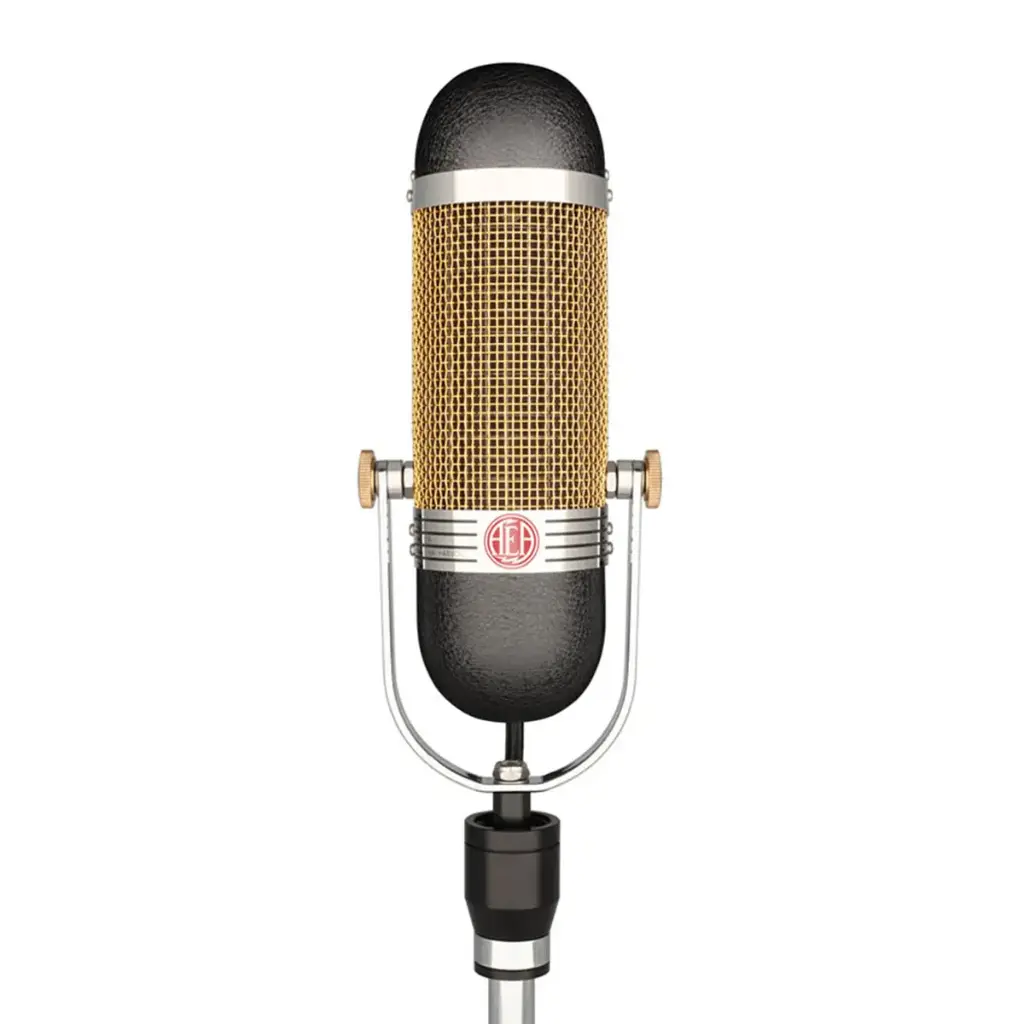
AEA R84A - 48V Ribbon Microphone - Exceptional Audio Capture
Rediscover the legendary warmth of the Big Ribbon with the flexibility of a modern active circuit.
The AEA R84A captures the soul of the legendary RCA 44BX in a handy format, offering 12 dB more output and stable impedance for optimal performance with any preamp. Designed to soften harsh sources while preserving organic depth, it's the go-to tool for professional studios and discerning musicians in Quebec.
The Essential Modern Ribbon
The recording industry has gone through major technological cycles, but few tools have retained such absolute relevance as the ribbon microphone. The AEA R84A doesn't just reproduce a sound of the past; it solves the real-world problems faced by sound engineers and musicians in a digital production environment often characterized by excessive clarity, even a certain clinical coldness. The main technical challenge in the studio lies in managing harsh high frequencies. Whether it's the sibilance of a voice, the sharpness of a brass section, or the metallic shimmer of poorly controlled cymbals, traditional condenser microphones often accentuate these flaws. The R84A, with its smooth and natural high-frequency roll-off, acts as an organic spectral processor, smoothing out harshness without sacrificing harmonic detail.
The authority of the AEA R84A rests on its "Big Ribbon" design. Where most manufacturers use short, narrow ribbons for cost or ease of mounting, AEA uses a massive 2.35-inch element made of pure aluminum. This geometry isn't merely aesthetic: it allows for an extremely low resonant frequency, tuned to 16.5 Hz, giving the microphone a bass response of rare depth and an ability to reproduce transients with temporal fidelity that heavy-diaphragm microphones cannot achieve. As an expert at Garage à Musique, analysis of professional feedback confirms that the R84A eliminates the major objection associated with passive ribbons: the need for an ultra-expensive, niche preamp. Thanks to its active JFET circuit, the microphone has a stable output impedance of 92 ohms, ensuring that the sonic character remains consistent whether you're using a high-end Neve console or a more modest desktop audio interface.
Full Technical Specifications
The following extract contains all documented technical data, without any omissions, in order to provide surgical precision to engineers and technicians.
| Audio Settings | Technical Data |
| Operating principle | Transducteur à gradient de pression |
| Item type | Ruban pur en aluminium ondulé de 1,8 µm |
| Polar diagram | Bidirectionnel natif (Figure-en-8) |
| Frequency response | < 20 Hz to > 20 kHz |
| Maximum SPL | 141+ dB SPL (1% troisième harmonique > 1 kHz) |
| Sensitivity | 6.3 mV/Pa (-44 dBv/Pa) dans un circuit non chargé |
| Clean noise | 17.5 dB(A) pondéré |
| Ribbon tuning | 16.5 Hz |
| Off-axis rejection | Jusqu'à 90 dB aux angles droits de l'axe principal |
| Rejection at 60° / 120° | 6 dB |
| 180° Rejection | 0 dB (Réponse identique à l'avant et à l'arrière) |
| Electronics and Connectivity | Technical Data |
| Circuit type | État solide (Active JFET) |
| Transformer | Toroïdal personnalisé (Lehle, Allemagne) |
| Output impedance | 92 Ω large bande (broadband) |
| Recommended load impedance | 1.0 kΩ ou supérieure |
| Power supply required | Alimentation fantôme P48 (Phantom Power) |
| Power consumption | 7 mA |
| Polarity | Pin 2 high pour une pression positive sur l'avant |
| Connector type | XLR-3M |
| Cable | Câble captif de 10 pieds (3 mètres) inclus |
| Dimensions and Materials | Technical Data |
| Microphone height | 11.6 po (29.5 cm) |
| Microphone width | 3.9 po (9.9 cm) |
| Microphone depth | 2.5 po (6.4 cm) |
| Weight (with cable) | 3 lb (1.36 kg) |
| Shipping weight | 4 lb (1.8 kg) |
| Ribbon material | Aluminium pur |
| Ribbon dimensions | 2.35 po (L) x 0.185 po (l) (59.7 mm x 4.7 mm) |
| Grid finishing | Plaquée or 18 carats (Spécifique au modèle R84A) |
| Mounting system | Yoke mount intégré (étrier en U) |
| Origin | Fabriqué aux États-Unis (Pasadena, Californie) |
Comparative Analysis: Industry References and Consensus
This analysis is based on rigorous testing and expert feedback from authoritative publications such as Sound on Sound , Gearspace , and MusicRadar . It allows us to position the AEA R84A in relation to market standards.
| Alternative Product | Market Segment | Comparative Analysis | Available at Garage à Musique |
| Royer R-121 | Standard Studio | Plus de mordant dans les hauts-médiums. Idéal pour les amplis de guitare saturés, mais moins de profondeur dans les graves que le R84A. | Available here. |
| Coles 4038 | BBC Classic | Son extrêmement plat et naturel. Plus "sombre" que le R84A avec une construction beaucoup plus lourde et fragile. | Available here. |
| AEA R44CE | Museum Replica | Le son original du RCA 44. Plus d'effet de proximité et un poids massif de 8 lb. Le R84A est sa version moderne optimisée. | Available here. |
| Beyerdynamic M160 | Hypercardioid Ribbon | Diagramme polaire directionnel unique. Plus nasal et focalisé. Manque de l'ouverture "aérienne" du R84A en figure-8. | Available here. |
| Shure KSM313 | Double Voice Ribbon | Offre deux tonalités distinctes (avant/arrière). Construction plus robuste pour le live, mais moins de fidélité "Big Ribbon". | Available here. |
| AEA KU5A | Supercardioid Ribbon | Conçu pour rejeter l'ambiance de pièce. Excellent pour le chant de proximité, mais moins polyvalent pour les ambiances de studio. | Available here. |
| sE Electronics RNR1 | Neve Active Tape | Réponse étendue jusqu'à 25 kHz. Très précis, presque comme un condensateur, perdant un peu de la chaleur vintage de l'AEA. | Available here. |
| Samar VL37 | Boutique Ribbon | Extrêmement linéaire et moderne. Très apprécié des audiophiles, mais moins de caractère "gras" caractéristique de la série 84. | Product not listed. |
| Royer R-122 MKII | Active Ribbon | Concurrent direct du R84A. Très silencieux, mais avec un focus plus marqué sur la projection frontale. Moins de bas-médiums. | Available here. |
| Warm Audio WA-44 | Budget Replica | Version abordable du son RCA. Construction passive uniquement. Ne possède pas la finesse transitoire ni le circuit JFET de l'AEA. | Available here. |
History & Evolution: The Heritage of Radio
The technological origins of the AEA R84A are inextricably linked to the history of sound recording itself. The foundations were laid in the 1920s in Germany by Walter Schottky and Erwin Gerlach at Telefunken, who co-invented the ribbon microphone. However, it was Harry Olson at RCA who transformed this concept into a mass-produced tool with the PB-31 model in 1931, quickly followed by the legendary Type 44-A in 1932. The RCA 44BX became the most recognizable microphone of the golden age of radio and music, used for everything from Orson Welles speeches to Elvis Presley recordings.
In the late 1960s, RCA ceased microphone production, leaving a huge void. Wes Dooley, founder of AEA in Pasadena, began by repairing these legendary microphones in the 1970s, acquiring the know-how and ribbon tensioning equipment directly from former RCA engineers. In 1998, after decades of service, AEA launched the R44C, an exact replica using original parts.
However, the R44's 8-pound weight and massive proximity effect were obstacles in modern project studios. In 2003, Wes Dooley designed the R84, using the same "Big Ribbon" engine but in a lighter, more streamlined body inspired by the RCA 77DX design. The final evolution came in 2008 with the launch of the active version (then called the A840, later renamed the R84A). This version incorporated a JFET circuit designed by Fred Forssell and a Lehle toroidal transformer to overcome the gain limitations of emerging digital interfaces. Today, the R84A represents the culmination of 90 years of ribbon engineering, combining Olson's physics with cutting-edge 21st-century electronics.
Cultural References & Artists
The R84A's sound is featured on countless award-winning albums. Here is a documented selection of its use by renowned artists and engineers:
Jack White (The White Stripes) : Album Icky Thump (2007). L'ingénieur Joe Chiccarelli a utilisé le R84 sur les amplis de guitare de Jack pour capturer le mordant sans la rudesse.
Leon Bridges : Connu pour son esthétique rétro, il utilise presque exclusivement des micros AEA pour ses voix et ses sections de cuivres afin de recréer le son soul des années 60.
The War On Drugs : Adam Granduciel utilise les R84A en studio et sur scène pour capturer ses textures de guitare complexes et atmosphériques.
Andy Shauf : Album Norm (2023). La guitare acoustique J-50 a été enregistrée avec un R84, contribuant à la signature sonore intimiste et feutrée de l'album.
Beck : Justin Meldal-Johnsen, son bassiste et producteur de longue date, cite le R84A comme son choix de prédilection pour les amplis de basse et les percussions.
Moby : Utilisateur fervent de la série R84, il a utilisé ces micros pour ses productions électroniques organiques avant de les vendre pour des œuvres caritatives.
Yannis Philippakis (Foals) : Album Holy Fire. Le R84 a été aperçu lors des sessions d'enregistrement pour adoucir les guitares électriques très rythmiques.
Justin Timberlake : L'ingénieur Josh (Sully Erna's studio) utilise des paires de R84 pour les overheads de batterie et les voix de fond.
Iggy Pop : Le producteur Danny Blume utilise le R84 pour les voix de baryton, appréciant sa capacité à gérer les chanteurs très dynamiques.
The Strokes : Joe Chiccarelli a utilisé le R84 lors de sessions récentes pour capturer des textures vocales plus chaleureuses que les condensateurs habituels.
Nathaniel Rateliff : Le groupe utilise les R84A pour les sessions de cuivres afin d'obtenir ce son "Stax" authentique sans agressivité.
Punch Brothers : Chris Eldridge utilise le R84 pour capturer la guitare acoustique en studio, louant sa fidélité aux timbres boisés.
Wilco : Le groupe possède plusieurs modèles R84 dans leur studio de Chicago, les utilisant fréquemment pour les pianos et les ambiances de salle.
Brandi Carlile : Sean Quackenbush utilise la série R84 pour capturer la dynamique vocale exceptionnelle de Brandi en environnement contrôlé.
Elliott Smith : Le producteur Rob Schnapf utilisait les rubans pour capturer les voix murmurées caractéristiques d'Elliott, minimisant la sibilance.
Radiohead : Darrell Thorp a documenté l'utilisation de micros AEA lors de sessions impliquant des arrangements de cordes complexes.
Paul McCartney : Utilisé lors de sessions récentes avec Darrell Thorp pour des prises d'instruments acoustiques traditionnels.
Health : Manny Nieto utilise le R84 pour les batteries, décrivant le micro comme "construit comme un tank" et indispensable pour les sons lourds.
Pat Metheny : Mark Egan a utilisé le R84 pour enregistrer des instruments acoustiques sur plusieurs projets jazz, appréciant la réponse transitoire naturelle.
Steve Albini (Electrical Audio) : Bien que partisan des condensateurs, il a utilisé des R84 lors de sessions pour des groupes comme New Secret Weapon à Chicago.
FAQ - Frequently Asked Questions
Is phantom power dangerous for the AEA R84A? Absolutely not, it's mandatory . Unlike the passive R84 model, the active R84A requires 48V of phantom power to power its internal JFET circuit. This circuit also acts as a protective barrier, preventing the ribbon from being damaged by leakage currents or accidental hot-patching in a patchbay, thus eliminating a common fear associated with ribbon microphones. You gain in safety and reliability.
Why choose the active version over the passive one? The main benefit is gain flexibility . The R84A offers 12 dB more output, meaning you don't need to push your preamps to their limits, thus avoiding excessive noise floor on softer sources like an acoustic guitar or a whispered vocal. Furthermore, the fixed impedance ensures consistent sound regardless of your equipment—expertise we value at Garage à Musique.
Can the R84A be used in front of a kick drum? Yes, but with a specific placement technique. The microphone can handle high sound pressure levels (SPL), but it is sensitive to large air blasts. Never place the microphone directly into the resonant head vent. Angle it slightly or use a pop filter to deflect air turbulence. The "hand test" is recommended: if you feel a rush of air where you place the microphone, move it back to protect the ribbon cable.
How does the R84A handle electromagnetic (RF) interference? Thanks to its active electronics and high-quality toroidal transformer, the R84A is extremely resistant to RF and induced noise. This is a crucial advantage if your studio is located near a light dimmer or transmission tower. You get a pure, hum-free signal, even with very long XLR cables, ensuring complete peace of mind during your sessions.
What are the advantages of the Figure-in-8 pattern for recording? This pattern allows for phenomenal side rejection (up to 90 dB). You can place two musicians facing each other and, by pointing the "dead" sides of the microphone towards the opposite sound source, achieve near-perfect isolation. It's the ultimate tool for recording a singer playing guitar simultaneously, a technique mastered by our experts at Garage à Musique.
Does the R84A require any special maintenance? The ribbon is a precision component that is sensitive to gravity. It is recommended to store the microphone vertically when not in use to prevent the ribbon from sagging (sag) over time. Also, avoid blowing directly into the grille. Simple maintenance ensures optimal performance for decades.
Can the R84A be used for podcasts or radio? Absolutely. Its natural high-frequency roll-off eliminates fatiguing sibilance ("s" and "sh") without the need for aggressive software de-essing. The voice sounds larger than life, with an authority and warmth reminiscent of the golden age of FM radio, while remaining perfectly intelligible thanks to its fast transient response.
How does the R84A handle ground loops? The JFET circuit and Lehle transformer are designed to minimize the risk of ground loops . If you hear a hum, check your phantom power supply. The R84A is designed to be one of the quietest ribbons on the market, offering an exceptional signal-to-noise ratio even with distant sources.
What is the ideal distance for capturing the proximity effect? The proximity effect starts to become noticeable around 12 inches (30 cm). Unlike the R44 model, which becomes very muffled up close, the R84A is more balanced. For a rich, radio-like vocal sound, stay at 6-8 inches. For a natural acoustic instrument capture, move back 2 or 3 feet to allow the sound to breathe in the room.
Where is the R84A manufactured and how reliable is it? Each AEA R84A is handcrafted in Pasadena, California, by a team of passionate craftsmen. Its mechanical robustness is exemplary ("built like a tank"). By purchasing from Garage à Musique, you benefit from the authority of a local dealer who provides after-sales service and guarantees a product manufactured to the highest industry standards.
In conclusion
The AEA R84A is more than just an accessory; it's an investment in the texture and dimension of your productions. By choosing this model from Garage à Musique, you're opting for an industry standard proven on the world's biggest stages and in the most prestigious studios. Its ability to transform a cold digital signal into a rich and organic listening experience makes it the undisputed authority on modern ribbon microphones in Quebec.
Avis clients
Aucun avis pour le moment. Soyez le premier à partager votre expérience après votre achat.