
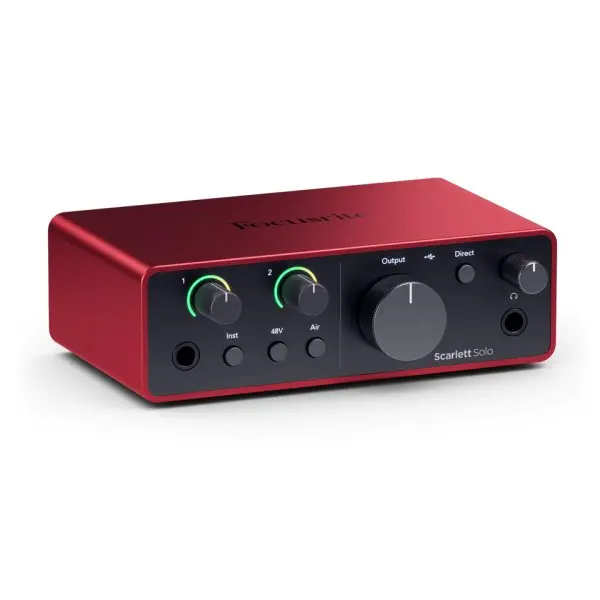
Focusrite Scarlett Solo 4th Gen USB-C Audio Interface
The Scarlett Solo 4th Gen is a USB-C audio interface that gets a voice and a guitar into your computer at the same time, cleanly, with no mixing desk and no engineer. One mic preamp on one side, one high-impedance instrument input on the other: it is built for the person who writes, sings and plays alone, and wants to keep their takes instead of redoing them on a phone.
What sets it apart
- Separate mic preamp and guitar input that work together
- 48V phantom power for condenser microphones
- Air mode with two settings: Presence or Harmonic Drive
- Headphone level set independently from the monitor level
- Loopback to capture your computer's own audio
- Powered by the USB-C cable, nothing else to plug in
Sing and play in the same take
Many small interfaces have just one input: you record the guitar, then start over for the vocal. The Solo keeps them apart. The mic goes into the preamp, the electric or acoustic-electric guitar into the instrument input, and each source lands on its own track in your software.
For a song you accompany yourself on, that is what keeps the performance natural: you play the way you would on stage, and you can still adjust the guitar level without touching the vocal.
Levels you can read at a glance
Each gain knob is ringed by a light that changes colour with the level. Set it while singing the loudest part of the song, and back off as soon as the ring warns you of clipping. The preamp gives you 57 dB of gain.
Air mode is one button away. Presence brightens the top end of a slightly dull voice; Harmonic Drive adds a light saturation that thickens an acoustic guitar.
Listen the way you want
On the 4th Gen, headphones and studio monitors each get their own control. You can turn the headphones up during a take without the speakers blaring, then play back quietly. The headphone amp delivers 32 mW into 33 ohms and still copes with high-impedance headphones.
Specifications
| Inputs | 1 mic preamp, 1 high-impedance instrument input |
|---|---|
| Preamp gain | 57 dB |
| Dynamic range | 113 dB A-weighted at the mic input, 120 dB at the outputs |
| Outputs | 2 balanced line outputs, 1 headphone output |
| Headphone power | 32 mW into 33 Ω, 22 mW into 300 Ω |
| Conversion | 24-bit, 44.1 to 192 kHz |
| Air modes | Presence, Harmonic Drive |
| Loopback | Yes |
| Connection and power | USB-C (USB 2.0), bus powered, 900 mA |
| Dimensions (W × D × H) | 143 × 96 × 46.5 mm |
| Weight | 382 g |
| Bundled software | Ableton Live Lite, Pro Tools Intro+, Cubase LE, Hitmaker Expansion |
What it's for
- Songwriter demos: vocal and guitar in a single take
- Electric guitar plugged in direct, with an amp simulator
- Voice-over for videos and tutorials
- Single-host podcast
- A first external interface for learning to record
Compared with other manufacturers
Other manufacturers make small interfaces for one person; here is how they differ from the Solo:
| Manufacturer | Comparable model | How it differs |
|---|---|---|
| Universal Audio | Volt 1 | A single combo input, with a Vintage mode on the preamp |
| Audient | iD4 MkII | Preamp derived from Audient consoles, JFET instrument input |
| Arturia | MiniFuse 1 | One combo mic, line or instrument input: one source at a time |
| Steinberg | UR12 | D-PRE preamp and Hi-Z input, bundled with Cubase AI |
Frequently asked questions
- Can I plug two microphones into the Scarlett Solo?
- No. It has a single mic preamp; the second input is a jack for guitar or a line-level source. To record two mics at once, you need an interface with two preamps, such as the Scarlett 2i2.
- Does it supply phantom power for a condenser mic?
- Yes, the preamp provides 48V. A button switches it on; leave it off with a dynamic mic, which does not need it.
- Do I need to install a driver?
- Not on a Mac: the interface is recognized as soon as you plug it in. On Windows, the driver comes with the Focusrite Control 2 software, downloaded from Focusrite.
- Scarlett Solo or Scarlett 2i2: which should I choose?
- The Solo is enough for one voice and one guitar. The 2i2 adds a second mic preamp, 69 dB of gain instead of 57, and the Auto Gain and Clip Safe modes the Solo does not have.
Avis clients
Aucun avis pour le moment. Soyez le premier à partager votre expérience après votre achat.