
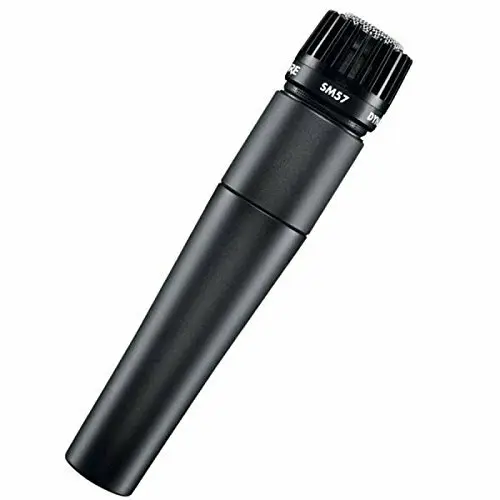
Shure SM57-LC Cardioid Dynamic Instrument Microphone (No Cable)
The Shure SM57-LC is a cardioid dynamic microphone designed first for instruments: snare, toms, guitar and bass amps, brass and woodwinds. The LC suffix means it is sold without a cable; the box holds the microphone, a swivel clip and a storage bag.
What sets it apart
- Cardioid pattern that isolates the target source and cuts background noise from the rear
- 40 to 15,000 Hz response with a presence rise that helps the instrument cut through the mix
- Pneumatic shock mount that reduces handling noise
- Die-cast steel housing, polycarbonate grille and stainless steel screen
- Built to take the high sound pressure of amps and drums without distortion
The mic you point at a snare
Shure presents the SM57 as its most versatile instrument microphone. Its cartridge shares the design of the SM58's, the brand's vocal mic, but it does not sit under a ball grille: the SM57's small grille is part of the cartridge. The diaphragm is therefore closer to the source, which gives a more pronounced proximity effect and slightly more output above 5 kHz.
On a snare, Shure's guide places it 2.5 to 7.5 cm above the rim of the batter head, aimed at the head: this is the position that gives the most snap from the stick. A second mic can go just below the rim of the snare-side head.
In front of a guitar amp: four positions, four sounds
The guide describes four placements in front of the speaker. At 2.5 cm, on axis with the centre of the cone: sharp attack, emphasized bass. At 2.5 cm, at the edge of the cone: sharp attack, brighter sound. At 15 to 30 cm, on axis: medium attack, full and balanced sound. At 60 to 90 cm: softer attack, less bass. The closer the mic, the more proximity effect boosts the low end, up to 6 to 10 dB below 100 Hz at about 6 mm from the source.
A story that starts in 1965
According to Shure's historian, it all starts with the Unidyne III cartridge, the element that picks up the sound, introduced in 1959 in an earlier mic, the Model 545. The same element went into the SM57, released in 1965. Justin Vernon recorded the first Bon Iver album with a single SM57, and Nile Rodgers tracked all his guitars on « Get Lucky » with one.
Specifications
| Type | Dynamic (moving coil) |
|---|---|
| Polar pattern | Cardioid |
| Frequency response | 40 to 15,000 Hz |
| Output impedance | 310 Ω |
| Sensitivity (1 kHz, open circuit) | -56.0 dBV/Pa (1.6 mV) |
| Connector | 3-pin male XLR |
| Housing | Dark grey enamelled die-cast steel, polycarbonate grille, stainless steel screen |
| Dimensions | 32 mm wide, 157 mm long |
| Net weight | 284 g |
| Included | A25D swivel clip, storage bag; cable not included |
What it's for
- Snare and toms, on stage and in the studio
- Guitar and bass amps
- Saxophone, trumpet and other brass or woodwinds
- Vocals, when a more present, closer sound is wanted
Compared with other manufacturers
Other dynamic instrument microphones from other manufacturers. Data as published by each manufacturer.
| Model | Polar pattern | Frequency response | Stated use |
|---|---|---|---|
| Shure SM57-LC | Cardioid | 40 to 15,000 Hz | Drums, amps, brass and woodwinds; vocals too |
| Sennheiser e 906 | Supercardioid | 40 to 18,000 Hz | Guitar amps; also drums, percussion and brass |
| Audix i5 | Cardioid | 50 to 16,000 Hz | A wide range of instruments, on stage, in the studio and in broadcast |
| Audio-Technica ATM650 | Hypercardioid | 80 to 17,000 Hz | Guitar amp speakers, snare and percussion |
| beyerdynamic TG I51 | Cardioid | 33 to 19,000 Hz | Drums, snare, toms, guitar amps and brass |
Frequently asked questions
- What is the difference between the SM57 and the SM57-LC?
- It is the same microphone. At Shure, LC means the version without a cable: the box holds the SM57, its A25D swivel clip and a storage bag. An XLR cable has to be bought separately.
- Are the SM57 and the SM58 the same mic?
- They are based on the same cartridge design; the grille makes the difference. The SM58 has a ball grille with a pop filter for vocals. The SM57 has a small grille built into the cartridge, which lets you get closer to the source and gives a little more output above 5 kHz.
- Can the SM57 be used for vocals?
- Yes. Shure's guide calls it excellent for instruments and vocals alike, with the lips less than 15 cm away, on axis. Shure notes that the stronger proximity effect and the bump around 5 kHz suit some voices; without a ball grille, it gives less protection against plosives.
- Why does the SM57 grille spin or rattle?
- The grille is meant to rotate freely: this is by design, not a break. When close-miking drums, a rattle can appear; Shure suggests a windscreen or a very small piece of foam wedged under the grille, never tape over the vents, which would upset the polar pattern.
- Does the SM57 need phantom power?
- No. A dynamic microphone has no active electronics. Shure states that phantom power will not damage a modern dynamic microphone in the vast majority of cases, and advises turning it off before plugging or unplugging a mic to avoid pops.
Avis clients
What source does your SM57 work on? Tell us.
Aucun avis pour le moment. Soyez le premier à partager votre expérience après votre achat.