
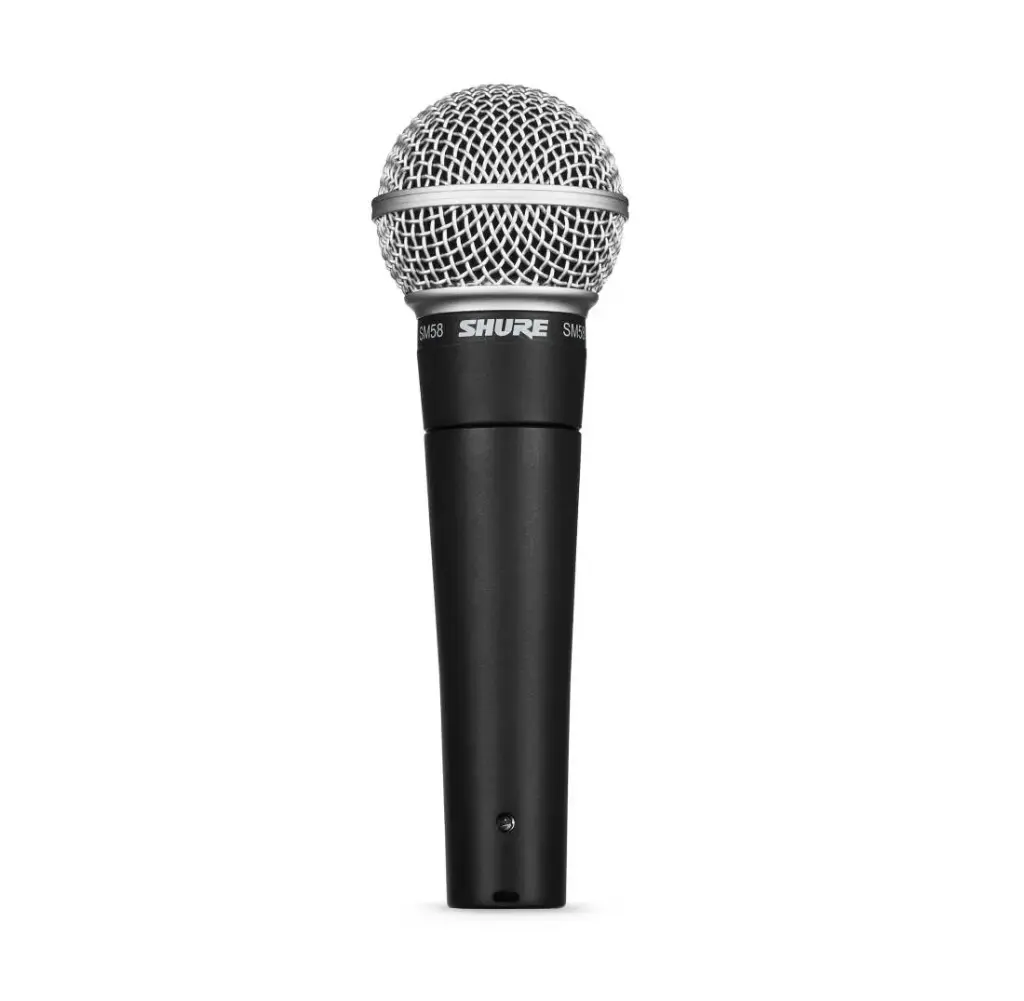
Shure SM58-LC Cardioid Dynamic Vocal Microphone (No Cable)
The Shure SM58-LC is a cardioid dynamic vocal microphone designed for the stage, sound reinforcement and studio recording. This version comes without a cable or a switch: the box holds the mic, its A25D stand adapter and a zippered storage bag.
What sets it apart
- Response from 50 to 15,000 Hz tailored for vocals: brightened midrange and bass rolloff
- Uniform cardioid pattern: high gain before feedback, good off-axis rejection
- Built-in spherical filter against wind and plosives
- Pneumatic capsule shock mount against handling noise
- Break-resistant stand adapter that rotates 180 degrees
Where to put the stage monitors
A cardioid microphone rejects best what comes straight from the rear. Shure therefore recommends placing monitors and loudspeakers directly behind the SM58, then testing that placement before the show to keep feedback down. The guide adds a few simple rules: one mic per source, as few mics as possible, a windscreen outdoors, and never a hand over the grille, which degrades the sound.
A studio mic that became a stage mic
The SM in its name stands for "Studio Microphone". According to Shure's historian, the SM58 was launched in 1966 for radio and television, hence its non-reflective dark grey finish and the absence of a switch. Sales lagged and, around 1970, its future was uncertain; Shure then introduced it to live sound engineers in Las Vegas, who adopted it for performance. The Who, the Rolling Stones, Paul McCartney and Patti Smith, among others, went on to sing into an SM58.
Bass and distance
The closer the mouth, the stronger the bass: this is proximity effect, in the range of 6 to 10 dB below 100 Hz when the source is only a few millimetres away. To keep the sound from booming up close, the SM58's response gradually rolls off in the bass; a singer can move in to warm up the voice without losing clarity.
Specifications
| Type | Dynamic (moving coil) |
|---|---|
| Polar pattern | Cardioid |
| Frequency response | 50 to 15,000 Hz |
| Sensitivity at 1 kHz | -56.0 dBV/Pa (1.6 mV) |
| Impedance | 300 ohms actual (150 ohms rated) |
| Connector | 3-pin male XLR |
| Housing | Dark grey enamelled die-cast metal, spherical steel mesh grille |
| Dimensions | 162 mm long, 51 mm wide |
| Net weight | 330 g |
| Supplied | A25D stand adapter, zippered bag; no cable |
| Replacement parts | R59 cartridge, RK143G grille |
What it's for
- Lead vocals in concert, from the bar to the big hall
- Backing vocals and harmonies in rehearsal
- Speeches, hosting and announcements on stage
- Vocals in a home studio
Compared with other manufacturers
Other dynamic stage vocal microphones, from other manufacturers. Data published by each manufacturer.
| Model | Polar pattern | Frequency response | Stated feature |
|---|---|---|---|
| Shure SM58-LC | Cardioid | 50 to 15,000 Hz | Spherical filter against wind and plosives |
| Sennheiser e 835 | Cardioid | 40 to 16,000 Hz | Hum-compensating coil |
| Sennheiser e 845 | Supercardioid | 40 to 16,000 Hz | Extended highs, high output |
| Audix OM2 | Hypercardioid | 50 Hz to 16 kHz | Very low-mass diaphragm |
| Audio-Technica ATM510 | Cardioid | 90 to 16,000 Hz | Rare-earth magnet, multi-stage grille |
Frequently asked questions
- Does the SM58 need phantom power?
- No. According to Shure, a dynamic microphone like the SM58 has no active electronics and does not need it. Phantom power will not damage it in the vast majority of cases, but Shure advises turning it off before plugging or unplugging a microphone.
- What is the difference between the SM58 and the SM57?
- Both are built on the same cartridge design. The SM58 has a ball grille that filters plosives, meant for vocals; the SM57, meant for instruments, has a small grille built into the cartridge, which brings its diaphragm closer to the source.
- Is the SM58 cardioid or supercardioid?
- Cardioid. It rejects best the sounds arriving from the rear, which is why Shure recommends placing stage monitors directly behind it.
- What comes in the SM58-LC box?
- The mic, the A25D swivel stand adapter and a zippered storage bag. No cable is included: an XLR cable must be bought separately.
Avis clients
Which stage has this SM58 proven itself on? Comments are open.
Aucun avis pour le moment. Soyez le premier à partager votre expérience après votre achat.