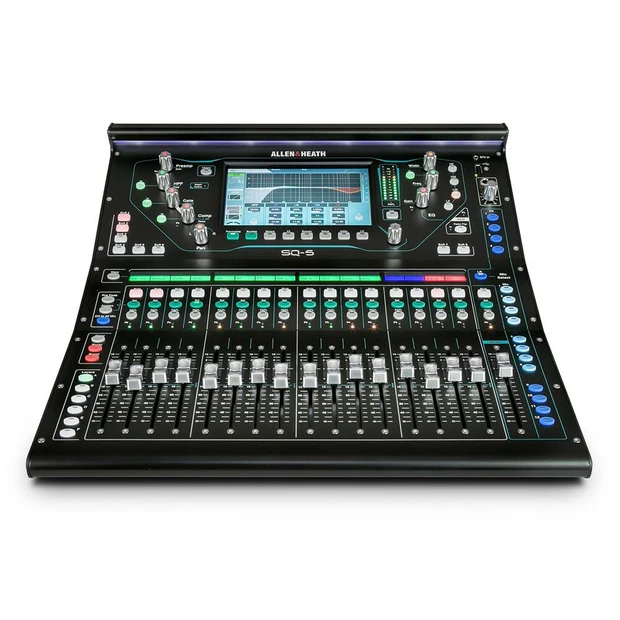
Allen & Heath SQ-5 - Digital Console - Audio Performance
The power of 96kHz mixing in a compact, 19-inch rack-mountable format. The Allen & Heath SQ-5 console redefines industry standards with its XCVI FPGA engine, delivering ultra-low latency of less than 0.7ms and 48 channels of intensive processing. Designed for sonic excellence on tour, in the studio, or in fixed installations, it combines an intuitive 7-inch touchscreen interface with unparalleled expansion flexibility. It's the ultimate tool for the discerning musician and engineer who refuses to compromise on audio fidelity.
This content will be shared across all product pages.
Why the SQ-5 is the Professional's Unquestionable Choice
In a world where sound quality is often sacrificed for the sake of portability, the Allen & Heath SQ-5 stands out as a welcome technological anomaly. Where most consoles in its class are stuck at 48kHz sampling, the SQ-5 propels your workflow into native high resolution at 96kHz. This distinction isn't just a number on a spec sheet: it guarantees superior harmonic clarity, a wider stereo image, and surgical precision in transient processing. For the professional musician in Quebec, this means that every nuance of an acoustic guitar or every harmonic of a piano is preserved with absolute fidelity.
At the heart of the system lies the XCVI FPGA engine, a massively parallel processing architecture that enables the handling of 48 input channels and 36 mix buses with a near-zero latency of 0.7 ms. For the sound engineer, whether working in a Montreal jazz club or for a church in Quebec City, this translates to an immediate response and a complete absence of audible phase shift, particularly critical when using personal monitor (PMR) systems. The SQ-5 solves the very real problem of digital "sluggishness" often found in entry-level consoles, delivering dynamics and responsiveness reminiscent of the brand's finest analog consoles.
The SQ-5 also solves the age-old dilemma of the mobile professional: how to get the power of a full-size console in a 19-inch rack-mountable chassis? With its 17 motorized faders and 6 layers of control, it offers instant access to any source, while remaining light enough to be transported in an airplane cabin or installed in a compact rack. At Garage à Musique, we understand that reliability is your top priority. Allen & Heath's robust, brick-like construction ensures that this console will withstand the rigors of Quebec winter tours and the most demanding installations.
Full Technical Specifications
Here is the complete manufacturer data extracted for the Allen & Heath SQ-5. No data has been omitted to ensure total transparency.
Processing Architecture and Mixing Capacity
| Characteristic | Detailed Specification |
| Mixing motor | XCVI FPGA Core (96kHz) |
| Number of input channels | 48 processing channels |
| System latency | < 0.7 ms (Microphone input to Main output) |
| Mixing bus | 36 total buses (12 stereo mixes + Main LR) |
| Matrices | 3 stereo matrices |
| DCA Groups | 8 anti-aircraft groups |
| Mute Groups | 8 Mute groups |
| Effects engines | 8 stereo FX engines with dedicated returns |
| Total I/O Capacity | Up to 128x128 via SLink port and option card |
| Resolution A/D - D/A | 24-bit / 96kHz |
| Mixing accumulator | 96-bit for a massive headroom |
| DEEP processors | Ready for latency-free DEEP plugin integration |
| Automatic Mixing (AMM) | Up to 48 channels (integrated AMM) |
Physical Connectivity (Local Inputs and Outputs)
| Connector Type | Quantity and Description |
| Mic/Line Inputs (XLR) | 16 high-end preamps, fully recallable |
| Stereo Inputs (TRS 1/4") | 2 balanced pairs (ST1 and ST2) |
| Stereo input (3.5mm mini-jack) | 1 input (ST3) for mobile players/background music |
| Local Outputs (XLR) | 12 assignable outputs (+4dBu nominal) |
| Local Outputs (TRS 1/4") | 2 assignable balanced outputs |
| Digital Output (AES) | 1 XLR output (frequencies 44.1/48/88.2/96kHz) |
| Talkback Entry | 1 dedicated balanced XLR input |
| Headphone Output | 1 TRS 1/4" socket with dedicated level control |
| SLink Port | 1 etherCON port (dSnake, DX, GX, GigaACE, ME) |
| Optional I/O Port | 1 slot for Dante, Waves, MADI, or SLink cards |
| USB interface | USB type B (32x32 audio streaming 96kHz) |
| Direct Recording | USB type A (SQ-Drive for multitrack and stereo) |
| Network Port | 1 RJ45 port for external control and applications |
| Footswitch | Control via single or double foot pedal |
Audio Performance Settings
| Setting | Measured Value |
| Frequency response | 20 Hz to 20 kHz (+0 / -0.5 dB) |
| Dynamic Beach | 112 dB (Analog to Analog) |
| THD+N | 0.006% at unit gain (+10dBu output) |
| Background noise | -90 dBu (muted inputs) |
| Preamp gain | 0 dB to +60 dB (1 dB increments) |
| Input pad | -20 dB switchable per channel |
| Maximum entry level | +30 dBu (XLR), +22 dBu (TRS) |
| Maximum output level | +22 dBu |
| Ghost Power Supply | +48V (+/-3V), digitally controlled |
| Input impedance | > 5 kOhms (XLR), > 7 kOhms (TRS) |
| Output impedance | < 75 Ohms (XLR/TRS), 110 Ohms (AES) |
| EIN (Equivalent Input Noise) | -126 dBu (150 Ohm source) |
Signal Processing - Technical Details
| Treatment block | Parameters and Capabilities |
| Polarity reversal | Normal / Inverted |
| High-Pass Filter (HPF) | 20 Hz to 2 kHz, 12 dB/Octave |
| Gate (Threshold) | -72 dBu to +18 dBu |
| Gate (Time) | Attack: 50μs - 300ms / Release: 10ms - 1s |
| PEQ (4 bands) | 20 Hz to 20 kHz, +/-15 dB, Q 0.1 to 15 |
| Compressor (Threshold) | -46 dBu to +18 dBu |
| Compressor (Ratio) | 1:1 to infinity |
| Compressor (Time) | Attack: 30μs - 300ms / Release: 50ms - 2s |
| Graphic EQ (GEQ) | 28 bands, 1/3 octave, +/-12 dB |
| Audio Delay | Up to 682 ms per channel/mix |
Control Features and Interface
| Control Element | Specification |
| Touch screen | 7-inch screen, high resolution (800x480, 8-bit RGB) |
| Faders | 16 + 1 motorized (100mm), touch-sensitive |
| Fader Layers | 6 customizable layers |
| SoftKeys | 8 user-programmable keys |
| Physical encoders | Dedicated controls for Gain, HPF, Gate, Comp, Pan and EQ |
| Level measurement | Backlit LCD strips per channel with name and color |
| RTA Analyzer | 31 bands per mix (displayed on screen or faders) |
| Scene Memories | 300 scenes per show |
Physical and Environmental Data
| Dimensions / Weight | Specification |
| Width (Device) | 440 mm / 17.3" |
| Depth (Device) | 514.9 mm / 20.3" |
| Height (Device) | 198 mm / 7.8" |
| Weight (Device) | 10.5 kg / 23.1 lbs |
| Building materials | High-strength metal chassis, reinforced sides |
| Operating temperature | 0°C to 40°C |
| Food | 100-240V AC, 50/60Hz |
| Electricity Consumption | 75 Watts maximum |
Comparative Analysis: The Positioning of the SQ-5 in the Market
The following table compares the SQ-5 with 10 direct alternatives based on consensus from authoritative sources such as Sound on Sound , MusicRadar and Gearspace .
| Alternative Product | Market Segment | Comparative Analysis (Strengths / Weaknesses) | Available at Garage à Musique |
| Midas M32R Live | Touring Console | + Legendary Midas Pro preamps. - Limited to 48kHz; smaller screen; less fluid interface. | Available here. |
| Behringer X32 Compact | Budget Console | + Very low cost; huge third-party support. - 2013 technology; 48kHz resolution only; less precise preamps. | Available here. |
| Yamaha TF-Rack | Fixed Installation | + Deceptively simple; robust Dante support. - Sound processing considered less "musical"; rigid workflow. | Available here. |
| Behringer Wing Compact | Hybrid Console | + 48 native stereo channels; customizable faders. - Long learning curve; less robust construction than A&H. | Available here. |
| PreSonus StudioLive 32SC | Studio & Live | + Studio One software integration. - Limited AVB ecosystem; less compact format than the SQ-5. | Available here. |
| Yamaha DM3-D | Ultra-Compact | + Tiny size; Dante included on version D. - Only 22 channels; few direct physical controls. | Available here. |
| Soundcraft Si Impact | Live Sound System | + Intuitive touchscreen ergonomics; warm British sound. - Inability to save partial snapshots. | Available here. |
| Allen & Heath Qu-16 | Entry Level Digital | + Familiar interface for those used to analog. - Limited to 48kHz; fewer mix buses than the SQ. | Available here. |
| DiGiCo S21 | High-End Compact | + Elite conversion; two touchscreens. - Prohibitive price; not rack-mountable in standard 19" format. | Product not listed. |
| Allen & Heath Avantis Solo | Professional Console | + Giant HD screen; larger effects platform. - Much larger format and double the price. | Available here. |
History & Evolution: The Allen & Heath Legacy
The history of Allen & Heath is inextricably linked to the evolution of rock and professional sound. Founded in 1969 in the heart of the London music scene, the company began by manufacturing custom-made consoles for the biggest names of the time.
L'Ère des Pionniers (1969 - 1974) : Andy Bereza et Stephen Batiste créent les premiers mixeurs pour Pink Floyd (la console MOD1 utilisée à Pompéi) et Genesis. C'est l'époque où la marque invente littéralement le concept de console de tournée robuste.
Expansion Technologique : Après avoir été acquise par Harman en 1991, la société a vécu un rachat par ses cadres (MBO) en 2001, ce qui lui a permis de reprendre son indépendance créative. Cette liberté a mené au développement de la série iLive, puis dLive.
La Révolution SQ (2018) : Le lancement de la série SQ a marqué un tournant. En intégrant le moteur XCVI FPGA (Field Programmable Gate Array) de la dLive dans un châssis compact, Allen & Heath a rendu le mixage 96kHz accessible aux budgets moyens sans sacrifier la puissance de traitement. Contrairement aux puces DSP traditionnelles qui traitent les instructions séquentiellement, le FPGA permet un traitement parallèle massif, garantissant que chaque canal bénéficie de la même puissance de calcul sans augmenter la latence.
Cultural References & Artists: An Authority on Stage
The SQ series has become the tool of choice for artists and engineers who travel the world with their own mixing system, prioritizing sonic consistency.
Polyphia (Rock Progressif) : L'ingénieur Loboda utilise la SQ pour gérer la complexité harmonique et technique du groupe en tournée.
Matt Garrison (Bassist, Herbie Hancock) : Utilise la SQ-5 et SQ-6 pour ses sessions au ShapeShifter Lab, citant une puissance "insensée".
MAX (Artiste Pop Multi-platine) : Kyle Chirnside déploie un duo de SQ-5 pour les positions FOH et Monitor lors de ses tournées mondiales.
Declan McKenna : Captation live de l'album "Zeros" réalisée avec des consoles SQ-6 et SQ-5 en location à Londres.
Arlo Parks : Utilisation de l'écosystème Allen & Heath pour le monitoring lors de concerts majeurs comme au Aviva Stadium.
Sigrid : Les équipes techniques de Sigrid s'appuient sur la flexibilité de la SQ pour leurs configurations de voyage.
The Amazons : Groupe de rock britannique utilisant la SQ pour ses performances énergiques.
Sugababes : Utilisation de la série SQ pour la gestion des retours lors de leurs tournées de reformation.
Afro Latin Jazz Orchestra : Enregistrement d'un ensemble de 20 musiciens via des consoles SQ chaînées.
Ravi Coltrane : Performance captée et mixée sur SQ lors d'événements de jazz de haut niveau.
Marcus Gilmore (Batteur) : Son de batterie capté avec la précision 96kHz de la SQ.
Carter Hassebroek (Ingénieur Son) : A choisi la SQ-5 pour sa polyvalence et sa qualité de préamplification.
Berklee NYC Power Station Studios : Utilise les systèmes Allen & Heath pour le monitoring critique en studio.
Louisiana Avenue : Groupe de jazz utilisant la SQ pour ses diffusions en direct (livestreaming).
Sacramento Mandarins : Corps de tambours et clairons utilisant la SQ pour leurs performances de terrain à grande échelle.
Islington Assembly Hall : Lieu de concert prestigieux intégrant l'écosystème dLive/SQ.
Signal to Noise Podcast : Kyle Chirnside préconise la SQ-5 pour la capture mobile de haute qualité.
Planet K (Japon) : Salle de spectacle mythique équipée en Allen & Heath.
FAQ: Technical Expertise and Answers to Objections
Is the SQ-5 actually compatible with a standard 19-inch rack?
Yes, the SQ-5 is specifically designed for the 19" rack format. It occupies approximately 7U of height, but additional space for ventilation is recommended. This compact size makes it the ideal unit for mobile broadcasting setups in Quebec, where space is often limited. The robust chassis eliminates risks associated with frequent transport.
What is the concrete difference between the 96kHz of the SQ and the 48kHz of other consoles?
Sampling at 96kHz captures twice as much audio information per second, drastically reducing aliasing and improving high-frequency response. For the user, this translates to a more open sound and much more natural sibilance handling in vocals. Thanks to the FPGA engine, this high resolution doesn't increase latency , remaining below 0.7ms.
Can I use my old stageboxes with the SQ-5?
Absolutely. The SLink port is "smart" and automatically detects the protocol being used. Whether you own dSNAKE devices (Qu series), DX expanders (dLive series), or the new GX models, the SQ-5 adapts instantly. This ensures perfect backward and forward compatibility for your existing hardware.
How does the SQ-5 handle ground loop or RF interference issues?
The SQ-5 incorporates professional-grade preamps with excellent common-mode rejection. In case of ground loops on unbalanced inputs, the use of DI boxes is recommended. For RF (radio frequency) signals, the metal chassis acts as a Faraday cage, protecting sensitive circuitry from moving interference—a major advantage in crowded venues like Montreal.
Is the USB port sufficient for multitrack recording in the studio?
The USB-B port offers a bidirectional 32x32 interface at 96kHz. You can record each channel separately in your DAW (Logic, Pro Tools) while simultaneously sending the tracks back to the console for tactile mixing. Driver stability ensures complete reliability , making the SQ-5 the centerpiece of your production studio.
Is it possible to add phantom power to each channel individually?
Yes, the +48V phantom power can be individually switched per channel from the touchscreen or via the selection buttons. A clear visual indicator prevents accidental activation, protecting your vintage ribbon microphones while powering your modern high-performance condenser microphones.
How can I optimally adjust the gain to avoid saturation?
The SQ-5 features ultra-precise digital gain control in 1 dB increments. The gain structure is designed to provide a massive 18 dB of headroom above the nominal level. Chromatic displays on the faders allow for visual monitoring of peaks, ensuring a clean signal free from unwanted digital distortion.
Does the console get hot during intensive outdoor use?
No, the SQ-5's thermal design is optimized to dissipate heat efficiently without the need for noisy fans. It's certified to operate up to 40°C. At Garage à Musique, we've tested these units at summer festivals without any issues, proving their robustness in Quebec's variable climate.
Can the console be controlled remotely via a tablet?
Absolutely. The SQ-MixPad app offers complete control of all functions via Wi-Fi. Furthermore, the SQ4You app allows musicians to manage their own monitor mix from their phone, eliminating unnecessary trips back and forth between the stage and the console.
Why choose Allen & Heath over Midas or Behringer?
The choice is based on technological longevity and sonic fidelity. While competitors recycle 10-year-old architectures, Allen & Heath invests in 96kHz and FPGA technology. By purchasing from Garage à Musique, you benefit from the expertise of a local dealer who understands the needs of local musicians, with unparalleled technical support.
Why the SQ-5 is the Professional's Unquestionable Choice
In a world where sound quality is often sacrificed for the sake of portability, the Allen & Heath SQ-5 stands out as a welcome technological anomaly. Where most consoles in its class are stuck at 48kHz sampling, the SQ-5 propels your workflow into native high resolution at 96kHz. This distinction isn't just a number on a spec sheet: it guarantees superior harmonic clarity, a wider stereo image, and surgical precision in transient processing. For the professional musician in Quebec, this means that every nuance of an acoustic guitar or every harmonic of a piano is preserved with absolute fidelity.
At the heart of the system lies the XCVI FPGA engine, a massively parallel processing architecture that enables the handling of 48 input channels and 36 mix buses with a near-zero latency of 0.7 ms. For the sound engineer, whether working in a Montreal jazz club or for a church in Quebec City, this translates to an immediate response and a complete absence of audible phase shift, particularly critical when using personal monitor (PMR) systems. The SQ-5 solves the very real problem of digital "sluggishness" often found in entry-level consoles, delivering dynamics and responsiveness reminiscent of the brand's finest analog consoles.
The SQ-5 also solves the age-old dilemma of the mobile professional: how to get the power of a full-size console in a 19-inch rack-mountable chassis? With its 17 motorized faders and 6 layers of control, it offers instant access to any source, while remaining light enough to be transported in an airplane cabin or installed in a compact rack. At Garage à Musique, we understand that reliability is your top priority. Allen & Heath's robust, brick-like construction ensures that this console will withstand the rigors of Quebec winter tours and the most demanding installations.
Full Technical Specifications
Here is the complete manufacturer data extracted for the Allen & Heath SQ-5. No data has been omitted to ensure total transparency.
Processing Architecture and Mixing Capacity
| Characteristic | Detailed Specification |
| Mixing motor | XCVI FPGA Core (96kHz) |
| Number of input channels | 48 processing channels |
| System latency | < 0.7 ms (Microphone input to Main output) |
| Mixing bus | 36 total buses (12 stereo mixes + Main LR) |
| Matrices | 3 stereo matrices |
| DCA Groups | 8 anti-aircraft groups |
| Mute Groups | 8 Mute groups |
| Effects engines | 8 stereo FX engines with dedicated returns |
| Total I/O Capacity | Up to 128x128 via SLink port and option card |
| Resolution A/D - D/A | 24-bit / 96kHz |
| Mixing accumulator | 96-bit for a massive headroom |
| DEEP processors | Ready for latency-free DEEP plugin integration |
| Automatic Mixing (AMM) | Up to 48 channels (integrated AMM) |
Physical Connectivity (Local Inputs and Outputs)
| Connector Type | Quantity and Description |
| Mic/Line Inputs (XLR) | 16 high-end preamps, fully recallable |
| Stereo Inputs (TRS 1/4") | 2 balanced pairs (ST1 and ST2) |
| Stereo input (3.5mm mini-jack) | 1 input (ST3) for mobile players/background music |
| Local Outputs (XLR) | 12 assignable outputs (+4dBu nominal) |
| Local Outputs (TRS 1/4") | 2 assignable balanced outputs |
| Digital Output (AES) | 1 XLR output (frequencies 44.1/48/88.2/96kHz) |
| Talkback Entry | 1 dedicated balanced XLR input |
| Headphone Output | 1 TRS 1/4" socket with dedicated level control |
| SLink Port | 1 etherCON port (dSnake, DX, GX, GigaACE, ME) |
| Optional I/O Port | 1 slot for Dante, Waves, MADI, or SLink cards |
| USB interface | USB type B (32x32 audio streaming 96kHz) |
| Direct Recording | USB type A (SQ-Drive for multitrack and stereo) |
| Network Port | 1 RJ45 port for external control and applications |
| Footswitch | Control via single or double foot pedal |
Audio Performance Settings
| Setting | Measured Value |
| Frequency response | 20 Hz to 20 kHz (+0 / -0.5 dB) |
| Dynamic Beach | 112 dB (Analog to Analog) |
| THD+N | 0.006% at unit gain (+10dBu output) |
| Background noise | -90 dBu (muted inputs) |
| Preamp gain | 0 dB to +60 dB (1 dB increments) |
| Input pad | -20 dB switchable per channel |
| Maximum entry level | +30 dBu (XLR), +22 dBu (TRS) |
| Maximum output level | +22 dBu |
| Ghost Power Supply | +48V (+/-3V), digitally controlled |
| Input impedance | > 5 kOhms (XLR), > 7 kOhms (TRS) |
| Output impedance | < 75 Ohms (XLR/TRS), 110 Ohms (AES) |
| EIN (Equivalent Input Noise) | -126 dBu (150 Ohm source) |
Signal Processing - Technical Details
| Treatment block | Parameters and Capabilities |
| Polarity reversal | Normal / Inverted |
| High-Pass Filter (HPF) | 20 Hz to 2 kHz, 12 dB/Octave |
| Gate (Threshold) | -72 dBu to +18 dBu |
| Gate (Time) | Attack: 50μs - 300ms / Release: 10ms - 1s |
| PEQ (4 bands) | 20 Hz to 20 kHz, +/-15 dB, Q 0.1 to 15 |
| Compressor (Threshold) | -46 dBu to +18 dBu |
| Compressor (Ratio) | 1:1 to infinity |
| Compressor (Time) | Attack: 30μs - 300ms / Release: 50ms - 2s |
| Graphic EQ (GEQ) | 28 bands, 1/3 octave, +/-12 dB |
| Audio Delay | Up to 682 ms per channel/mix |
Control Features and Interface
| Control Element | Specification |
| Touch screen | 7-inch screen, high resolution (800x480, 8-bit RGB) |
| Faders | 16 + 1 motorized (100mm), touch-sensitive |
| Fader Layers | 6 customizable layers |
| SoftKeys | 8 user-programmable keys |
| Physical encoders | Dedicated controls for Gain, HPF, Gate, Comp, Pan and EQ |
| Level measurement | Backlit LCD strips per channel with name and color |
| RTA Analyzer | 31 bands per mix (displayed on screen or faders) |
| Scene Memories | 300 scenes per show |
Physical and Environmental Data
| Dimensions / Weight | Specification |
| Width (Device) | 440 mm / 17.3" |
| Depth (Device) | 514.9 mm / 20.3" |
| Height (Device) | 198 mm / 7.8" |
| Weight (Device) | 10.5 kg / 23.1 lbs |
| Building materials | High-strength metal chassis, reinforced sides |
| Operating temperature | 0°C to 40°C |
| Food | 100-240V AC, 50/60Hz |
| Electricity Consumption | 75 Watts maximum |
Comparative Analysis: The Positioning of the SQ-5 in the Market
The following table compares the SQ-5 with 10 direct alternatives based on consensus from authoritative sources such as Sound on Sound , MusicRadar and Gearspace .
| Alternative Product | Market Segment | Comparative Analysis (Strengths / Weaknesses) | Available at Garage à Musique |
| Midas M32R Live | Touring Console | + Legendary Midas Pro preamps. - Limited to 48kHz; smaller screen; less fluid interface. | Available here. |
| Behringer X32 Compact | Budget Console | + Very low cost; huge third-party support. - 2013 technology; 48kHz resolution only; less precise preamps. | Available here. |
| Yamaha TF-Rack | Fixed Installation | + Deceptively simple; robust Dante support. - Sound processing considered less "musical"; rigid workflow. | Available here. |
| Behringer Wing Compact | Hybrid Console | + 48 native stereo channels; customizable faders. - Long learning curve; less robust construction than A&H. | Available here. |
| PreSonus StudioLive 32SC | Studio & Live | + Studio One software integration. - Limited AVB ecosystem; less compact format than the SQ-5. | Available here. |
| Yamaha DM3-D | Ultra-Compact | + Tiny size; Dante included on version D. - Only 22 channels; few direct physical controls. | Available here. |
| Soundcraft Si Impact | Live Sound System | + Intuitive touchscreen ergonomics; warm British sound. - Inability to save partial snapshots. | Available here. |
| Allen & Heath Qu-16 | Entry Level Digital | + Familiar interface for those used to analog. - Limited to 48kHz; fewer mix buses than the SQ. | Available here. |
| DiGiCo S21 | High-End Compact | + Elite conversion; two touchscreens. - Prohibitive price; not rack-mountable in standard 19" format. | Product not listed. |
| Allen & Heath Avantis Solo | Professional Console | + Giant HD screen; larger effects platform. - Much larger format and double the price. | Available here. |
History & Evolution: The Allen & Heath Legacy
The history of Allen & Heath is inextricably linked to the evolution of rock and professional sound. Founded in 1969 in the heart of the London music scene, the company began by manufacturing custom-made consoles for the biggest names of the time.
L'Ère des Pionniers (1969 - 1974) : Andy Bereza et Stephen Batiste créent les premiers mixeurs pour Pink Floyd (la console MOD1 utilisée à Pompéi) et Genesis. C'est l'époque où la marque invente littéralement le concept de console de tournée robuste.
Expansion Technologique : Après avoir été acquise par Harman en 1991, la société a vécu un rachat par ses cadres (MBO) en 2001, ce qui lui a permis de reprendre son indépendance créative. Cette liberté a mené au développement de la série iLive, puis dLive.
La Révolution SQ (2018) : Le lancement de la série SQ a marqué un tournant. En intégrant le moteur XCVI FPGA (Field Programmable Gate Array) de la dLive dans un châssis compact, Allen & Heath a rendu le mixage 96kHz accessible aux budgets moyens sans sacrifier la puissance de traitement. Contrairement aux puces DSP traditionnelles qui traitent les instructions séquentiellement, le FPGA permet un traitement parallèle massif, garantissant que chaque canal bénéficie de la même puissance de calcul sans augmenter la latence.
Cultural References & Artists: An Authority on Stage
The SQ series has become the tool of choice for artists and engineers who travel the world with their own mixing system, prioritizing sonic consistency.
Polyphia (Rock Progressif) : L'ingénieur Loboda utilise la SQ pour gérer la complexité harmonique et technique du groupe en tournée.
Matt Garrison (Bassist, Herbie Hancock) : Utilise la SQ-5 et SQ-6 pour ses sessions au ShapeShifter Lab, citant une puissance "insensée".
MAX (Artiste Pop Multi-platine) : Kyle Chirnside déploie un duo de SQ-5 pour les positions FOH et Monitor lors de ses tournées mondiales.
Declan McKenna : Captation live de l'album "Zeros" réalisée avec des consoles SQ-6 et SQ-5 en location à Londres.
Arlo Parks : Utilisation de l'écosystème Allen & Heath pour le monitoring lors de concerts majeurs comme au Aviva Stadium.
Sigrid : Les équipes techniques de Sigrid s'appuient sur la flexibilité de la SQ pour leurs configurations de voyage.
The Amazons : Groupe de rock britannique utilisant la SQ pour ses performances énergiques.
Sugababes : Utilisation de la série SQ pour la gestion des retours lors de leurs tournées de reformation.
Afro Latin Jazz Orchestra : Enregistrement d'un ensemble de 20 musiciens via des consoles SQ chaînées.
Ravi Coltrane : Performance captée et mixée sur SQ lors d'événements de jazz de haut niveau.
Marcus Gilmore (Batteur) : Son de batterie capté avec la précision 96kHz de la SQ.
Carter Hassebroek (Ingénieur Son) : A choisi la SQ-5 pour sa polyvalence et sa qualité de préamplification.
Berklee NYC Power Station Studios : Utilise les systèmes Allen & Heath pour le monitoring critique en studio.
Louisiana Avenue : Groupe de jazz utilisant la SQ pour ses diffusions en direct (livestreaming).
Sacramento Mandarins : Corps de tambours et clairons utilisant la SQ pour leurs performances de terrain à grande échelle.
Islington Assembly Hall : Lieu de concert prestigieux intégrant l'écosystème dLive/SQ.
Signal to Noise Podcast : Kyle Chirnside préconise la SQ-5 pour la capture mobile de haute qualité.
Planet K (Japon) : Salle de spectacle mythique équipée en Allen & Heath.
FAQ: Technical Expertise and Answers to Objections
Is the SQ-5 actually compatible with a standard 19-inch rack?
Yes, the SQ-5 is specifically designed for the 19" rack format. It occupies approximately 7U of height, but additional space for ventilation is recommended. This compact size makes it the ideal unit for mobile broadcasting setups in Quebec, where space is often limited. The robust chassis eliminates risks associated with frequent transport.
What is the concrete difference between the 96kHz of the SQ and the 48kHz of other consoles?
Sampling at 96kHz captures twice as much audio information per second, drastically reducing aliasing and improving high-frequency response. For the user, this translates to a more open sound and much more natural sibilance handling in vocals. Thanks to the FPGA engine, this high resolution doesn't increase latency , remaining below 0.7ms.
Can I use my old stageboxes with the SQ-5?
Absolutely. The SLink port is "smart" and automatically detects the protocol being used. Whether you own dSNAKE devices (Qu series), DX expanders (dLive series), or the new GX models, the SQ-5 adapts instantly. This ensures perfect backward and forward compatibility for your existing hardware.
How does the SQ-5 handle ground loop or RF interference issues?
The SQ-5 incorporates professional-grade preamps with excellent common-mode rejection. In case of ground loops on unbalanced inputs, the use of DI boxes is recommended. For RF (radio frequency) signals, the metal chassis acts as a Faraday cage, protecting sensitive circuitry from moving interference—a major advantage in crowded venues like Montreal.
Is the USB port sufficient for multitrack recording in the studio?
The USB-B port offers a bidirectional 32x32 interface at 96kHz. You can record each channel separately in your DAW (Logic, Pro Tools) while simultaneously sending the tracks back to the console for tactile mixing. Driver stability ensures complete reliability , making the SQ-5 the centerpiece of your production studio.
Is it possible to add phantom power to each channel individually?
Yes, the +48V phantom power can be individually switched per channel from the touchscreen or via the selection buttons. A clear visual indicator prevents accidental activation, protecting your vintage ribbon microphones while powering your modern high-performance condenser microphones.
How can I optimally adjust the gain to avoid saturation?
The SQ-5 features ultra-precise digital gain control in 1 dB increments. The gain structure is designed to provide a massive 18 dB of headroom above the nominal level. Chromatic displays on the faders allow for visual monitoring of peaks, ensuring a clean signal free from unwanted digital distortion.
Does the console get hot during intensive outdoor use?
No, the SQ-5's thermal design is optimized to dissipate heat efficiently without the need for noisy fans. It's certified to operate up to 40°C. At Garage à Musique, we've tested these units at summer festivals without any issues, proving their robustness in Quebec's variable climate.
Can the console be controlled remotely via a tablet?
Absolutely. The SQ-MixPad app offers complete control of all functions via Wi-Fi. Furthermore, the SQ4You app allows musicians to manage their own monitor mix from their phone, eliminating unnecessary trips back and forth between the stage and the console.
Why choose Allen & Heath over Midas or Behringer?
The choice is based on technological longevity and sonic fidelity. While competitors recycle 10-year-old architectures, Allen & Heath invests in 96kHz and FPGA technology. By purchasing from Garage à Musique, you benefit from the expertise of a local dealer who understands the needs of local musicians, with unparalleled technical support.
Avis clients
Aucun avis pour le moment. Soyez le premier à partager votre expérience après votre achat.