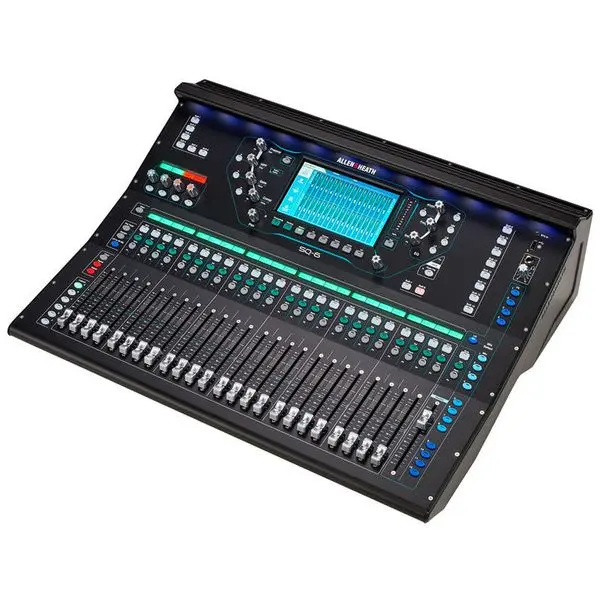
Allen & Heath SQ-6 - Digital Console - Advanced Sound System
Élevez votre signature sonore avec la précision chirurgicale du moteur FPGA 96kHz, conçu pour l'élite de l'audio professionnel. L'Allen & Heath SQ-6 est une table de mixage numérique monumentale offrant 48 canaux de traitement haute résolution dans un châssis robuste, idéal pour les live en tout genre et le studio. Équipée de 25 faders motorisés et d'une interface tactile intuitive de 7 pouces, elle garantit une latence imperceptible de moins de 0,7 ms, assurant une clarté absolue pour vos retours IEM et vos mixages de façade. Faites confiance à l'autorité de Garage à Musique pour transformer votre flux de travail avec cette console future-proof, prêt pour vos sons les meilleurs.
This content will be shared across all product pages.
Table de mixage SQ-6 : le coeur de Votre Système Audio
In the complex landscape of modern audio production, choosing a mixing console is no longer simply about counting inputs and outputs. It's about defining the foundation of your signal chain. The Allen & Heath SQ-6 stands out as a benchmark by addressing the fundamental problem of digital processing: latency and harmonic resolution. Thanks to its revolutionary XCVI 96kHz FPGA core, the SQ-6 processes audio with 96-bit precision, delivering a dynamic range of 112dB that preserves every nuance of your performance, where traditional 48kHz systems reach their limits.
For professional musicians in Quebec, the SQ-6 is more than just a mixing tool; it's a solution to technical bottlenecks. Its ultra-low latency of <0.7 ms eliminates comb-filtering in in-ear monitor (IEM) systems, allowing singers and instrumentalists to hear themselves with natural, instant fidelity. Whether you're a touring sound engineer, a technical director in a house of worship, or a studio producer, the SQ-6's ergonomic design—with its 25 motorized faders and 6 control layers—allows you to navigate complex mixes with instinctive speed. By choosing Garage à Musique, you benefit not only from cutting-edge equipment but also from the expertise of a local partner who understands the reliability and performance requirements of the Quebec market.
Full Technical Specifications: Manufacturer's Precision
The SQ-6's technical excellence is based on an uncompromising architecture. Here are the complete technical specifications for absolute transparency.
Audio Performance and Digital Processing
| Characteristic | Detailed Specification |
| Mixing Motor | XCVI 96kHz FPGA Core |
| Sampling Frequency | 96kHz Native |
| Internal Resolution | 96-bit accumulator |
| System Latency | < 0.7ms (Local Mic In to Main L/R) |
| Dynamic Beach | 112 dB |
| Frequency Response | +0/-0.5dB (20Hz to 20kHz) |
| THD+N (Gain Unity 0dB) | 0.002% -92dBu (20Hz-20kHz, AES Direct Out) |
| Residual Output Noise | -90dBu (Muted, 20Hz-20kHz) |
| Maximum Output Level | +22dBu |
| Bit Depth | Custom bit widths up to 96 bits |
Local Inputs and Outputs (Local I/O)
| Connection Type | Technical Details |
| Mic/Line Inputs | 24 x XLR, Fully recallable |
| Stereo Line Inputs (ST1, ST2) | Balanced 1/4" TRS Jack, +4dBu Sensitivity |
| Stereo Line Input (ST3) | Unbalanced 3.5mm Mini Jack, 0dBu Sensitivity |
| XLR outputs | 14 x XLR, Fully assignable |
| Line Outputs (A out, B out) | 2 x Balanced 1/4" TRS Jack |
| AES Digital Output | 1 x XLR (2 channels), switchable 44.1/48/88.2/96kHz |
| Headphone jack | 1 x 1/4" TRS with dedicated volume control |
| Talkback Entry | 1 x dedicated XLR with phantom power |
Network Connectivity and Extension
| Port / Protocol | Features and Capabilities |
| SLink Port | Neutrik EtherCON (RJ45), supports dSnake (48kHz), DX (96kHz), GigaACE/GX (96kHz) |
| SLink I/O capability | Up to 128x128 channels depending on the protocol |
| I/O Port (Option Card) | Slot for Dante, Waves, MADI, SLink cards (64x64) |
| USB Type B | 32x32 Audio Interface (Core Audio/ASIO), DAW Control |
| USB Type A (SQ-Drive) | 16-track (96kHz) or 32-track (48kHz) multitrack recording |
| Ethernet (Network) | RJ45 for control via SQ MixPad, SQ4You, TCP/IP |
| Footswitch | 1 x 1/4" TRS for single/dual pedal control |
Control Interface and Ergonomics
| Component | Features |
| Faders | 24 + 1 motorized (100mm) |
| Layers | 6 Assignable Layers (Total of 144 channel strips) |
| Touch screen | 7" Capacitive Touchscreen, 800 x 480 Resolution, 24-bit RGB |
| SoftKeys | 16 assignable keys with backlighting |
| Soft Rotaries | 4 assignable rotary encoders with dedicated LCD screens |
| Channel Display | 24 Backlit LCD Screens (Scribble Strips) |
| Level Measurement | Chromatic Channel Metering (Dimmable LED) |
| Lighting | Light bar integrated into the chassis |
Physical and Environmental
| Setting | Metric/Imperial Value |
| Chassis | 3-tier metal, all-metal chassis |
| Materials | Aluminium, steel and carbon fibre |
| Dimensions (L x W x H) | 638 mm x 514.9 mm x 198 mm (25.1" x 20.3" x 7.8") |
| Dimensions (Packaged) | 820mm x 680mm x 360mm (32.3" x 26.8" x 14.2") |
| Weight (Net) | 14.5 kg (32 lbs) |
| Weight (Packed) | 17.3 kg (38.1 lbs) |
| Mains Power Supply | 100-240V AC, 50/60Hz |
| Maximum Consumption | 90W |
| Temperature Range | 0°C to 40°C (32°F to 104°F) |
Comparative Analysis: The Industry's Rigorous Protocol
To accurately position the SQ-6, we have synthesized expert consensus from authoritative sources such as Sound on Sound, MusicRadar and Gearspace.
| Alternative Product | Market Segment | Comparative Analysis (Industry Expertise) | Music Garage Availability |
| Midas M32 Live | Live Console & Studio Standard | Strengths: Legendary Midas Pro preamps, 192kHz touchscreen interface. Weaknesses: Processing limited to 48kHz, slower workflow. | Available here |
| Behringer WING | Modern Digital Console | Strengths: Top screen, source-based routing, aggressive pricing. Weaknesses: Layout sometimes considered chaotic. | Available here |
| Yamaha TF5 | Entry-Level Pro Console | Strengths: "TouchFlow" workflow ideal for beginners, Yamaha reliability. Weaknesses: No 96kHz, higher latency. | Available here |
| PreSonus StudioLive 32S | Hybrid Live/Recording Console | Strengths: Native Studio One DAW integration, 34-track SD recording. Weaknesses: Less flexible ecosystem, no FPGA engine. | Available here |
| Soundcraft Si Impact | Direct Access Console | Strengths: Ergonomic "One-knob per function", British sound quality. Weaknesses: Outdated technology, no native 96kHz. | Available here |
| DiGiCo S21 | Compact Touring Console | Strengths: Dual touchscreen, brand prestige. Weaknesses: Very high cost of options, slower for feedback mixes. | Product not listed |
| Allen & Heath SQ-5 | Ultra-Compact Console (Rack) | Strengths: Same XCVI engine, 19" rack-mountable. Weaknesses: Only 17 faders. | Available here |
| Allen & Heath SQ-7 | Flagship console of the series | Strengths: 33 faders, 32 local preamps. Weaknesses: Larger footprint. | Available here |
| QSC TouchMix-30 Pro | Compact Touchscreen Console | Strengths: Extreme portability. Weaknesses: Lack of motorized physical faders. | Available here |
| Allen & Heath Qu-32 | Classic Console (Legacy) | Strengths: Exemplary simplicity, advantageous price. Weaknesses: 48kHz architecture. | Available here |
History & Evolution: From dLive to the SQ Revolution
The Allen & Heath SQ-6 is not simply an update of a previous model; it is the result of a major technological revolution within the British brand. The source of its power lies in the development of the dLive system, Allen & Heath's flagship system used on the biggest tours worldwide.
Historically, Allen & Heath has always sought to bridge the gap between inaccessible professional consoles and entry-level mixers. Following the success of the iLive series and the introduction of the GLD series (which offered unprecedented routing flexibility at 48kHz), the brand took a quantum leap with the XCVI FPGA engine. Launched around 2017, the SQ series was designed to miniaturize this 96kHz technology without sacrificing processing power.
The SQ-6's remarkable evolution continued through its firmware. Version 1.6 transformed the console into a formidable theater and installation tool by introducing Split Matrices (allowing up to six mono matrices), Cue Lists for simplified scene management, and simultaneous recording redundancy via SQ-Drive and USB-B. Today, the SQ-6 is considered the "M32 killer," offering double the resolution (96kHz vs. 48kHz) and half the latency.
Cultural References & Artists: The SQ on the Ground
The SQ-6 has proven its worth in a wide variety of environments, from intimate clubs to legendary amphitheaters. Here are some verifiable examples of its use:
- Matt Garrison (Bassiste, ShapeShifter Lab) : Utilise la SQ-6 comme pièce centrale pour ses sessions de streaming et l'enregistrement de son album Generations.
- Ravi Coltrane (Saxophoniste) : Performance captée en direct via SQ-6 lors d'un événement de lancement d'application à Brooklyn.
- Marcus Gilmore (Batteur, Chick Corea) : Enregistrement de batterie haute fidélité utilisant les préamplis transparents de la SQ-6.
- Polyphia (Groupe de Math Rock) : Utilise la série SQ pour gérer leurs configurations de scène complexes et leurs mixages IEM ultra-précis.
- Red Rocks Amphitheatre (Gasoline Lollipops) : Deux consoles SQ-6 en duo ont assuré la façade et les retours pour un spectacle complet dans ce lieu iconique du Colorado.
- Sacramento Mandarins (Drum Corps International) : Intégration de la SQ-6 pour la gestion audio en temps réel de leurs performances dynamiques en plein air.
- Common Kings (Reggae/Pop) : Tournée internationale utilisant les capacités de monitoring de la série SQ pour une clarté optimale.
- Elijah Woods (Artiste Pop) : Utilise un système compact Allen & Heath incluant des éléments de la série SQ pour ses tournées mondiales.
- Afro Latin Jazz Orchestra (3 Grammy Wins) : Enregistrement d'un big band de 20 musiciens en utilisant une SQ-6 comme console principale.
- 4U Recording (Studio A) : La SQ-6 sert d'interface multitrack principale pour capturer des sessions live avec une latence zéro.
- Princeton University (Concert Hall) : Modernisation de leur système audio avec la SQ-6 pour sa flexibilité de routage réseau.
- Barry Can't Swim (Headline Tour) : Utilisation des matrices de la SQ pour un split de diffusion complexe entre façade, streaming et VIP.
- Islington Assembly Hall : Intégration de consoles SQ pour leur fiabilité et leur facilité de configuration.
- Berklee NYC Power Station : Utilisation de l'écosystème SQ pour le monitoring de précision des étudiants et professionnels.
- Billsville House Venue : Upgrade de leur installation avec la SQ pour offrir une qualité sonore de niveau festival dans un cadre intime.
FAQ - Frequently Asked Questions
Is the SQ-6 compatible with stage boxes from other brands?
No, the SQ-6 uses the proprietary SLink protocol, which is compatible exclusively with the Allen & Heath ecosystem (Everything I/O family). However, by adding an optional Dante or Waves card to the I/O slot, you can interface the console with any device that supports these industry-standard protocols. This network flexibility eliminates compatibility issues and ensures optimal gain staging.
Can you record directly onto a USB drive without a computer?
Yes, the SQ-Drive function allows you to record 16 or 32 tracks directly to an external USB drive. To ensure flawless performance and avoid streaming errors, we strongly recommend using an external SSD rather than a standard USB flash drive. This allows you to capture your performances in high-resolution 96kHz, offering a significant advantage for virtual soundchecks or post-concert production.
How to eliminate a hum or ground loop with the SQ-6?
Use the ground lift switches available on your stage boxes or via external DIs. The SQ-6 is designed with rigorous isolation, but in older buildings in Quebec, a ground loop can occur. By using digital SLink connectivity, you galvanically isolate the console from stage sources, drastically reducing the risk of unwanted noise and RF interference.
Can phantom power damage my ribbon microphones?
The SQ-6's 48V phantom power can be individually activated per channel, protecting your sensitive equipment. It is crucial to ensure the 48V is switched off before connecting a passive ribbon microphone. The console provides clear visual feedback on the touchscreen and via channel LEDs, allowing you to safely manage your equipment.
Is the latency of the SQ-6 really imperceptible for EMP feedback?
With less than 0.7 ms of latency, the SQ-6 offers a near-instantaneous response, crucial for vocalists. High latency in IEMs creates a comb filtering effect that distorts the perception of pitch. The power of the XCVI FPGA engine ensures that the signal reaches the artist's ears without any audible delay, enhancing the authority of your mix.
Can I control the SQ-6 from my iPad or Android tablet?
Yes, the free SQ MixPad app offers complete wireless control of all mixing functions. By connecting a Wi-Fi router to the console's Network port, you can adjust levels, EQ, and compression from anywhere in the room. This is a major advantage for engineers who need to validate the sound in acoustically challenging areas.
How does the SQ-6 handle multiple speakers simultaneously?
The console incorporates two automatic microphone mixers (AMMs), each with 24 channels. The AMM protocol intelligently adjusts the gain of each microphone in real time, reducing background noise and preventing feedback. It's the ideal solution for corporate conferences or roundtables.
What is the difference between DEEP add-ons and standard effects?
DEEP plugins are integrated directly into the core of channel processing, without adding any extra latency. Unlike traditional rack effects that require send/return routing, DEEP compressors (like the OptTronik or Bus Comp) are an integral part of the channel strip. This delivers analog warmth and superior dynamic accuracy.
Is the SQ-6 robust enough for the rigors of touring in Canada?
The SQ-6's metal chassis is designed to withstand shocks and harsh environmental conditions. Allen & Heath tested this console according to rigorous stress protocols. From the intense cold of Quebec to the humidity of summer festivals, its steel and aluminum construction ensures exceptional durability. Garage à Musique always recommends using a flight case for maximum protection.
Why choose the SQ-6 over the SQ-5 or the SQ-7?
The SQ-6 offers the best balance between the number of physical faders (25) and portability. While the SQ-5 is limited to 17 faders and the SQ-7 is much larger, the SQ-6 allows for 48-channel mixes with optimal visibility without cluttering the control room. It's the preferred choice for professionals who demand complete tactile control.
Garage à Musique, your local expert in Montreal and throughout Quebec, will guide you through the integration of your Allen & Heath SQ-6 to guarantee uncompromising sound performance.
Table de mixage SQ-6 : le coeur de Votre Système Audio
In the complex landscape of modern audio production, choosing a mixing console is no longer simply about counting inputs and outputs. It's about defining the foundation of your signal chain. The Allen & Heath SQ-6 stands out as a benchmark by addressing the fundamental problem of digital processing: latency and harmonic resolution. Thanks to its revolutionary XCVI 96kHz FPGA core, the SQ-6 processes audio with 96-bit precision, delivering a dynamic range of 112dB that preserves every nuance of your performance, where traditional 48kHz systems reach their limits.
For professional musicians in Quebec, the SQ-6 is more than just a mixing tool; it's a solution to technical bottlenecks. Its ultra-low latency of <0.7 ms eliminates comb-filtering in in-ear monitor (IEM) systems, allowing singers and instrumentalists to hear themselves with natural, instant fidelity. Whether you're a touring sound engineer, a technical director in a house of worship, or a studio producer, the SQ-6's ergonomic design—with its 25 motorized faders and 6 control layers—allows you to navigate complex mixes with instinctive speed. By choosing Garage à Musique, you benefit not only from cutting-edge equipment but also from the expertise of a local partner who understands the reliability and performance requirements of the Quebec market.
Full Technical Specifications: Manufacturer's Precision
The SQ-6's technical excellence is based on an uncompromising architecture. Here are the complete technical specifications for absolute transparency.
Audio Performance and Digital Processing
| Characteristic | Detailed Specification |
| Mixing Motor | XCVI 96kHz FPGA Core |
| Sampling Frequency | 96kHz Native |
| Internal Resolution | 96-bit accumulator |
| System Latency | < 0.7ms (Local Mic In to Main L/R) |
| Dynamic Beach | 112 dB |
| Frequency Response | +0/-0.5dB (20Hz to 20kHz) |
| THD+N (Gain Unity 0dB) | 0.002% -92dBu (20Hz-20kHz, AES Direct Out) |
| Residual Output Noise | -90dBu (Muted, 20Hz-20kHz) |
| Maximum Output Level | +22dBu |
| Bit Depth | Custom bit widths up to 96 bits |
Local Inputs and Outputs (Local I/O)
| Connection Type | Technical Details |
| Mic/Line Inputs | 24 x XLR, Fully recallable |
| Stereo Line Inputs (ST1, ST2) | Balanced 1/4" TRS Jack, +4dBu Sensitivity |
| Stereo Line Input (ST3) | Unbalanced 3.5mm Mini Jack, 0dBu Sensitivity |
| XLR outputs | 14 x XLR, Fully assignable |
| Line Outputs (A out, B out) | 2 x Balanced 1/4" TRS Jack |
| AES Digital Output | 1 x XLR (2 channels), switchable 44.1/48/88.2/96kHz |
| Headphone jack | 1 x 1/4" TRS with dedicated volume control |
| Talkback Entry | 1 x dedicated XLR with phantom power |
Network Connectivity and Extension
| Port / Protocol | Features and Capabilities |
| SLink Port | Neutrik EtherCON (RJ45), supports dSnake (48kHz), DX (96kHz), GigaACE/GX (96kHz) |
| SLink I/O capability | Up to 128x128 channels depending on the protocol |
| I/O Port (Option Card) | Slot for Dante, Waves, MADI, SLink cards (64x64) |
| USB Type B | 32x32 Audio Interface (Core Audio/ASIO), DAW Control |
| USB Type A (SQ-Drive) | 16-track (96kHz) or 32-track (48kHz) multitrack recording |
| Ethernet (Network) | RJ45 for control via SQ MixPad, SQ4You, TCP/IP |
| Footswitch | 1 x 1/4" TRS for single/dual pedal control |
Control Interface and Ergonomics
| Component | Features |
| Faders | 24 + 1 motorized (100mm) |
| Layers | 6 Assignable Layers (Total of 144 channel strips) |
| Touch screen | 7" Capacitive Touchscreen, 800 x 480 Resolution, 24-bit RGB |
| SoftKeys | 16 assignable keys with backlighting |
| Soft Rotaries | 4 assignable rotary encoders with dedicated LCD screens |
| Channel Display | 24 Backlit LCD Screens (Scribble Strips) |
| Level Measurement | Chromatic Channel Metering (Dimmable LED) |
| Lighting | Light bar integrated into the chassis |
Physical and Environmental
| Setting | Metric/Imperial Value |
| Chassis | 3-tier metal, all-metal chassis |
| Materials | Aluminium, steel and carbon fibre |
| Dimensions (L x W x H) | 638 mm x 514.9 mm x 198 mm (25.1" x 20.3" x 7.8") |
| Dimensions (Packaged) | 820mm x 680mm x 360mm (32.3" x 26.8" x 14.2") |
| Weight (Net) | 14.5 kg (32 lbs) |
| Weight (Packed) | 17.3 kg (38.1 lbs) |
| Mains Power Supply | 100-240V AC, 50/60Hz |
| Maximum Consumption | 90W |
| Temperature Range | 0°C to 40°C (32°F to 104°F) |
Comparative Analysis: The Industry's Rigorous Protocol
To accurately position the SQ-6, we have synthesized expert consensus from authoritative sources such as Sound on Sound, MusicRadar and Gearspace.
| Alternative Product | Market Segment | Comparative Analysis (Industry Expertise) | Music Garage Availability |
| Midas M32 Live | Live Console & Studio Standard | Strengths: Legendary Midas Pro preamps, 192kHz touchscreen interface. Weaknesses: Processing limited to 48kHz, slower workflow. | Available here |
| Behringer WING | Modern Digital Console | Strengths: Top screen, source-based routing, aggressive pricing. Weaknesses: Layout sometimes considered chaotic. | Available here |
| Yamaha TF5 | Entry-Level Pro Console | Strengths: "TouchFlow" workflow ideal for beginners, Yamaha reliability. Weaknesses: No 96kHz, higher latency. | Available here |
| PreSonus StudioLive 32S | Hybrid Live/Recording Console | Strengths: Native Studio One DAW integration, 34-track SD recording. Weaknesses: Less flexible ecosystem, no FPGA engine. | Available here |
| Soundcraft Si Impact | Direct Access Console | Strengths: Ergonomic "One-knob per function", British sound quality. Weaknesses: Outdated technology, no native 96kHz. | Available here |
| DiGiCo S21 | Compact Touring Console | Strengths: Dual touchscreen, brand prestige. Weaknesses: Very high cost of options, slower for feedback mixes. | Product not listed |
| Allen & Heath SQ-5 | Ultra-Compact Console (Rack) | Strengths: Same XCVI engine, 19" rack-mountable. Weaknesses: Only 17 faders. | Available here |
| Allen & Heath SQ-7 | Flagship console of the series | Strengths: 33 faders, 32 local preamps. Weaknesses: Larger footprint. | Available here |
| QSC TouchMix-30 Pro | Compact Touchscreen Console | Strengths: Extreme portability. Weaknesses: Lack of motorized physical faders. | Available here |
| Allen & Heath Qu-32 | Classic Console (Legacy) | Strengths: Exemplary simplicity, advantageous price. Weaknesses: 48kHz architecture. | Available here |
History & Evolution: From dLive to the SQ Revolution
The Allen & Heath SQ-6 is not simply an update of a previous model; it is the result of a major technological revolution within the British brand. The source of its power lies in the development of the dLive system, Allen & Heath's flagship system used on the biggest tours worldwide.
Historically, Allen & Heath has always sought to bridge the gap between inaccessible professional consoles and entry-level mixers. Following the success of the iLive series and the introduction of the GLD series (which offered unprecedented routing flexibility at 48kHz), the brand took a quantum leap with the XCVI FPGA engine. Launched around 2017, the SQ series was designed to miniaturize this 96kHz technology without sacrificing processing power.
The SQ-6's remarkable evolution continued through its firmware. Version 1.6 transformed the console into a formidable theater and installation tool by introducing Split Matrices (allowing up to six mono matrices), Cue Lists for simplified scene management, and simultaneous recording redundancy via SQ-Drive and USB-B. Today, the SQ-6 is considered the "M32 killer," offering double the resolution (96kHz vs. 48kHz) and half the latency.
Cultural References & Artists: The SQ on the Ground
The SQ-6 has proven its worth in a wide variety of environments, from intimate clubs to legendary amphitheaters. Here are some verifiable examples of its use:
- Matt Garrison (Bassiste, ShapeShifter Lab) : Utilise la SQ-6 comme pièce centrale pour ses sessions de streaming et l'enregistrement de son album Generations.
- Ravi Coltrane (Saxophoniste) : Performance captée en direct via SQ-6 lors d'un événement de lancement d'application à Brooklyn.
- Marcus Gilmore (Batteur, Chick Corea) : Enregistrement de batterie haute fidélité utilisant les préamplis transparents de la SQ-6.
- Polyphia (Groupe de Math Rock) : Utilise la série SQ pour gérer leurs configurations de scène complexes et leurs mixages IEM ultra-précis.
- Red Rocks Amphitheatre (Gasoline Lollipops) : Deux consoles SQ-6 en duo ont assuré la façade et les retours pour un spectacle complet dans ce lieu iconique du Colorado.
- Sacramento Mandarins (Drum Corps International) : Intégration de la SQ-6 pour la gestion audio en temps réel de leurs performances dynamiques en plein air.
- Common Kings (Reggae/Pop) : Tournée internationale utilisant les capacités de monitoring de la série SQ pour une clarté optimale.
- Elijah Woods (Artiste Pop) : Utilise un système compact Allen & Heath incluant des éléments de la série SQ pour ses tournées mondiales.
- Afro Latin Jazz Orchestra (3 Grammy Wins) : Enregistrement d'un big band de 20 musiciens en utilisant une SQ-6 comme console principale.
- 4U Recording (Studio A) : La SQ-6 sert d'interface multitrack principale pour capturer des sessions live avec une latence zéro.
- Princeton University (Concert Hall) : Modernisation de leur système audio avec la SQ-6 pour sa flexibilité de routage réseau.
- Barry Can't Swim (Headline Tour) : Utilisation des matrices de la SQ pour un split de diffusion complexe entre façade, streaming et VIP.
- Islington Assembly Hall : Intégration de consoles SQ pour leur fiabilité et leur facilité de configuration.
- Berklee NYC Power Station : Utilisation de l'écosystème SQ pour le monitoring de précision des étudiants et professionnels.
- Billsville House Venue : Upgrade de leur installation avec la SQ pour offrir une qualité sonore de niveau festival dans un cadre intime.
FAQ - Frequently Asked Questions
Is the SQ-6 compatible with stage boxes from other brands?
No, the SQ-6 uses the proprietary SLink protocol, which is compatible exclusively with the Allen & Heath ecosystem (Everything I/O family). However, by adding an optional Dante or Waves card to the I/O slot, you can interface the console with any device that supports these industry-standard protocols. This network flexibility eliminates compatibility issues and ensures optimal gain staging.
Can you record directly onto a USB drive without a computer?
Yes, the SQ-Drive function allows you to record 16 or 32 tracks directly to an external USB drive. To ensure flawless performance and avoid streaming errors, we strongly recommend using an external SSD rather than a standard USB flash drive. This allows you to capture your performances in high-resolution 96kHz, offering a significant advantage for virtual soundchecks or post-concert production.
How to eliminate a hum or ground loop with the SQ-6?
Use the ground lift switches available on your stage boxes or via external DIs. The SQ-6 is designed with rigorous isolation, but in older buildings in Quebec, a ground loop can occur. By using digital SLink connectivity, you galvanically isolate the console from stage sources, drastically reducing the risk of unwanted noise and RF interference.
Can phantom power damage my ribbon microphones?
The SQ-6's 48V phantom power can be individually activated per channel, protecting your sensitive equipment. It is crucial to ensure the 48V is switched off before connecting a passive ribbon microphone. The console provides clear visual feedback on the touchscreen and via channel LEDs, allowing you to safely manage your equipment.
Is the latency of the SQ-6 really imperceptible for EMP feedback?
With less than 0.7 ms of latency, the SQ-6 offers a near-instantaneous response, crucial for vocalists. High latency in IEMs creates a comb filtering effect that distorts the perception of pitch. The power of the XCVI FPGA engine ensures that the signal reaches the artist's ears without any audible delay, enhancing the authority of your mix.
Can I control the SQ-6 from my iPad or Android tablet?
Yes, the free SQ MixPad app offers complete wireless control of all mixing functions. By connecting a Wi-Fi router to the console's Network port, you can adjust levels, EQ, and compression from anywhere in the room. This is a major advantage for engineers who need to validate the sound in acoustically challenging areas.
How does the SQ-6 handle multiple speakers simultaneously?
The console incorporates two automatic microphone mixers (AMMs), each with 24 channels. The AMM protocol intelligently adjusts the gain of each microphone in real time, reducing background noise and preventing feedback. It's the ideal solution for corporate conferences or roundtables.
What is the difference between DEEP add-ons and standard effects?
DEEP plugins are integrated directly into the core of channel processing, without adding any extra latency. Unlike traditional rack effects that require send/return routing, DEEP compressors (like the OptTronik or Bus Comp) are an integral part of the channel strip. This delivers analog warmth and superior dynamic accuracy.
Is the SQ-6 robust enough for the rigors of touring in Canada?
The SQ-6's metal chassis is designed to withstand shocks and harsh environmental conditions. Allen & Heath tested this console according to rigorous stress protocols. From the intense cold of Quebec to the humidity of summer festivals, its steel and aluminum construction ensures exceptional durability. Garage à Musique always recommends using a flight case for maximum protection.
Why choose the SQ-6 over the SQ-5 or the SQ-7?
The SQ-6 offers the best balance between the number of physical faders (25) and portability. While the SQ-5 is limited to 17 faders and the SQ-7 is much larger, the SQ-6 allows for 48-channel mixes with optimal visibility without cluttering the control room. It's the preferred choice for professionals who demand complete tactile control.
Garage à Musique, your local expert in Montreal and throughout Quebec, will guide you through the integration of your Allen & Heath SQ-6 to guarantee uncompromising sound performance.
Avis clients
Aucun avis pour le moment. Soyez le premier à partager votre expérience après votre achat.