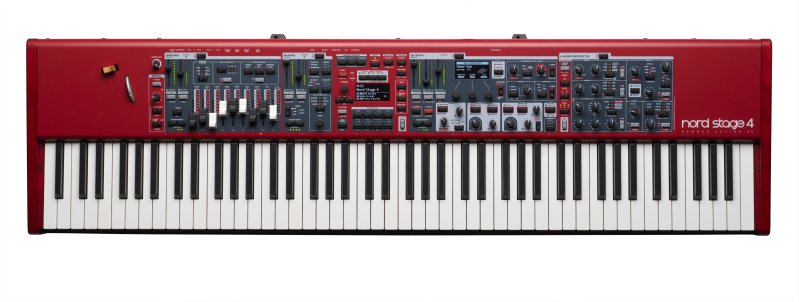
Nord Stage 4 - Stage Piano -
Designed for uncompromising musicians, it blends Nord's legendary piano libraries, Wave 2 synthesis, and physical drawbars with LED indicators. It's the ultimate instrument for dominating the stage and studio with absolute playing fluidity.
This content will be shared across all product pages.
Nord Stage 4: The masterful evolution of the Swedish legend
Why did the Nord Stage 4 become, upon its release, the centerpiece of professional setups in Quebec and around the world? Because it solves the keyboardist's eternal dilemma: accessing infinite sonic complexity without ever losing fluidity in the middle of a live performance. With its physical faders featuring LED indicators and its new synthesis section based on the Nord Wave 2 engine, the Stage 4 isn't just an update; it's a reinvention. Whether you need to layer cinematic string pads or instantly switch from a roaring B3 organ to a mellow concert grand piano, the Stage 4 responds with zero latency and surgical acoustic fidelity.
Full Technical Specifications
General & Interface
| Characteristic | Details |
| Keyboard | Triple sensor (Hammer Action or Compact depending on model) with Aftertouch |
| Layer controls | Physical faders with LED bars for each layer (A, B, C) |
| Program memory | 8 banks of 64 programs (512 locations in total) |
| Live Mode | 8 dedicated live programs |
| Transitions | Seamless Transitions (no audio skipping when changing patches) |
Piano Section
| Characteristic | Details |
| Memory | 2 GB for the Nord Piano Library |
| Polyphony | 120 votes |
| Categories | Large, Upright, Electric, Digital, Layer, Clav/Harpsichord |
| Features | Dynamic Compression, Unison, 3 Velocity Curves, String Resonance |
Synthesizer Section
| Characteristic | Details |
| Engine | Nord Wave 2 with sample playback |
| Memory Samples | 1 GB for the Nord Sample Library |
| Polyphony | 46 votes |
| Oscillators | Pure Wave, Analog (incl. Sync), PWM, Wavetable, FM, Noise |
| Filters | LP (12/24dB), LP, HP, Ladder M, Dedicated drive |
Organ & Effects Section
| Characteristic | Details |
| Organ Models | B3 Tonewheel, B3 Bass, Vox, Farfisa, 2 Pipe Organs |
| Drawbars | Physical pull tabs with LED indicators |
| Layer Effects | Mod 1 (Tremolo, Wah, etc.), Mod 2 (Chorus, Flanger), Amp Sim, Delay, EQ, Reverb |
| Reverb | 6 types (Spring, Booth, Room, Stage, Hall, Cathedral) with Dark/Bright and Choir mode |
Physics & Connectivity
| Characteristic | Details |
| Audio Outputs | 4 x 1/4" (assignable), Stereo Headphone Output |
| Monitor Inputs | 1 x 1/8" jack |
| NOON | In/Out (5-pin DIN) and USB-MIDI |
| Pedals | Sustain, Triple Pedal, Control, Organ Swell, Program Change |
| Dimensions (88) | 1282 mm x 121 mm x 349 mm |
| Weight (88) | 19.6 kg |
Comparative Analysis (Rigorous Protocol)
Sources: Sound on Sound, MusicRadar, Gearspace.
| Alternative Product | Market Segment | Comparative Analysis (vs Nord Stage 4) | Music Garage Availability |
| Roland RD-2000 | Piano Stage | Excellent V-Piano feel, but a more complex and less immediate interface than Nord. | Voir le produit |
| Yamaha CP88 | Piano Stage | Ultra-simple workflow, superb piano sounds, but limited synth section compared to the Wave 2. | Voir le produit |
| Korg Kronos 2 | Workstation | Superior synthesis power, integrated sequencer, but long startup time and less "live" touchscreen. | Voir le produit |
| Kawai MP11SE | Piano Stage | The best wood feel on the market, but very heavy and less versatile sound palette. | Voir le produit |
| Dexibell VIVO S10 | Piano Stage | High resolution audio (24-bit/48kHz), but a smaller sound library than the Nord ecosystem. | Product not listed |
| Sequential Prophet XL | Hybrid Synthesizer | Raw analog power, but does not offer the dedicated organ and piano engines of the Stage 4. | Voir le produit |
| Hammond SK Pro | Organ/Stage | Unrivaled organ engine, but piano section and overall interface less versatile for the pop/rock scene. | Voir le produit |
| Crumar Seven | Digital Piano | Unique vintage design, physical modeling, but lacks multitimbral versatility. | Product not listed |
| Kurzweil Forte | Piano Stage | Very deep VAST motor, but steep learning curve compared to Nord's "One knob per function". | Voir le produit |
| Studiologic Numa X Piano GT | Piano Stage | Excellent value for money/feel, but lacks the sonic authority of Nord sample libraries. | Voir le produit |
History & Evolution
The Nord Stage line began in 2005, revolutionizing the world of keyboards by combining three independent sections (Piano, Organ, Synth) under an iconic red chassis. The Stage 2 introduced sample support, while the Stage 3 incorporated the Lead A1 engine. The Stage 4 marks the most significant technological leap of the decade: it abandons the rigid "Slot" structure for a fully flexible "Layer" system, integrating the synthesis power of the Wave 2 and doubled physical control hardware, addressing 20 years of feedback from professional users.
Cultural References & Artists
The Nord Stage is ubiquitous. Here are a few examples of its use:
Cory Henry (Snarky Puppy) : Utilisation intensive du moteur d'orgue et synthé en live.
Jordan Rudess (Dream Theater) : Intégré dans son rig pour la polyvalence des textures.
Alicia Keys : Utilisé fréquemment pour ses pianos électriques sur scène.
Bon Iver (22, A Million) : Manipulation des moteurs de samples pour des textures organiques.
Vulfpeck (Jack Stratton) : Clavinets et pianos électriques sur de nombreuses tournées.
Radiohead : Présent dans le setup de tournée pour les sons Rhodes et Mellotron.
Tame Impala : Pour les nappes de synthés vintage et phasers.
Billie Eilish (Finneas) : Utilisé pour les pianos feutrés et les basses de synthé.
Snarky Puppy (We Like It Here) : Omniprésence des nappes et leads Nord.
The Killers (Day & Age) : Les pianos brillants caractéristiques du groupe.
Muse (Matt Bellamy) : Utilisé pour les textures de synthé arpégées.
Keane (Hopes and Fears) : Le son de piano CP-80 émulé à la perfection.
Hillsong Worship : Le standard absolu pour les textures "Ambient" et "Pads".
Jacob Collier : Pour l'exploration harmonique grâce à la précision du moteur de synthèse.
John Legend : Fidèle au Nord Stage pour ses performances solo piano-voix.
Enhanced FAQ (Expert)
1. What is the major difference between Stage 3 and Stage 4?
The interface is the most radical change: Stage 4 offers physical faders for each layer, a complete effects section for each layer (instead of shared effects) and the Wave 2 synthesis engine.
2. Is the Nord Stage 4 compatible with previous sound libraries?
Yes, it supports the Nord Piano Library and the Nord Sample Library 4.0, giving you access to thousands of free and regularly updated sounds.
3. Can I use the Stage 4 as a master keyboard in the studio?
Absolutely. Its "Extern" section allows you to control external modules or virtual instruments (VST) via MIDI with a dedicated split area.
4. What is the difference between the 88, 73 and Compact versions?
The 88 and 73 versions feature a hammer action, ideal for pianists. The Compact version has 73 semi-weighted keys (waterfall), perfect for organ and synthesizer playing.
5. Are the drawbars physical on all models?
Yes, unlike Stage 3 where some models had buttons, Stage 4 incorporates physical pull tabs with LED indicators across the entire range.
6. Does the keyboard support Aftertouch?
Yes, Aftertouch is built-in and can be assigned to modulate filters, vibrato, or effect parameters.
7. Can we import our own samples?
Absolutely. Thanks to the Nord Sample Editor software, you can transform any audio file into a playable instrument on the Stage 4.
8. Is the power supply internal?
Yes, no bulky external power supply is needed. A simple standard IEC cable is all you need.
9. Does Stage 4 have built-in speakers?
No, it's a professional instrument designed to be plugged into a PA system, studio monitors or a keyboard amp.
10. Why choose Nord rather than a workstation like the Fantom or the Montage?
For immediacy. At Nord, there are no deep menus. Each important function has its own button or potentiometer, which is crucial for live performance.
Nord Stage 4: The masterful evolution of the Swedish legend
Why did the Nord Stage 4 become, upon its release, the centerpiece of professional setups in Quebec and around the world? Because it solves the keyboardist's eternal dilemma: accessing infinite sonic complexity without ever losing fluidity in the middle of a live performance. With its physical faders featuring LED indicators and its new synthesis section based on the Nord Wave 2 engine, the Stage 4 isn't just an update; it's a reinvention. Whether you need to layer cinematic string pads or instantly switch from a roaring B3 organ to a mellow concert grand piano, the Stage 4 responds with zero latency and surgical acoustic fidelity.
Full Technical Specifications
General & Interface
| Characteristic | Details |
| Keyboard | Triple sensor (Hammer Action or Compact depending on model) with Aftertouch |
| Layer controls | Physical faders with LED bars for each layer (A, B, C) |
| Program memory | 8 banks of 64 programs (512 locations in total) |
| Live Mode | 8 dedicated live programs |
| Transitions | Seamless Transitions (no audio skipping when changing patches) |
Piano Section
| Characteristic | Details |
| Memory | 2 GB for the Nord Piano Library |
| Polyphony | 120 votes |
| Categories | Large, Upright, Electric, Digital, Layer, Clav/Harpsichord |
| Features | Dynamic Compression, Unison, 3 Velocity Curves, String Resonance |
Synthesizer Section
| Characteristic | Details |
| Engine | Nord Wave 2 with sample playback |
| Memory Samples | 1 GB for the Nord Sample Library |
| Polyphony | 46 votes |
| Oscillators | Pure Wave, Analog (incl. Sync), PWM, Wavetable, FM, Noise |
| Filters | LP (12/24dB), LP, HP, Ladder M, Dedicated drive |
Organ & Effects Section
| Characteristic | Details |
| Organ Models | B3 Tonewheel, B3 Bass, Vox, Farfisa, 2 Pipe Organs |
| Drawbars | Physical pull tabs with LED indicators |
| Layer Effects | Mod 1 (Tremolo, Wah, etc.), Mod 2 (Chorus, Flanger), Amp Sim, Delay, EQ, Reverb |
| Reverb | 6 types (Spring, Booth, Room, Stage, Hall, Cathedral) with Dark/Bright and Choir mode |
Physics & Connectivity
| Characteristic | Details |
| Audio Outputs | 4 x 1/4" (assignable), Stereo Headphone Output |
| Monitor Inputs | 1 x 1/8" jack |
| NOON | In/Out (5-pin DIN) and USB-MIDI |
| Pedals | Sustain, Triple Pedal, Control, Organ Swell, Program Change |
| Dimensions (88) | 1282 mm x 121 mm x 349 mm |
| Weight (88) | 19.6 kg |
Comparative Analysis (Rigorous Protocol)
Sources: Sound on Sound, MusicRadar, Gearspace.
| Alternative Product | Market Segment | Comparative Analysis (vs Nord Stage 4) | Music Garage Availability |
| Roland RD-2000 | Piano Stage | Excellent V-Piano feel, but a more complex and less immediate interface than Nord. | Voir le produit |
| Yamaha CP88 | Piano Stage | Ultra-simple workflow, superb piano sounds, but limited synth section compared to the Wave 2. | Voir le produit |
| Korg Kronos 2 | Workstation | Superior synthesis power, integrated sequencer, but long startup time and less "live" touchscreen. | Voir le produit |
| Kawai MP11SE | Piano Stage | The best wood feel on the market, but very heavy and less versatile sound palette. | Voir le produit |
| Dexibell VIVO S10 | Piano Stage | High resolution audio (24-bit/48kHz), but a smaller sound library than the Nord ecosystem. | Product not listed |
| Sequential Prophet XL | Hybrid Synthesizer | Raw analog power, but does not offer the dedicated organ and piano engines of the Stage 4. | Voir le produit |
| Hammond SK Pro | Organ/Stage | Unrivaled organ engine, but piano section and overall interface less versatile for the pop/rock scene. | Voir le produit |
| Crumar Seven | Digital Piano | Unique vintage design, physical modeling, but lacks multitimbral versatility. | Product not listed |
| Kurzweil Forte | Piano Stage | Very deep VAST motor, but steep learning curve compared to Nord's "One knob per function". | Voir le produit |
| Studiologic Numa X Piano GT | Piano Stage | Excellent value for money/feel, but lacks the sonic authority of Nord sample libraries. | Voir le produit |
History & Evolution
The Nord Stage line began in 2005, revolutionizing the world of keyboards by combining three independent sections (Piano, Organ, Synth) under an iconic red chassis. The Stage 2 introduced sample support, while the Stage 3 incorporated the Lead A1 engine. The Stage 4 marks the most significant technological leap of the decade: it abandons the rigid "Slot" structure for a fully flexible "Layer" system, integrating the synthesis power of the Wave 2 and doubled physical control hardware, addressing 20 years of feedback from professional users.
Cultural References & Artists
The Nord Stage is ubiquitous. Here are a few examples of its use:
Cory Henry (Snarky Puppy) : Utilisation intensive du moteur d'orgue et synthé en live.
Jordan Rudess (Dream Theater) : Intégré dans son rig pour la polyvalence des textures.
Alicia Keys : Utilisé fréquemment pour ses pianos électriques sur scène.
Bon Iver (22, A Million) : Manipulation des moteurs de samples pour des textures organiques.
Vulfpeck (Jack Stratton) : Clavinets et pianos électriques sur de nombreuses tournées.
Radiohead : Présent dans le setup de tournée pour les sons Rhodes et Mellotron.
Tame Impala : Pour les nappes de synthés vintage et phasers.
Billie Eilish (Finneas) : Utilisé pour les pianos feutrés et les basses de synthé.
Snarky Puppy (We Like It Here) : Omniprésence des nappes et leads Nord.
The Killers (Day & Age) : Les pianos brillants caractéristiques du groupe.
Muse (Matt Bellamy) : Utilisé pour les textures de synthé arpégées.
Keane (Hopes and Fears) : Le son de piano CP-80 émulé à la perfection.
Hillsong Worship : Le standard absolu pour les textures "Ambient" et "Pads".
Jacob Collier : Pour l'exploration harmonique grâce à la précision du moteur de synthèse.
John Legend : Fidèle au Nord Stage pour ses performances solo piano-voix.
Enhanced FAQ (Expert)
1. What is the major difference between Stage 3 and Stage 4?
The interface is the most radical change: Stage 4 offers physical faders for each layer, a complete effects section for each layer (instead of shared effects) and the Wave 2 synthesis engine.
2. Is the Nord Stage 4 compatible with previous sound libraries?
Yes, it supports the Nord Piano Library and the Nord Sample Library 4.0, giving you access to thousands of free and regularly updated sounds.
3. Can I use the Stage 4 as a master keyboard in the studio?
Absolutely. Its "Extern" section allows you to control external modules or virtual instruments (VST) via MIDI with a dedicated split area.
4. What is the difference between the 88, 73 and Compact versions?
The 88 and 73 versions feature a hammer action, ideal for pianists. The Compact version has 73 semi-weighted keys (waterfall), perfect for organ and synthesizer playing.
5. Are the drawbars physical on all models?
Yes, unlike Stage 3 where some models had buttons, Stage 4 incorporates physical pull tabs with LED indicators across the entire range.
6. Does the keyboard support Aftertouch?
Yes, Aftertouch is built-in and can be assigned to modulate filters, vibrato, or effect parameters.
7. Can we import our own samples?
Absolutely. Thanks to the Nord Sample Editor software, you can transform any audio file into a playable instrument on the Stage 4.
8. Is the power supply internal?
Yes, no bulky external power supply is needed. A simple standard IEC cable is all you need.
9. Does Stage 4 have built-in speakers?
No, it's a professional instrument designed to be plugged into a PA system, studio monitors or a keyboard amp.
10. Why choose Nord rather than a workstation like the Fantom or the Montage?
For immediacy. At Nord, there are no deep menus. Each important function has its own button or potentiometer, which is crucial for live performance.