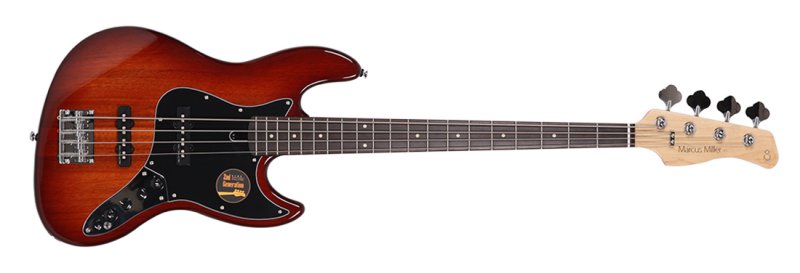
Sire Bass Guitars V3-4-2NDGEN-TS Marcus
Discover the V3 New Gen 4 string: its new Alnico pickups deliver a warm sound, enhanced by the unique comfort of its rounded-edge neck.
This content will be shared across all product pages.
The bass revolution starts here.
The Sire Marcus Miller V3 (2nd Gen) is living proof that you no longer need to spend $1000 to have a professional bass.
What makes V3 unique:
Rolled Edges Comfort: This is unprecedented in this price range. The edges of the rosewood fingerboard are hand-rounded. The result? An immediate feeling of smoothness, as if you were playing a vintage bass worn by time. No more frets that scratch your hand.
The Marcus Miller Sound: It's equipped with the same preamp (Heritage-3) as the brand's high-end models. You have access to a 3-band EQ with parametric mid-range control. It's a recording studio built into your instrument.
Mahogany Body: The V3 is distinguished by its mahogany body. This gives it a warmer sound, richer in the lower mids and a bit more "growl" than traditional alder.
"Revolution" Pickups: The 2nd generation saw the arrival of new pickups, offering superior clarity and definition, perfect for slap as well as fingerstyle playing.
Technical Specifications
| Characteristic | Technical Details |
| Format | New Marcus Miller Jazz Type |
| body | Mahogany |
| Sleeve | Canadian Hardmaple |
| Sleeve Profile | C-Shape with Rolled Edges |
| Touch | Rosewood |
| Diapason | 34" (Standard Long Scale) |
| Nut width | 38mm (Jazz Bass style, thin and fast) |
| Microphones | Marcus Standard-J Revolution Set |
| Electronics | Marcus Heritage-3 with Middle Frequency Control |
| Controls | Volume/Tone (Dual Pot), Pickup Blender, Treble, Middle/Freq (Dual Pot), Bass |
| Switch | Mini-Toggle (Active / Passive) |
| Easel | Marcus Standard Bass Bridge (Through or Top-Load) |
| Nut | Natural Bone |
Comparative Table: Sire V3 vs. The Competition
The V3 redefines what we expect from a bass under the $600-700 mark.
| Model | Sire Marcus Miller V3 (4 Strings) | Squier Classic Vibe 60s | Yamaha TRBX304 |
| Price | Best Value for Money | $$(Similar) | $$(Similar) |
| Electronics | Active/Passive (Switch) | Passive | Active (5 positions) |
| EQ | 3 Bands + Parametric Midrange | General Tone | 2 Bands |
| Comfort | Rounded Touchline Edges | Standard | Standard |
| body | Mahogany (Warm Tone) | Poplar/Nato | Mahogany |
| Verdict | The most technically complete. | The pure vintage look. | The modern look. |
FAQ – The most frequently asked questions on the web
Based on the most frequent Google searches regarding the Sire V3 4-String.
1. What is the difference between the "1st Gen" and the "2nd Gen"?
C'est la question #1. La 2nd Gen (que nous vendons) a apporté les bords de touche arrondis (confort énorme), des micros améliorés ("Revolution") et un couvercle de batterie en bois (plus esthétique). Ne cherchez pas la Gen 1, la Gen 2 est supérieure en tout point.
2. Is this a good bass for beginners?
It's even too good for beginners, and that's the advantage. Unlike a "low-end" bass that you'll want to replace after a year, the V3 can last you 10 years. Its slim neck (38mm at the nut) is very easy to learn on.
3. Is the active system complicated to use?
It may look scary with all its buttons, but it's simple:
Passive Mode (Switch off): You use Volume, Tone and Balance. Simple.
Active Mode (Switch on): You add the Bass, Treble and Midrange. This is where you sculpt your sound.
4. What happens if the battery dies?
No worries! Thanks to the Active/Passive switch, the bass continues to function in passive mode even without batteries. This is an essential safety feature for live performances. (The bass uses two 9V batteries for a more dynamic sound).
5. V3 vs V5 vs V7: Which one to choose?
V3: Mahogany body, modern/simple look, complete preamp. The budget/performance choice.
V5: 100% Passive Bass (Vintage), roasted maple neck.
V7: The benchmark. More classic woods (Alder/Ash), premium hardware, binding on the neck.
6. Is it heavy?
Mahogany can be dense, but the V3 remains within the standard weight range for Jazz Basses (approximately 4kg to 4.3kg). It is well-balanced and does not "dive" at the neck (neck dive).
The bass revolution starts here.
The Sire Marcus Miller V3 (2nd Gen) is living proof that you no longer need to spend $1000 to have a professional bass.
What makes V3 unique:
Rolled Edges Comfort: This is unprecedented in this price range. The edges of the rosewood fingerboard are hand-rounded. The result? An immediate feeling of smoothness, as if you were playing a vintage bass worn by time. No more frets that scratch your hand.
The Marcus Miller Sound: It's equipped with the same preamp (Heritage-3) as the brand's high-end models. You have access to a 3-band EQ with parametric mid-range control. It's a recording studio built into your instrument.
Mahogany Body: The V3 is distinguished by its mahogany body. This gives it a warmer sound, richer in the lower mids and a bit more "growl" than traditional alder.
"Revolution" Pickups: The 2nd generation saw the arrival of new pickups, offering superior clarity and definition, perfect for slap as well as fingerstyle playing.
Technical Specifications
| Characteristic | Technical Details |
| Format | New Marcus Miller Jazz Type |
| body | Mahogany |
| Sleeve | Canadian Hardmaple |
| Sleeve Profile | C-Shape with Rolled Edges |
| Touch | Rosewood |
| Diapason | 34" (Standard Long Scale) |
| Nut width | 38mm (Jazz Bass style, thin and fast) |
| Microphones | Marcus Standard-J Revolution Set |
| Electronics | Marcus Heritage-3 with Middle Frequency Control |
| Controls | Volume/Tone (Dual Pot), Pickup Blender, Treble, Middle/Freq (Dual Pot), Bass |
| Switch | Mini-Toggle (Active / Passive) |
| Easel | Marcus Standard Bass Bridge (Through or Top-Load) |
| Nut | Natural Bone |
Comparative Table: Sire V3 vs. The Competition
The V3 redefines what we expect from a bass under the $600-700 mark.
| Model | Sire Marcus Miller V3 (4 Strings) | Squier Classic Vibe 60s | Yamaha TRBX304 |
| Price | Best Value for Money | $$(Similar) | $$(Similar) |
| Electronics | Active/Passive (Switch) | Passive | Active (5 positions) |
| EQ | 3 Bands + Parametric Midrange | General Tone | 2 Bands |
| Comfort | Rounded Touchline Edges | Standard | Standard |
| body | Mahogany (Warm Tone) | Poplar/Nato | Mahogany |
| Verdict | The most technically complete. | The pure vintage look. | The modern look. |
FAQ – The most frequently asked questions on the web
Based on the most frequent Google searches regarding the Sire V3 4-String.
1. What is the difference between the "1st Gen" and the "2nd Gen"?
C'est la question #1. La 2nd Gen (que nous vendons) a apporté les bords de touche arrondis (confort énorme), des micros améliorés ("Revolution") et un couvercle de batterie en bois (plus esthétique). Ne cherchez pas la Gen 1, la Gen 2 est supérieure en tout point.
2. Is this a good bass for beginners?
It's even too good for beginners, and that's the advantage. Unlike a "low-end" bass that you'll want to replace after a year, the V3 can last you 10 years. Its slim neck (38mm at the nut) is very easy to learn on.
3. Is the active system complicated to use?
It may look scary with all its buttons, but it's simple:
Passive Mode (Switch off): You use Volume, Tone and Balance. Simple.
Active Mode (Switch on): You add the Bass, Treble and Midrange. This is where you sculpt your sound.
4. What happens if the battery dies?
No worries! Thanks to the Active/Passive switch, the bass continues to function in passive mode even without batteries. This is an essential safety feature for live performances. (The bass uses two 9V batteries for a more dynamic sound).
5. V3 vs V5 vs V7: Which one to choose?
V3: Mahogany body, modern/simple look, complete preamp. The budget/performance choice.
V5: 100% Passive Bass (Vintage), roasted maple neck.
V7: The benchmark. More classic woods (Alder/Ash), premium hardware, binding on the neck.
6. Is it heavy?
Mahogany can be dense, but the V3 remains within the standard weight range for Jazz Basses (approximately 4kg to 4.3kg). It is well-balanced and does not "dive" at the neck (neck dive).