Vater Zero Pad 11 in Practice Pad — Minimal Rebound
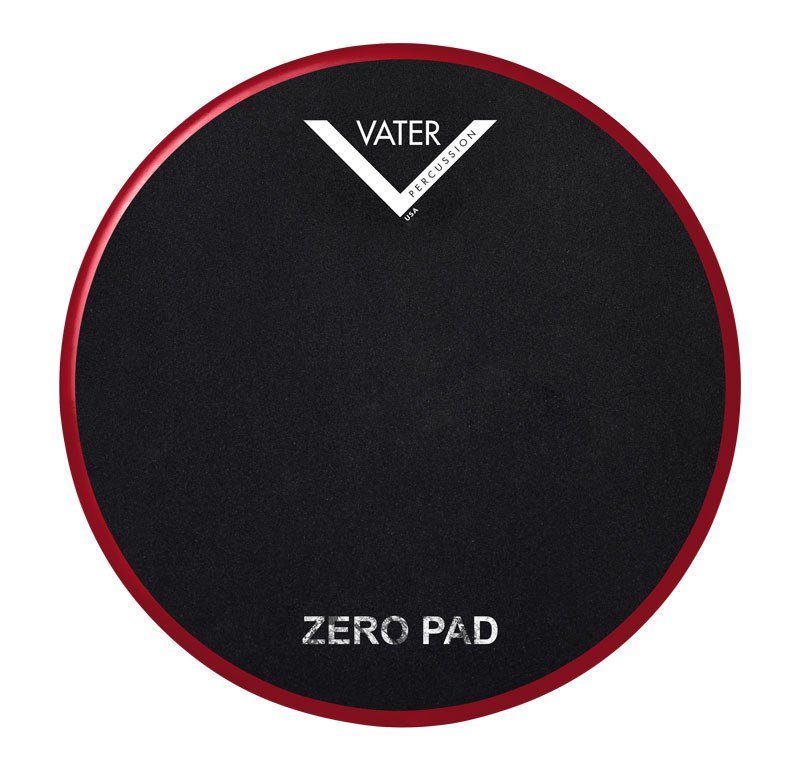
The Zero Pad is an 11 in practice pad, 3/4 in thick, with a plush surface that gives minimal rebound compared with gum rubber. It makes the drummer produce every stroke, and it comes with a printed rudiment chart.
What sets it apart
- Minimal rebound, plush surface
- 11 in (27.94 cm) diameter, 3/4 in (1.9 cm) thick
- Single-sided on a wood base
- Thin non-slip rubber back
- Chart of essential rudiments included
What rebound hides from you
On a gum rubber surface, part of the stroke's energy returns to the stick and launches the next motion. It feels good, it works well for doubles, and it is misleading: the drummer thinks they have mastered a motion that the material is actually doing for them.
Without rebound, the illusion falls away. Every stroke starts from a deliberate motion, every return is driven by the fingers. Hidden flaws come out (a tense wrist, a weak hand, uneven subdivisions) and can finally be corrected.
A real tool for silence
The plush material absorbs nearly the entire impact. The sound level drops to the point where the stick moving through the air is about as loud as the stroke itself.
That silence changes where you can practise: hotel room, dressing room, shared apartment, backstage during a show. The question is no longer whether you can play, but how long you want to practise.
The rudiment chart is not just a freebie
A pad with no rebound is only useful if you know what to work on. The included chart lists the standard rudiments, the basic grammar on which all snare drum technique rests.
For a student who sits down in the evening with no teacher nearby, having that list next to the pad prevents an improvised session that goes in circles. The program is there; all you have to do is follow it.
Specifications
| Disc diameter | 11 in (27.94 cm) |
|---|---|
| Thickness | 3/4 in (1.9 cm) |
| Surface | Plush material with minimal rebound |
| Body | Wood base, rubber back |
| Volume | Very low |
| Included | Printed rudiment chart |
What it is for
- Late-night practice in shared housing
- Correcting a weak hand or a tense wrist
- Practice on tour, in a dressing room or hotel room
- Rudiment work guided by the included chart
- A complement to a bouncy pad you already own
Compare with other manufacturers
Low-rebound surfaces offered elsewhere:
| Manufacturer | Similar product | Main difference |
|---|---|---|
| Vic Firth | Heavy conditioning pads | Resistance from mass rather than absorption |
| Evans | Dead-surface pads | Often combined with a bouncy side |
| Remo | Loose-head pads | Rebound adjustable through tension, not eliminated |
| Promark | Quiet practice pads | Smaller formats, designed for travel |
Frequently asked questions
- Can a no-rebound pad hurt my technique?
- Used alone and for too long, it can encourage heavy-handed strokes. The usual approach is to alternate it with a surface that gives back, to keep both reflexes.
- How is it different from a gum rubber pad?
- Gum rubber sends the stick back and comes closer to a tuned snare drum. This surface gives back almost nothing: it is for building mechanics, not for imitating the instrument.
- Is the rudiment chart suitable for a beginner?
- It lists the standard patterns without explaining them. It is a useful reminder alongside lessons, not a standalone method.
- Can I use it in a snare stand basket?
- Yes. At 11 in, it sits in one, and the rubber back limits the vibration passed to the stand.
Avis clients
Does your technique hold up without help from the rebound?
Aucun avis pour le moment. Soyez le premier à partager votre expérience après votre achat.