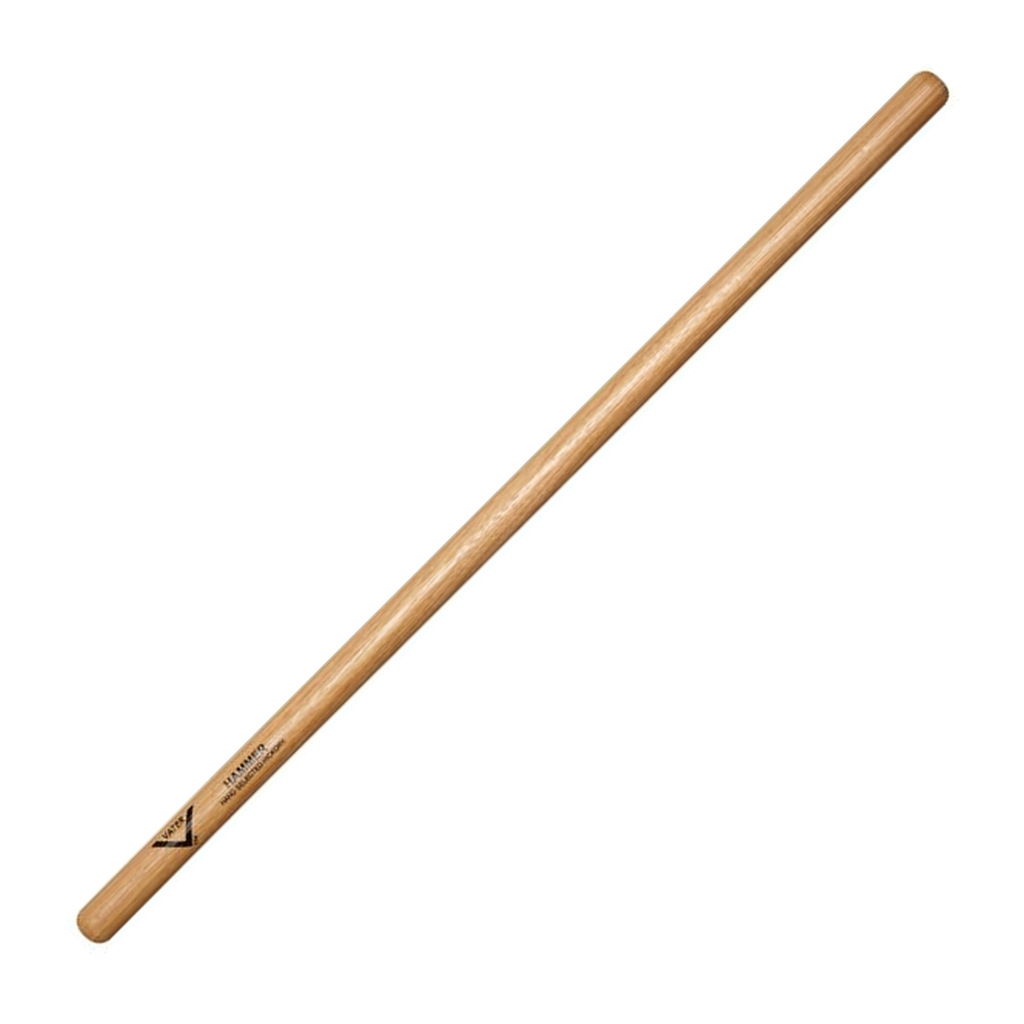
Vater American Hickory Hammer Drumsticks — Double Butt End, No Tip
The Hammer is a pair of American hickory drumsticks with no tip: instead of a bead, each end is a butt end. The grip stays at the 5A size, 0.570 in, but the most fragile part of a stick has simply been removed, and the cymbal sound becomes a mass rather than a point.
What sets it apart
- Two butt ends, no tip: nothing at the end to break
- Wood kept at both ends, where a tip would take some away
- 5A-size grip, 0.570 in (14.5 mm)
- Standard 16 in (40.6 cm) length
- American hickory, to take heavy hitting
- Reversible: flip the pair when one end wears
Remove the tip and you remove the breaking point
On an ordinary stick, everything converges toward the tip: the shaft thins, the wood loses thickness, and that is where a missed rimshot tears off a splinter. The Hammer gets around the problem by having nothing there. The shaft keeps its thickness all the way to the end.
The direct result: when one end eventually wears, you flip the stick and keep going. No other stick allows that, because all of them have an end you cannot play.
What the butt end sounds like
A flat butt end strikes a cymbal over a much wider surface than a tip. The result is not a louder attack but a broader one. The ride loses definition and gains body, the hi-hat comes out thick, and the snare takes on a dull crack.
So this is not a stick for articulating a ride pattern. It is a stick for pushing sound: big parts, flat-out playing, passages where everyone is playing loud.
A stick made for volume
The manufacturer is upfront about it: this model is aimed at loud, aggressive situations. It is not an all-purpose stick, and buying it for a nuanced repertoire would mean shelving it after one rehearsal.
The trade-off is clear. You give up the fine attack of a shaped tip in exchange for durability and a thicker sound everywhere. Knowing which of the two you want is enough to decide.
Specifications
| Wood | American hickory |
|---|---|
| Overall length | 16 in (40.6 cm) |
| Grip diameter | 0.570 in (14.5 mm) |
| Tip shape | None, double butt end |
| Finish | Lacquered |
| Intended use | High volume and heavy hitting |
What it is for
- Rock and metal played at sustained volume
- Drummers who break tips faster than they wear out shafts
- Flat-out playing on snare and toms
- Passages where the cymbal needs to fill rather than cut
- Rehearsal in a loud room
Compare with other manufacturers
Other sticks built without a conventional tip:
| Manufacturer | Comparable model | What differs |
|---|---|---|
| Vic Firth | American Classic 2B | Heavy stick, but with a classic taper and wood tip |
| Promark | Classic Attack 5B | Short shoulder for power, tip retained |
| Zildjian | Hickory Heavy | Thickened shaft, with a tip and taper |
| Regal Tip | Performer | Traditional tapered stick with a wood tip |
Frequently asked questions
- Can you really play with both ends?
- Yes, that is the point of the double butt end. Both ends are identical, so you flip the pair as soon as one side shows wear.
- Is the cymbal sound less defined?
- Much less. A butt end strikes wide: the cymbal responds as a mass, not a point. For an articulate ride pattern, you need a stick with a tip.
- Is it suitable for beginners?
- Not as a first choice. A flat butt end does not rebound like a shaped tip, and working with the rebound is exactly what you learn at the start.
- Is it more durable than a regular stick?
- At the end, yes: there is no thinned section to break. The shaft, on the other hand, wears like any hickory shaft that rubs against rims.
Avis clients
How long does a pair of Hammers last you?
Aucun avis pour le moment. Soyez le premier à partager votre expérience après votre achat.