
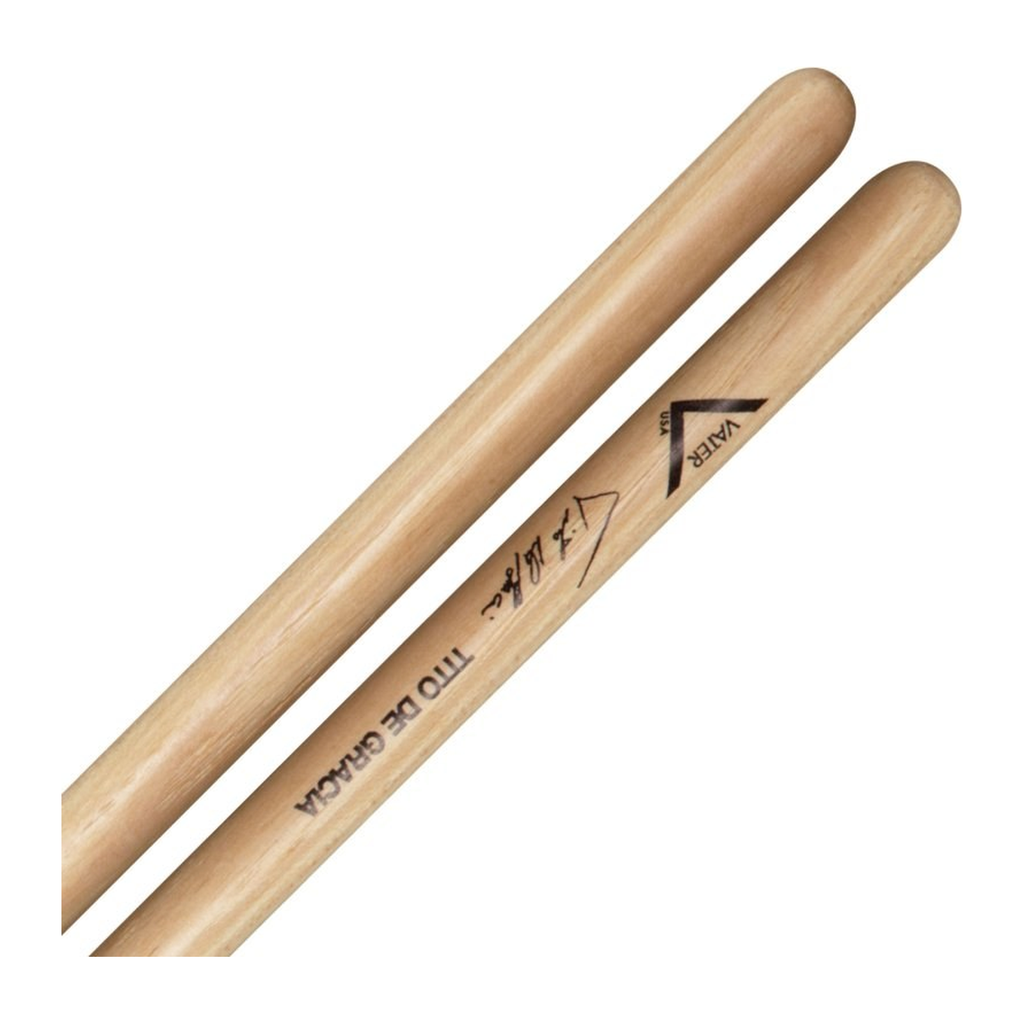
Vater Players Design Tito De Gracia Timbale Sticks — Hickory
The timbale stick designed with Tito De Gracia measures 16.25 in long and 0.500 in in diameter. That extra quarter inch of length compared with typical timbale sticks adds weight where it counts: at the end.
What sets it apart
- 0.500 in diameter, with no tip or bead at the end
- 16 1/4 in — a quarter inch longer than the three sizes in the lineup
- Extra weight concentrated toward the end
- American hickory, chosen for durability on the shell
- Designed with a stage and studio timbalero
- Direct attack on the cowbell as well as the head
Why a timbale stick has no tip
Timbales are played on the head, the shell and the cowbell, with strokes that land flat as often as on the edge. A tip would serve no purpose there and would break on the first abanico. The shaft therefore ends squarely, with no bead or added acorn.
The lack of a tip also changes the grip: the stick can rotate in the hand without the sound changing, which is essential when you alternate between cáscara, cowbell and rolls.
The extra quarter inch, and what it brings
Lengthening the shaft adds mass, and therefore weight at the end. On the cowbell, the stroke gains depth; on the shell, the cáscara sounds fuller.
The trade-off is a stick that is a little less lively in very fast passages. It is a stage timbalero's choice, where projection matters more than quiet virtuosity.
Specifications
| Diameter | 0.500 in (1/2 in) |
|---|---|
| Length | 16 1/4 in |
| Profile | No tip |
| Wood | American hickory |
| Family | Timbale sticks |
What it is for
- Salsa and Latin jazz on stage
- Cáscara and cowbell playing in a band
- A percussionist looking for more projection than a standard 1/2 in stick
- Alternating timbales and accessories in the same tune
- Recording Latin percussion sections
Compare with other manufacturers
Timbale sticks from other manufacturers, and what sets them apart:
| Manufacturer | Closest model | The design difference |
|---|---|---|
| Vic Firth | Timbale sticks | No extended length: the range sticks to the usual lengths |
| Latin Percussion | Timbale sticks | Various wood species and diameters depending on the series |
| Regal Tip | Timbale sticks | Similar diameters, no model signed by a timbalero |
| Gon Bops | Timbale sticks | A range built around Latin percussion alone |
Frequently asked questions
- Can you play timbales with regular drumsticks?
- You can, but it is not very satisfying: the tip breaks on the shell, and the taper makes the sound uneven depending on how the stick is turned.
- Why hickory rather than a lighter wood?
- Because the shell and the cowbell are metal. Hickory is dense and takes those repeated impacts much better than a softer wood.
- How is it different from a standard 1/2 in timbale stick?
- The diameter is identical; the length is what changes, with an extra quarter inch and therefore more weight at the end.
- Can these sticks be used on a drum kit too?
- On cymbals and rims, yes. On the heads, the lack of a tip gives a flat sound that rarely works.
Avis clients
Do you play salsa with this pair? Tell us how it sounds on the cowbell.
Aucun avis pour le moment. Soyez le premier à partager votre expérience après votre achat.