
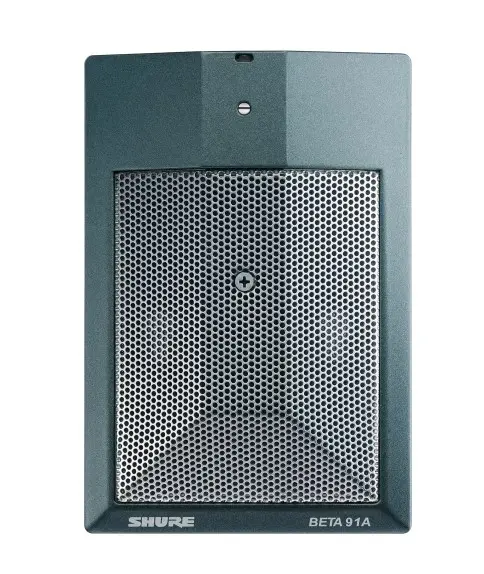
Shure Beta 91A Half-Cardioid Condenser Kick Drum Microphone
The Shure Beta 91A is an electret condenser boundary microphone with a half-cardioid pattern, designed for the kick drum. It lies flat inside the shell, on the pillow or cushion, and captures the beater's attack with a solid low end, with no mic stand or mount to set up.
What sets it apart
- Half-cardioid pattern: cardioid in the hemisphere above the mounting surface, for good gain before feedback
- Preamp and XLR connector built into the housing: an ordinary mic cable is all it takes
- Two-position contour switch under the mic: flat response or a low-mid scoop
- Handles up to 155 dB SPL into a 2500-ohm load
- Steel grille and die-cast metal housing, with no mounting hardware to plan for
Inside the shell, not in front of it
Kick drum mics often go on a stand, in front of the head or at the port. The Beta 91A takes the opposite approach: it sits inside the drum, on a pillow or other cushioned surface, 25 to 152 mm (1 to 6 in.) from the batter head. Shure's user guide describes the result as a full, natural sound. Nothing sticks out of the kit, and no stand slides around during the show.
Because it is a boundary microphone, Shure asks that sound sources be kept within a 60-degree range above the surface it rests on.
The contour switch
Under the housing, a two-position selector changes the response with no tools. In the flat position, the sound stays at its most natural. In the low-mid scoop position, the filter removes 7 dB centred on 400 Hz: the low end keeps its punch and the higher frequencies gain attack. With the same placement in the shell, the guide then speaks of a sharp attack and the most low-end punch.
Pairing it with the Beta 52A
Shure describes a two-mic technique, sometimes called "in and out". The Beta 91A, inside the kick drum, captures the click of the beater; the Beta 52A, a dynamic mic placed near the port, captures the weight of the low end. The two channels are then blended, each playing to its strength. Since two mics are picking up the same source, Shure suggests trying a phase inversion on one of them to get the most coherent sound.
Power and connection
The Beta 91A requires phantom power. It performs best at 48 V and works from as low as 11 V, with slightly less headroom and sensitivity. It connects with a balanced XLR-to-XLR cable, to a preamp with an input impedance of at least 1000 ohms; the higher that impedance, the higher the maximum SPL and the wider the dynamic range. Holes under the housing also let it be screwed to a prepared surface.
Specifications
| Type | Electret condenser, boundary microphone |
|---|---|
| Polar pattern | Half-cardioid (cardioid in the hemisphere above the mounting surface) |
| Frequency response | 20 Hz to 20 kHz |
| Sensitivity | -48.5 dBV/Pa (3.8 mV) at 1 kHz |
| Maximum SPL | 155 dB SPL (2500-ohm load); 151 dB SPL (1000-ohm load) |
| Signal-to-noise ratio | 64.5 dB |
| Self-noise | 29.5 dB SPL, A-weighted |
| Dynamic range | 125.5 dB (2500-ohm load) |
| Contour filter | -7 dB centred on 400 Hz |
| Output impedance | 150 ohms |
| Power | Phantom, 11 to 52 V DC, 5.4 mA |
| Connector | 3-pin male XLR, balanced |
| Weight | 470 g |
| Supplied accessory | Zippered carrying bag |
What it's for
- Live kick drum, lying on the cushion inside the shell
- Two-mic setup with a dynamic kick mic near the port
- Grand piano, mounted under the lid or upright against the frame
- Home studio, when the drum kit has no room for one more stand
Compared with other manufacturers
Other kick drum microphones from other manufacturers: two boundary mics and two stand-mounted dynamics. Data as published by each manufacturer.
| Model | Type | Polar pattern | Frequency response |
|---|---|---|---|
| Shure Beta 91A | Condenser, boundary microphone | Half-cardioid | 20 Hz to 20 kHz |
| Sennheiser e 901 | Pre-polarized condenser, boundary microphone | Half-cardioid | 20 Hz to 20 kHz |
| Beyerdynamic TG D71 | Boundary microphone | Half-cardioid | 25 Hz to 20 kHz |
| Audix D6 | Dynamic, stand-mounted | Cardioid | Not listed on the page consulted |
| Audio-Technica ATM250 | Dynamic, stand-mounted | Hypercardioid | 40 Hz to 15 kHz |
Frequently asked questions
- Does the Beta 91A need phantom power?
- Yes. It is a condenser microphone with a built-in preamp: it accepts 11 to 52 V and performs best at 48 V. Most current mixers and interfaces supply this power.
- Beta 91A or Beta 52A for kick drum?
- Shure designs both for kick drum, with different strengths: the Beta 52A, a dynamic, delivers the weight of the low end; the Beta 91A, lying inside the drum, delivers the attack. Shure presents combining the two as a popular technique.
- Can the Beta 91A be used on a piano?
- Yes, the guide suggests two placements. Mounted under the lid, over the lower treble strings, it gives a bright, well-balanced sound with a strong attack. Placed upright against the frame, near the apex of the curve, it gives a full sound with little hammer and damper noise.
- What is the switch under the Beta 91A for?
- It is the contour switch. Set to flat, it leaves the response natural; set to scoop, it cuts 7 dB around 400 Hz so the kick drum gains attack and definition.
Avis clients
What pillow does your Beta 91A sleep on? Tell us about your placement.
Aucun avis pour le moment. Soyez le premier à partager votre expérience après votre achat.