
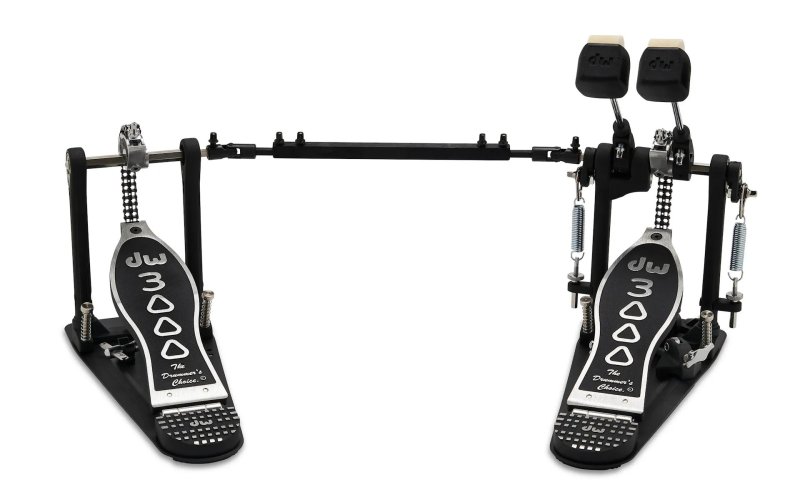
DW 3000 Double Bass Drum Pedal, Double Chain
The DW 3002A is a double-chain double bass drum pedal. Both footboards get the same Accelerator cam and the same bearing-mounted rocker: whatever gap remains between your right and left foot is a gap in practice, not in mechanics.
What sets it apart
- Offset Accelerator cams on both footboards
- Double chain on the left as on the right
- Dual-bearing rockers, one per side
- Swivel clamps that conform to uneven hoops
- DW101 beaters with adjustable shaft weight and memory locks
- Two steel plates, each with its own mat
The offset cam and the left foot
An offset cam does not give back the same thing at the start and the end of the motion: it starts smooth and pushes at the end. On a run of eighth notes, that is exactly what you want, because the foot never delivers the same pressure twice.
The slave side gets the same cam. Two alternating strokes therefore finish with the same energy at the head, which is what it takes for the run to sound like one line rather than two voices.
What a drive shaft loses, and how to make it up
No double pedal escapes the loss: the drive shaft and universal joint absorb part of the left foot's energy. Denying that leads to symmetrical settings that sound lopsided.
You make it up with the spring, set slightly tighter on the left, and with the beater weight, moved up a notch on the slave shaft. Both adjustments exist on both sides precisely to allow that deliberate asymmetry.
Installing the drive shaft without moving everything else
The drive shaft crosses the front of the kit. Before tightening anything, decide where the hi-hat stand goes: over it, moved back, or replaced by a two-leg model. Doing it after everything else is set means starting over.
Once the spot is found, the memory locks hold the depth of both beaters. The next setup returns to the same position without trial and error.
Specifications
| Setup | Two footboards linked by a drive shaft |
|---|---|
| Chains | Double, on offset Accelerator cams |
| Spring anchors | Dual-bearing rockers, one per footboard |
| Mount | Swivel clamps |
| Beaters included | Two DW101s, adjustable shaft weight |
| Settings | Memory locks on both shafts |
| Bases | Steel plates, non-slip mats |
What it is for
- Styles with sustained eighth and sixteenth notes on the feet
- Drummers who want the same response on both sides
- Moving from an entry-level double to a double-chain mechanism
- Back-to-back gigs where the setup has to be reproduced quickly
- Independence work on gear that does not betray the motion
Compare with other manufacturers
Double pedals at this tier differ mainly in the universal joint and the cam:
| Manufacturer | Comparable model | What differs |
|---|---|---|
| Tama | Iron Cobra 600 double | Cam switches between round and offset profiles, no tools needed |
| Pearl | Demonator double | Dial-type tension adjustment and long footboards on both sides |
| Mapex | Mid-range double | Drive shaft design specific to the brand, a distinct slave-side feel |
Frequently asked questions
- Why set the left spring tighter?
- To make up for the energy absorbed by the drive shaft and universal joint. Without that asymmetry, the left stroke lands weaker than the right.
- Are the cams really identical on both sides?
- Yes. Both footboards carry an offset Accelerator cam, which gives the same stroke profile on the left and the right.
- Can I play it as a single by removing the drive shaft?
- Yes. The primary footboard remains a complete pedal, with its own chain, cam and beater.
- Do I need to change my hi-hat stand?
- Often. The drive shaft takes up the area where the stand's legs sit; a two-leg model frees that path without moving the cymbals.
Avis clients
How did you set up your left side? Your review will help others.
Aucun avis pour le moment. Soyez le premier à partager votre expérience après votre achat.