
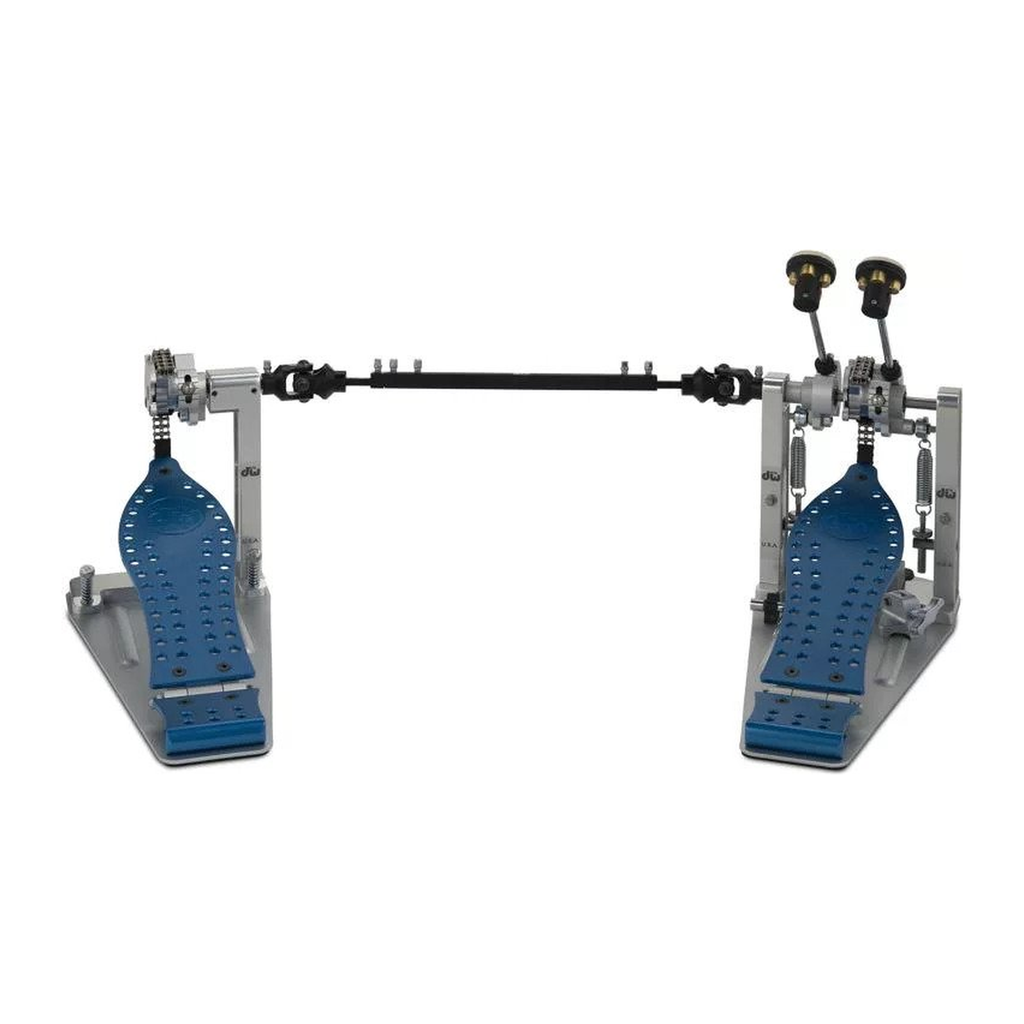
DW MFG MCD2 Double Bass Drum Pedal, Anodized Cobalt
The MCD2 Cobalt is a chain-drive double kick pedal, anodized blue on both halves. Under the footboard, the part doing the quiet work is the interlocking Delta hinge: it holds the heel of the board and decides whether the pedal stays silent or starts clicking after two hundred gigs.
What sets it apart
- Patented interlocking Delta hinge on both footboards
- Wide bearing surface that prevents side-to-side play at the heel
- Anodized Cobalt finish, one of the line's four colours
- Chain and lever-operated cam
- Adjustable-mass beaters on both halves
- Soft leatherette case, carried as a backpack
The hinge, where noise begins
A pedal hinge takes all the twisting force of your foot. As it wears, the heel of the footboard develops a few tenths of a millimetre of play. You cannot see that play; you hear it. The pedal starts making a small metallic click just before the stroke, and that click ends up in the room mics.
The interlocking Delta hinge spreads the load over surfaces that nest into one another rather than over a simple through-pin. The bearing surface is wider, the pressure per unit of area is lower, and wear takes much longer to produce play.
Mechanical silence, a studio requirement
In rehearsal, nobody hears a pedal. In the studio, the overhead mics above the kit pick up everything happening on the floor, and a heel click ends up in the mix, impossible to remove without hurting the cymbal sound around it.
That is why a well-made hinge matters as much as a well-designed cam. The first test is what you hear when the pedal is not striking.
Two hinges, twice the risk
A double pedal has two footboards, so two hinges, so two possible sources of unwanted noise. The left half is also the most exposed: it takes the extra stress fed back through the shaft.
That is worth a close look when buying. An oversized hinge on both halves is an investment measured in years of peace of mind, not in how it feels on day one in the store.
Specifications
| Hinge | Interlocking Delta, US patent 9472174 |
|---|---|
| Colour | Anodized Cobalt |
| Format | Double pedal |
| Drive | Chain with adjustable cam |
| Heel plate | Contoured, aluminum |
| Manufacturing | Machined in the USA |
What it is for
- Recording, where overhead mics catch everything
- Drummers who play a lot and wear out hardware quickly
- Setups built around a bold blue look
- Replacing a double pedal that has become noisy
- Rental, where gear has to last hundreds of hours
Compare with other manufacturers
How other manufacturers build the heel joint on their high-end pedals:
| Manufacturer | Comparable model | What differs |
|---|---|---|
| Tama | Speed Cobra 910 | Free-rolling bearing hinge, a different pivot principle |
| Yamaha | FP9500 9000 series | Conventional through-pin, maintained with periodic greasing |
| Pearl | Demon Drive | Height-adjustable heel, with the pivot moving along with it |
| Gibraltar | 9711 Series | Simple hinge and widely available spare parts |
Frequently asked questions
- Why does a pedal start clicking over time?
- Because the heel joint develops play. The noise shows up several months before any change in feel.
- Can you hear that click on a recording?
- Yes, the mics above the kit pick it up, and it is very hard to remove in the mix.
- Does the hinge need maintenance?
- Dusting it off and checking that it is tight is enough. It does not need regular greasing.
- Does Cobalt also come as a single pedal?
- Yes, the colour covers the line's single pedals, double pedals and hi-hat stands.
Avis clients
Has your pedal stayed quiet? How many hours of playing so far?
Aucun avis pour le moment. Soyez le premier à partager votre expérience après votre achat.