
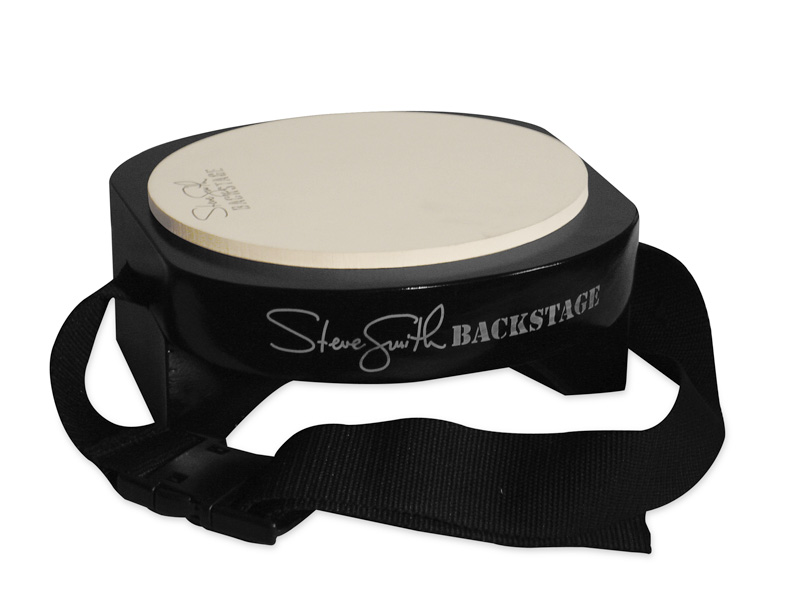
DW SMPADSS Backstage Knee Practice Pad, Designed with Steve Smith
Developed with Steve Smith, this practice pad straps to your thigh: the playing surface goes wherever the drummer can sit. Dressing room, bus seat, waiting-room bench — working on your hands no longer requires a stand, a table and space.
What sets it apart
- Worn on the thigh, with no stand or surface to rest on
- Quick-release nylon strap
- Contoured shape that follows the leg
- Designed with Steve Smith
- Works with matched grip as well as traditional grip
- Compact, made to go everywhere
Downtime, the raw material of progress
Most drummers spend more hours waiting than playing: after soundcheck, on the road, in the dressing room, during the other bands' sets. That time is available, but it is spent sitting down, with no surface.
A pad you wear on your thigh turns that constraint into an opportunity. Fifteen minutes of work repeated four times over a touring day adds up to more than a scheduled hour of practice that never happens.
Why the contoured shape is not just for looks
A flat plate on a thigh slides and tips: the striking point changes with every stroke, and your hand compensates instead of working. A contoured underside follows the leg and stays in place.
The quick-release strap completes the design. It holds tight enough that the surface does not move, and opens in one motion — which matters when you get called on stage in the middle of an exercise.
Both grips, and what that demands of the design
In traditional grip, the left hand comes in at a very different, lower angle than the right. A pad designed only for matched grip often puts the surface too high or too far forward for that motion to be comfortable.
Accepting both grips requires a surface you can reach from several angles. That is what lets the same accessory serve a jazz drummer and a rock drummer without a compromise for either.
Specifications
| Worn | On the thigh, strapped |
|---|---|
| Strap | Nylon, quick-release |
| Shape | Contoured |
| Grips | Matched and traditional |
| Design | Steve Smith and DW |
What it is for
- Hand work in the dressing room before a show
- Practice on the road, on a train or a plane
- Seated warm-up just before going on stage
- Working on traditional grip away from the rehearsal room
- Keeping up your technique during a stretch without a kit
Compare with other manufacturers
Portable pads from other manufacturers:
| Manufacturer | Comparable model | What differs |
|---|---|---|
| Vic Firth | Strapped knee pad | Flat surface, held by a simple strap with no contoured shape |
| Evans | RealFeel pocket pad | Small disc to lay down, with no way to attach it to your leg |
| Promark | Travel pad | Made for a table or the floor, not to be worn |
| Remo | Travel practice pad | Tensioned head surface, takes up more space |
Frequently asked questions
- Does it really stay put when you play fast?
- The contoured shape and a tight strap hold it in place. Adjusting the strap is the key: too loose, and it pivots after a few bars.
- Can you play with both hands on it?
- Yes. The surface takes both hands, in matched or traditional grip, the latter just needing a slight shift of position on the thigh.
- Is it quiet enough for a plane or a train?
- The volume is that of a rubber pad, so it can be heard from the next seat. A light touch and some restraint make it acceptable; it is not silent.
- Does it replace a tabletop pad?
- For hand work, it covers most of it. For work that needs a perfectly fixed surface and hands spread wide apart, a pad that sits on a surface remains more comfortable.
Avis clients
Wasting your downtime because there's nowhere to practise?
Aucun avis pour le moment. Soyez le premier à partager votre expérience après votre achat.