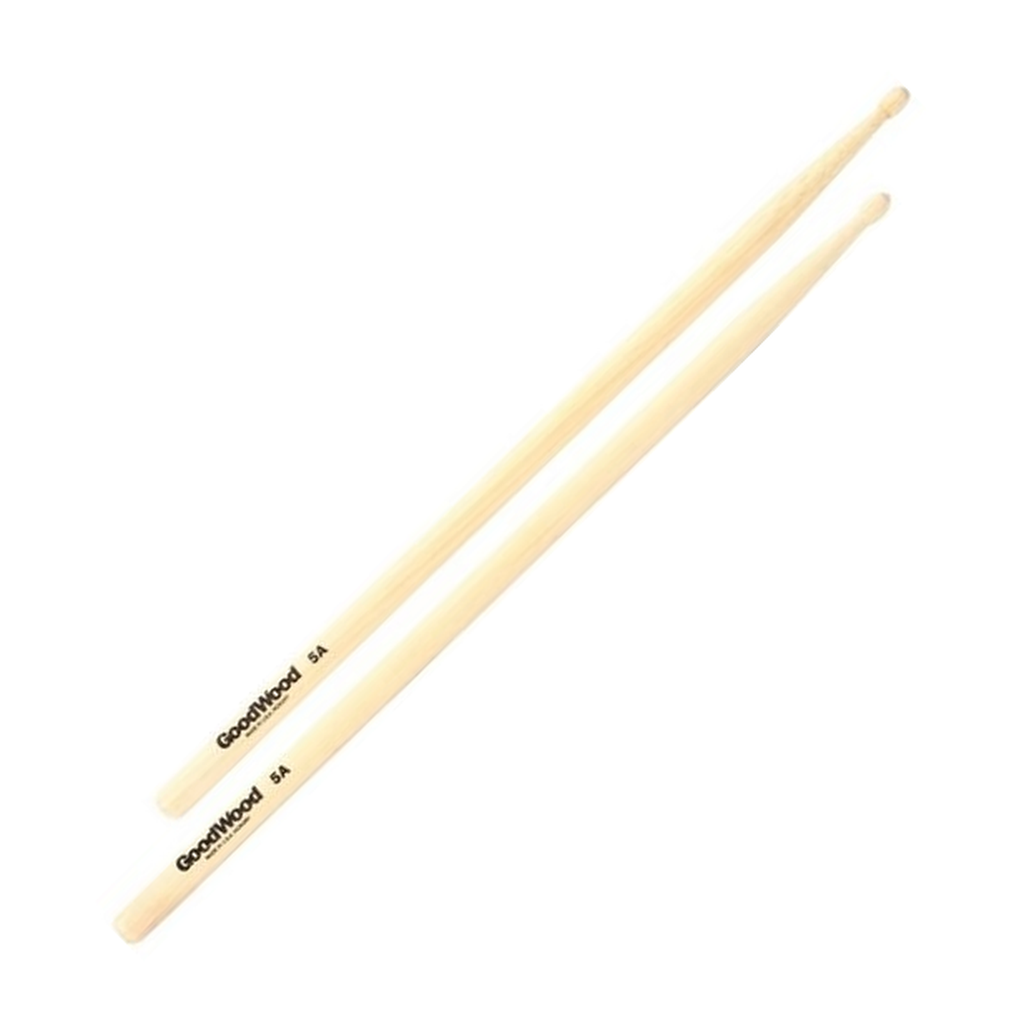
Vater Goodwood 5A Drumsticks — Wood Tip, Hickory
The Goodwood 5A is a hickory 5A drumstick with a wood tip, cut to the most played size there is. It is the pair you keep in reserve in your stick bag, the one that works almost anywhere, and the one every other stick ends up being compared to.
What sets it apart
- The most played size in the world, across all brands
- Versatile balance: neither the finesse of a 7A nor the mass of a 5B
- Hickory tip, warmth and roundness on bronze
- A useful reference for placing every other stick
- Inexpensive to replace: you buy several pairs
- Suits most styles played in a band
The 5A as ground zero
When a drummer says a stick is “a bit thick” or “a bit short”, they are almost always comparing it to a 5A without saying so. This size is the zero on the scale, and that is why it takes up so much room in stick bags.
Starting there has a practical advantage: after a few months, you can tell which direction to go. More mass to project, less to gain finesse. Without that starting point, the next choice is a shot in the dark.
Why hickory, and not something else
The manufacturer gives its reason directly: hickory is the most widely used wood for drumsticks because it absorbs shock and it lasts. Those are the only two qualities that really matter on something you strike thousands of times a night.
It uses only two species, shellbark and shagbark, and dowels with a moisture content between 10 and 12 % — what you demand of a striking tool. Too dry, the wood breaks; too damp, it softens.
A stick you buy several pairs at a time
Drumsticks are a consumable. A playing pair always comes with a spare pair, and you are rarely wrong to keep a third in the bag.
That is the logic of the Goodwood line: a moderate replacement cost on a size you know, so you never hesitate to open a new pair in the middle of a rehearsal.
Specifications
| Wood | Hickory |
|---|---|
| Size | 5A |
| Tip | Wood, turned from the shaft |
| Place in the line | Between the 7A and the 5B |
| Format | Pair |
What it is for
- Band rehearsal and all-round playing
- Pop, funk and popular music in a band
- A spare pair to keep in the bag
- Music schools and instrument fleets
- Exploring the drums after the first few months
Compare with other manufacturers
Every drumstick maker offers its own take on the 5A. Here is where they stand relative to one another:
| Manufacturer | Equivalent | What changes |
|---|---|---|
| Vic Firth | American Classic 5A | The manufacturer's benchmark 5A, with its own tip |
| Promark | Classic Forward 5A | Balance point moved toward the tip |
| Zildjian | 5A Hickory | Sticks from a cymbal manufacturer, with their own taper |
| Los Cabos | 5A White Hickory | Untreated hickory, made in Canada |
| Regal Tip | 5A | The historic home of the attached tip |
Frequently asked questions
- What do the number and letter mean on drumsticks?
- The number roughly indicates circumference — the smaller it is, the thicker the stick. The letter comes from an old classification by use: A for dance orchestra, B for band, S for street.
- 5A or 5B for a drummer who is progressing?
- The 5A first. It develops rebound and dynamics. You move to the 5B when the band's volume calls for it or when the snare has to project more.
- How long does a pair of drumsticks last?
- It depends entirely on style and how hard you hit. A jazz drummer can keep the same pair for months; a rock drummer goes through several a month. The snare drum rim is almost always the culprit.
- Should I rotate my sticks so they wear evenly?
- Many drummers do, and it delays a flat spot forming on the shaft. It will not save a tip that is already dented, though.
Avis clients
How many pairs do you go through in a season? Tell us.
Aucun avis pour le moment. Soyez le premier à partager votre expérience après votre achat.