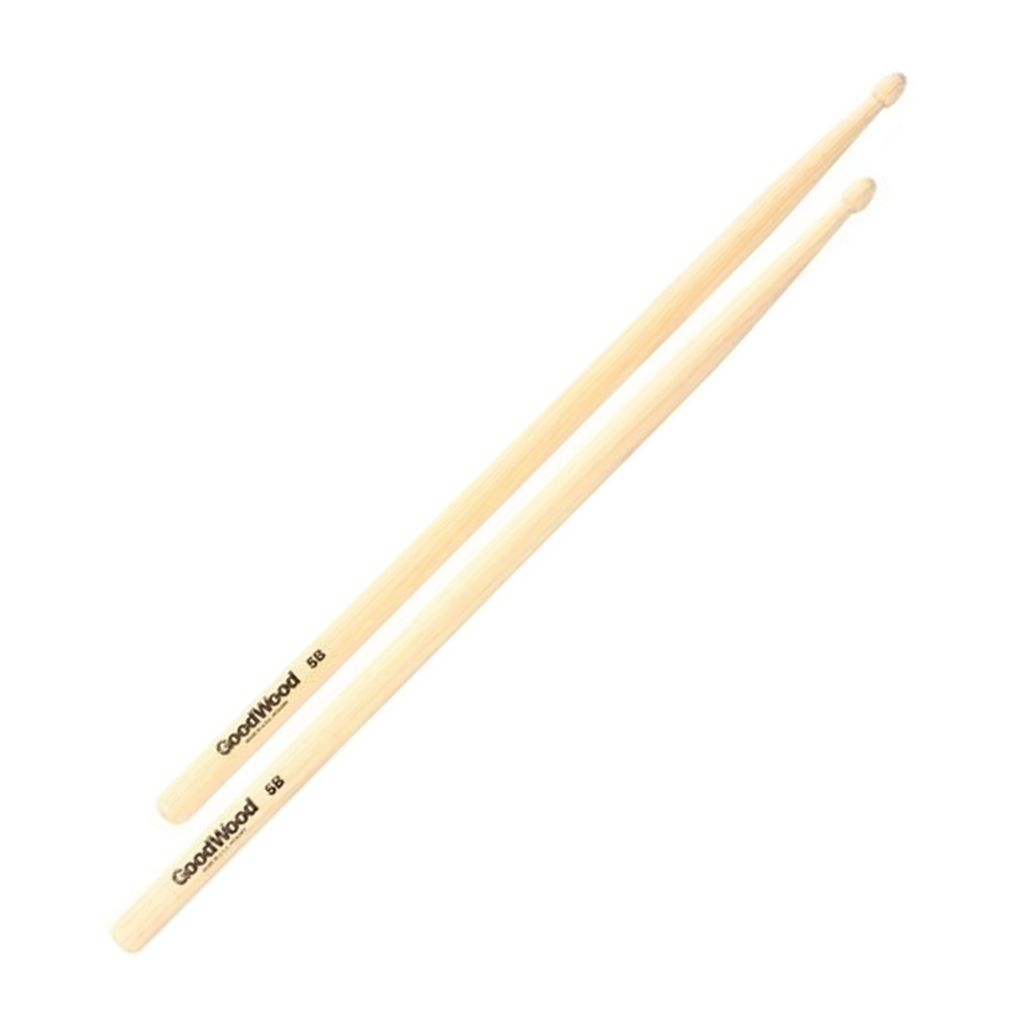
Vater Goodwood 5B Drumsticks — Wood Tip, Hickory
The Goodwood 5B is a thick-grip drumstick in hickory with a wood tip. More wood in your hand means more mass at the end of the stroke: the snare projects further and a rimshot stops being an effort.
What sets it apart
- Thick grip: more mass carried into every stroke
- Rimshots come out without tensing up
- Stands up better to repeated hits against the rim
- Hickory tip, warm contact on cymbals
- A common choice for drummers who break their 5A sticks
- Hickory: the wood the manufacturer chooses for its shock resistance
Mass makes volume, not force
A drummer who cannot be heard has two options: hit harder, or hit with more mass. The first tires you out, stiffens the motion and ends up hurting the sound. The second costs nothing, since the stick does the work.
Going from a 5A to a 5B hands part of the effort over to the wood. The arm relaxes, the stroke stays loose, and the snare projects more. Many drummers discover this way that they were hitting too hard with a stick that was too thin.
The rimshot, the test of a size
A rimshot needs the tip and the shaft to hit the head and the rim at the same instant. A thin stick handles that double contact poorly: it vibrates, it gets marked, and it eventually splits along the contact line.
A thicker shaft spreads that impact over more wood. That is why drummers who lean on rimshots keep coming back to the 5B — the sound is fuller, and the stick lasts longer.
What you give up by going heavier
Nothing is free. A 5B is slower to bring back up than a 5A, and fast passages ask a little more of your fingers. On a fast jazz tune, you feel the difference.
So the right question is not “which one is better” but “what volume do I play at most of the time”. The 5B answers sustained volume; below that, it becomes unnecessary weight.
Specifications
| Material | Hickory |
|---|---|
| Size | 5B — thicker than the 5A |
| Tip | Wood tip, one piece |
| Setting | Sustained volume |
| Supplied | As a pair |
What it is for
- Rock and amplified music in clubs
- Heavy use of the snare rimshot
- Drummers who split thinner sticks
- Street marching bands and outdoor groups
- Rehearsing with guitars and bass at high volume
Compare with other manufacturers
Other manufacturers' thick sizes, and how each one approaches the question:
| Manufacturer | Comparable model | What differs |
|---|---|---|
| Vic Firth | American Classic 5B | The manufacturer's own 5B, with its own taper and tip |
| Promark | Classic Forward 5B | Weight shifted toward the front of the shaft |
| Zildjian | 5B Hickory | Range from a cymbal manufacturer |
| Los Cabos | 5B Red Hickory | Heat-treated hickory, made in Canada |
Frequently asked questions
- Should I switch to 5B sticks if I keep breaking them?
- It is often the right move, provided you first check where they break. A break that always happens in the same spot sometimes points to a stroke angle that needs fixing rather than to a stick that is too thin.
- Are 5B sticks harder on the wrists?
- They are heavier, so slower to bring back up. In return, they need less force for the same volume. For heavy playing, the balance often tips in their favour.
- Does it work for switching back and forth with brushes?
- The size is no obstacle, but the weight difference with a brush is noticeable. Drummers who switch often usually prefer a size closer to the 5A.
- Hickory or maple for this size?
- The manufacturer describes both woods itself: sugar maple is lighter, with a fast feel and warmer tones; hickory brings weight and volume. On a size already meant for volume, hickory is the consistent choice.
Avis clients
Did the 5B solve your broken-stick problem? Share your experience.
Aucun avis pour le moment. Soyez le premier à partager votre expérience après votre achat.