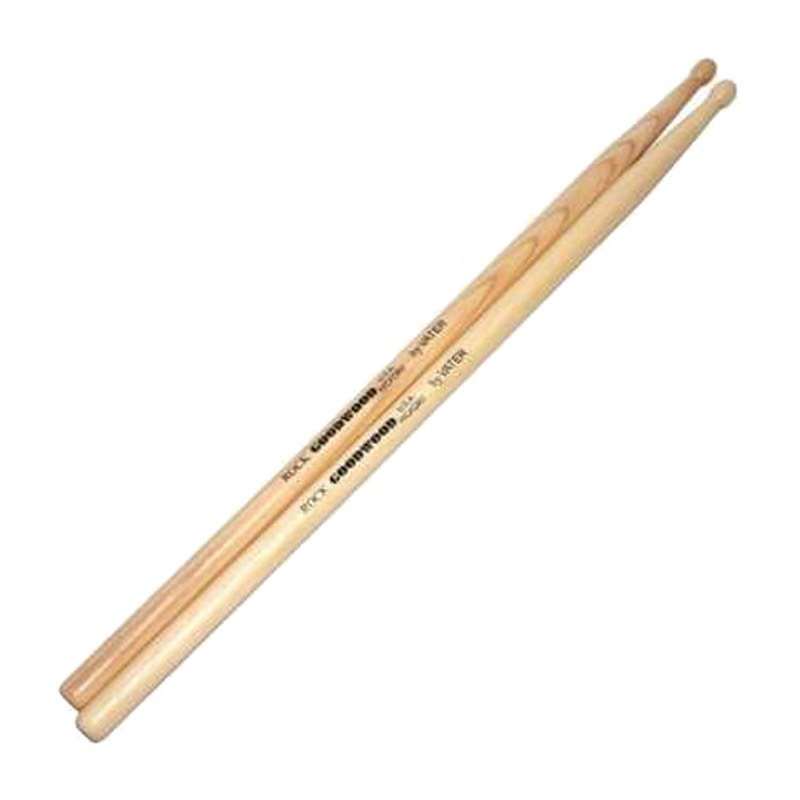
Vater Goodwood Rock Drumsticks — Wood Tip, Hickory
The Goodwood Rock is a drumstick made for volume. With this manufacturer, the Rock name refers to the size that outweighs the whole Power family, itself already above a 5B: it is the name given to the heavy end of the scale.
What sets it apart
- Rock size: the heavy end of the scale, beyond the Power sizes
- Full strokes on the toms, where mass decides the sound
- Plenty of wood in the area that rubs against cymbal edges
- Tip turned from the wood, full contact on a tight head
- Hickory: the wood the manufacturer chooses for shock absorption
- Goodwood line: affordable to replace under heavy use
Getting a floor tom to speak
A snare responds to speed; a floor tom responds to mass. Its head is wide, its shell is deep, and you have to put energy into it for the note to really drop instead of staying on the surface. A drummer who runs tom fills with a thin stick gets a sound that rises instead of falling.
A heavy size fixes that without asking anything more of your arm. The wood brings the energy on its own, the head goes low, and the fill gains the depth you were trying to force out by hitting harder.
You do not hit a crash cymbal with the tip
Many drummers learn it late: a crash cymbal is played with the shoulder of the stick, a few centimetres from the end, against the edge of the metal. The tip itself is only for the ride and hi-hat.
That part of the shaft takes repeated edge hits, and that is where the wood gets notched first, well before it breaks anywhere else. The more wood there is at that spot, the more shows the stick gets through before it splits.
A name rather than a number
Numbered sizes come from an old classification where the number roughly gave the circumference and the letter the use. They no longer tell you much about how sticks are used today, and you have to know the scale by heart to find your way.
When a manufacturer names a model Rock instead of giving it a code, it announces a purpose before a measurement. That is information you can use directly when choosing: you know what the tool was made for.
Specifications
| Wood | Hickory |
|---|---|
| Name | Rock |
| Tip | Wood, turned from the solid stick |
| Use case | Loud playing, toms and crash cymbals |
| Quantity | Two sticks |
What it is for
- Rock on stage and amplified music
- Tom fills and heavy playing on the floor tom
- Heavy crash cymbal playing
- Outdoor stages, where the sound gets lost quickly
- Drummers who split their sticks on cymbal edges
Compare with other manufacturers
Heavy rock sizes from other drumstick manufacturers:
| Manufacturer | Similar model | The difference |
|---|---|---|
| Vic Firth | American Classic Rock | Rock-style profile, the manufacturer's own taper |
| Promark | Classic Forward Rock | Forward balance on a generous shaft |
| Zildjian | Rock Hickory | Range from the cymbal manufacturer |
| Los Cabos | Rock Red Hickory | Heat-treated hickory, made in Canada |
Frequently asked questions
- Why do my drumsticks always break in the same spot?
- Because it is not the tip that takes the hits, but the shoulder, a few centimetres behind it. That is the area that meets the cymbal edges and the rim; a thicker size puts more wood there.
- Do heavier drumsticks hit harder?
- For the same motion, yes. Volume comes from the weight the stick carries into the impact, not from tension in the arm. On the other hand, the stick comes back more slowly and is less forgiving on fast passages.
- What stick length do I need for a large drum kit?
- The one that lets you reach the farthest piece without lifting your shoulder. It is a posture question, to check sitting behind your own kit.
- Are heavy sticks a good choice for a beginner?
- Rarely, on a drum kit. The weight hides the rebound, and the student ends up pushing the stick instead of letting it come back. A medium size teaches the motion better.
Avis clients
Do you hit hard and break sticks quickly? Tell us how long these lasted.
Aucun avis pour le moment. Soyez le premier à partager votre expérience après votre achat.