
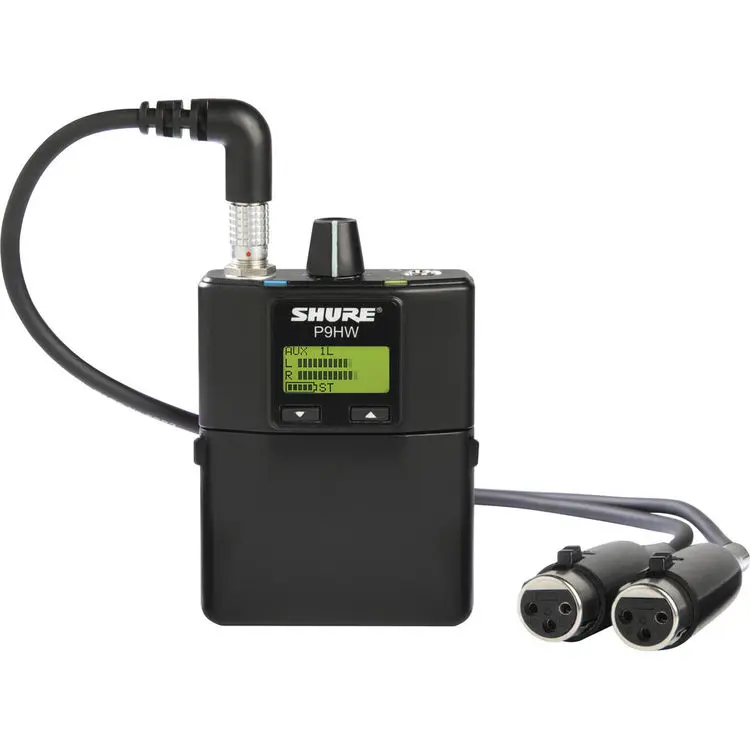
Shure P9HW PSM 900 Wired In-Ear Monitor Bodypack
The Shure P9HW is a wired bodypack for in-ear monitoring: cabled to the mixer, it lets the musician hear one or two monitor mixes in their earphones, in stereo or as an adjustable mono blend, in place of floor wedge speakers. The signal arrives over the cable: no wireless transmitter is needed.
What sets it apart
- Two inputs through the supplied Y-cable: two XLRs to a 5-pin LEMO connector
- Stereo mode with balance, or MixMode to blend two mixes in mono
- 4-band parametric EQ and adjustable volume limiter
- Up to 9 hours on two AA batteries, or optional Shure SB900C rechargeable battery
- All-metal 196 g body with batteries, worn on a belt or guitar strap
Why wired in-ear monitoring
Shure designed the P9HW to replace floor wedge speakers. Its user guide credits it with these advantages over them: it is less visible, gives clearer and better controlled sound, reduces the chance of feedback and declutters the stage. A drummer behind the kit or a keyboard player who never leaves the rig does not need freedom of movement: the cable is enough.
Shure aims it at sound reinforcement, live music, studio recording, broadcast and theatre. The bodypack connects directly to the mixer or to a stage patch bay.
Stereo or MixMode: two ways to listen
In stereo mode, the default, channel 1 goes to the left earphone and channel 2 to the right; the balance sets the level between the two sides. Shure points out that stereo listening increases clarity and separation between sources.
In MixMode, both channels are heard in both ears, in mono, and the balance becomes a blend between two mixes. Shure's example: an instrument mix on channel 1, a vocal mix on channel 2; move the balance left for more instruments, right for more vocals. This blend is adjusted from the home screen with the arrow buttons.
Fine tuning: EQ, limiter, input level
The parametric EQ has four bands: low, low-mid, high-mid and high. Each band adjusts from −6 to +6 dB in 2 dB steps; low and high are shelf filters fixed at 100 Hz and 10 kHz, while the two middle bands have adjustable frequency and width.
The VLIMIT function lowers the maximum volume by −3 to −21 dB: the knob keeps its full travel, but the range narrows, without compressing the audio. The input accepts a +4 dBu line level, for a mixer, or a −10 dBV aux level, for a computer or player. A clip LED lights when the input overloads: turn the level down at the mixer. The panel lock blocks everything except the volume knob.
Power and battery life
Two AA alkaline batteries give about 9 hours of continuous listening. The SB900C lithium-ion rechargeable battery, sold separately, extends that to about 11 h 45 under Shure's test conditions; it charges to 50% in one hour and fully in three hours, and the bodypack then shows remaining runtime, temperature and battery health. After five minutes with no earphones plugged in, the bodypack enters power-save mode; auto-off can be set to 5, 30 or 60 minutes.
Which earphones to plug in
The P9HW part number is sold without earphones. Its output is a 3.5 mm stereo jack that accepts any headphones or in-ear monitors with that plug, with a minimum impedance of 9.5 ohms. Shure says it performs best with its own earphones, and offers its SE series as options, from the dynamic SE215 to the four-driver SE846.
Specifications
| Inputs | 2 channels, supplied Y-cable (2 XLR to 5-pin LEMO) |
|---|---|
| Input level | Line +4 dBu or aux −10 dBV |
| Output | 3.5 mm stereo jack |
| Listening modes | Stereo or MixMode |
| EQ | Parametric, 4 bands, ±6 dB |
| Volume limiter | −3 to −21 dB |
| Frequency response | 20 Hz to 20 kHz (±3 dB) |
| Signal-to-noise ratio | 98 dB, A-weighted |
| Harmonic distortion | Less than 0.2% at 1 kHz |
| Channel separation | More than 55 dB at 1 kHz |
| Minimum load impedance | 9.5 ohms |
| Power | 2 AA batteries or optional SB900C rechargeable battery |
| Battery life | 9 h on AA alkaline batteries |
| Dimensions | 99 × 66 × 23 mm |
| Weight | 196 g with batteries |
| Operating temperature | −18 to +63 °C |
What it's for
- Drummer or keyboard player who stays put for the whole show
- Pit musician in theatre
- Studio session with two monitor mixes
- Small, crowded stage where wedges take up too much room
Compared with other manufacturers
Other wired in-ear monitor bodypacks from other manufacturers. Data published by each manufacturer.
| Model | Inputs | Listening modes | Power |
|---|---|---|---|
| Shure P9HW | 2 XLR via Y-cable to LEMO | Stereo or MixMode, 4-band EQ | 2 AA batteries or rechargeable battery |
| Behringer POWERPLAY P2 | Locking XLR/TRS combo | Mono or stereo, internal switch | Not specified on the manufacturer's page |
| Fischer Amps Hard-Wired In-Ear Monitor Belt Pack | 2 XLR | Stereo or mono mix with balance | Battery or 9 V DC supply |
| Fischer Amps In Ear Body Pack XL | Mix inputs plus mic input with 48 V phantom power | Stereo or mono mix | 9 V battery or power supply |
| Rolls PM55P | XLR mic with pass-through, 6.35 mm monitor input | Stereo or mono monitor, optical limiter | 9 V battery or included PS27s supply |
Frequently asked questions
- How long do the P9HW batteries last?
- About 9 hours on two AA alkaline batteries, according to Shure. With the SB900C rechargeable battery, sold separately, the guide gives about 11 h 45. A five-segment meter shows the remaining charge.
- Which cable replaces the P9HW Y-cable?
- Shure's PA720 cable, two XLRs to a 5-pin LEMO connector. When plugging in, the red dot on the cable lines up with the notch in the bodypack jack.
- Can the P9HW work in mono?
- Yes. It accepts one or two sources, and in MixMode the signal is mono: each mix is heard in both ears, and the balance sets how much of each.
- Which earphones work with the P9HW?
- Any headphones or in-ear monitors with a 3.5 mm stereo plug, at 9.5 ohms or more. Shure recommends its own SE series earphones, from the SE215 to the SE846.
Avis clients
Did the P9HW replace your floor wedges? Tell us your favourite setting.
Aucun avis pour le moment. Soyez le premier à partager votre expérience après votre achat.